
Reverse-osmosis (RO) water can taste flat to some people, so mineral drops offer a simple way to add minerals back to a glass or pitcher. The best choice depends on what you want to add, how much flavor you can tolerate, and whether you prefer a smaller bottle or a larger supply. Below, we compare five liquid mineral concentrates, including options sourced from the Great Salt Lake, the Southern Ocean, and other natural sources.
Quick Comparison
| Product | Source and format | What stands out |
|---|---|---|
| Trace Minerals ConcenTrace, 8 fl oz | Liquid concentrate sourced from the Great Salt Lake | 70+ ionic minerals; third-party tested for quality and purity |
| ConcenTrace Trace Mineral Drops, 4 fl oz | Liquid concentrate sourced from the Great Salt Lake | Directions suggest starting with 10 drops; listing details describe a three-bottle pack |
| OmniBlue Ocean Minerals, 8 fl oz | Liquid concentrate sourced from deep ocean water | Lists 420 mg of ionic magnesium and more than 70 trace minerals |
| OmniBlue Ocean Minerals, 2 fl oz | Liquid concentrate sourced from deep ocean water | Compact bottle with the same stated mineral profile as the larger option |
| Premier Research Labs Premier pH Minerals | 2 fl oz liquid mineral drops | Magnesium-rich formula with sulfur, boron, and lithium |
Our Picks: Best Mineral Drops For Ro Water reviews
Best Larger Bottle: Trace Minerals ConcenTrace 8 fl oz

ConcenTrace is a liquid trace-mineral concentrate sourced from the Great Salt Lake. The brand describes it as containing more than 70 naturally occurring ionic minerals and lists it as suitable for remineralizing reverse-osmosis water. Its 8-fl-oz bottle is the largest single bottle among the Great Salt Lake options in this lineup.
The formula is described as having no additives, and the product details say it is third-party tested for quality and purity. That makes it a straightforward option if you want a mineral concentrate without added flavors or sweeteners. The supplied details do not provide a specific serving size for this bottle, so follow the product label rather than estimating a dose.
Its main trade-off is that a broad mineral blend may not be the best fit if you want to target a specific mineral or prefer precise mineral amounts per serving. As with other concentrated drops, the taste and the amount you use can affect how noticeable it is in plain water.
Pros:
- Contains more than 70 ionic trace minerals
- Sourced from the Great Salt Lake
- Large 8-fl-oz bottle
- Described as additive-free and third-party tested
Cons:
- Supplied product details do not state a serving size
- Does not list the amount of each individual trace mineral
Verdict: Choose this ConcenTrace bottle if you want a larger, broad-spectrum mineral concentrate for RO water and value the stated testing and additive-free formula.
Best Smaller-Bottle ConcenTrace Option: 4 fl oz Mineral Drops

This ConcenTrace formula also provides more than 70 ionic trace minerals sourced from the Great Salt Lake. The product details suggest adding the drops to water, juice, or food, starting with 10 drops and increasing daily. That gives you more ways to use it than a water-only mineral additive.
The listing needs a closer look before you order: its title says 4 fl oz, while the supplied description says the pack includes three 4-fl-oz bottles. Check the current package details to confirm the quantity. The formula is described as low in sodium, free of additives, and third-party tested for quality and purity.
This may suit someone who wants the same general mineral profile as the larger ConcenTrace option but prefers a smaller bottle format or a multipack. It is less suitable if you need exact amounts for each mineral, since those figures are not included in the supplied product information.
Pros:
- More than 70 ionic trace minerals
- Can be added to water, juice, or food
- Directions suggest starting with 10 drops
- Described as low-sodium and additive-free
Cons:
- Pack quantity is not clear from the title alone
- Does not list the amount of each individual mineral
Verdict: This is a practical alternative if you want ConcenTrace in a smaller or multipack format, but verify the bottle count and package size before buying.
Best Ocean-Sourced Blend: OmniBlue Ocean Minerals, 8 fl oz
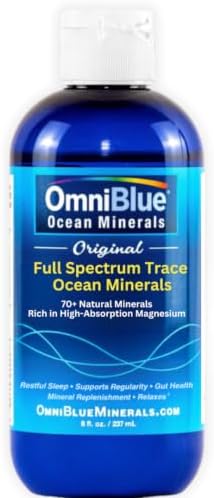
OmniBlue Original is made from deep ocean water concentrated through solar evaporation. Its product details list 420 mg of ionic magnesium along with more than 70 trace minerals and electrolytes. That stated magnesium amount gives shoppers a more specific mineral figure to compare with the broader blends in this guide.
The brand recommends about 1 teaspoon, or roughly 100 drops, in a large beverage. It also notes that the concentrate has a strong taste and suggests mixing it with juice, coffee, smoothies, or food to help mask the flavor. The 8-fl-oz size makes more sense if you expect to use the product regularly or want a bottle that is less compact than the 2-fl-oz version.
The flavor is an important practical consideration: this may be harder to enjoy in plain water than a product with a milder taste. Also, the product’s claims about wellness benefits should not replace medical advice or a balanced diet. Compare its label with your needs, particularly if you are tracking magnesium or electrolyte intake.
Pros:
- Lists 420 mg of ionic magnesium
- Contains more than 70 trace minerals and electrolytes
- Sourced from deep ocean water
- Can be mixed into beverages or food
Cons:
- Product details describe a strong taste
- Suggested serving is about 1 teaspoon, a larger amount than some drop-based directions
Verdict: Pick the 8-fl-oz OmniBlue if you want an ocean-sourced blend with a stated magnesium amount and are comfortable mixing it into a flavored drink or food.
Best Compact Ocean-Mineral Bottle: OmniBlue 2 fl oz

This smaller OmniBlue bottle has the same stated formula as the 8-fl-oz option: deep-ocean minerals, 420 mg of ionic magnesium, and more than 70 trace minerals and electrolytes. The compact size may be more convenient if you want to try the formula before choosing a larger bottle or prefer to keep a small concentrate on hand.
Usage directions call for about 1 teaspoon, or around 100 drops, in a large beverage. The product details describe a strong taste, so plan to mix it with something that can help cover the mineral flavor. Because the supplied details do not state a different serving size for this bottle, check the label for the exact number of servings and directions.
Compared with the 8-fl-oz version, the main difference is bottle size rather than the listed mineral profile. If you already know you will use it regularly, the larger option may be more convenient; if you are unsure about the taste, the smaller format is a lower-commitment way to assess whether it suits you.
Pros:
- Compact 2-fl-oz bottle
- Lists the same 420 mg of ionic magnesium as the larger size
- Contains more than 70 trace minerals and electrolytes
- Can be mixed into drinks or food
Cons:
- Strong taste may not suit plain-water use
- Smaller bottle means less product than the 8-fl-oz option
Verdict: Choose this size if you want to try OmniBlue or prefer a compact bottle; select the larger bottle if you already know the flavor works for you.
Best Magnesium-Focused Pick: Premier Research Labs Premier pH Minerals

Premier pH Minerals is a 2-fl-oz mineral additive for water that features ionic magnesium along with sulfur, boron, and lithium. Unlike the broad-spectrum blends above, the supplied description highlights these specific minerals but does not state exact amounts for each one.
The directions recommend 1/2 teaspoon in 1 liter of water or juice for regular use. For people described as sensitive, the suggested amount is 1/4 teaspoon in 2 liters of water. These clear measurements can make it easier to follow the label, but they also mean this product is not dosed by a small number of drops.
The product name and description refer to pH balance. Treat that as a product positioning point rather than a reason to expect a health result from changing your water. Its small bottle and focused ingredient list may appeal if you want a magnesium-containing blend, but shoppers seeking a full-spectrum mineral count or a stated magnesium quantity may prefer another option.
Pros:
- Includes ionic magnesium, sulfur, boron, and lithium
- Provides measured directions for water or juice
- Small 2-fl-oz bottle
- Designed as a mineral additive for drinking water
Cons:
- Does not list the amount of each mineral in the supplied details
- Directions use teaspoon measures rather than a drop count
Verdict: Consider Premier pH Minerals if its listed mineral combination and measured directions match your preferences, but compare the full label if you need exact mineral amounts.
How to Choose Mineral Drops for RO Water
Compare the Mineral Profile
Some concentrates describe a broad blend of trace minerals, while others highlight particular minerals such as magnesium. Look for the amount per serving if you need to track a specific mineral. A product that lists many minerals may sound comprehensive, but the number of minerals alone does not tell you how much of each one is in a serving.
Check the Source and Product Details
The options here include minerals sourced from the Great Salt Lake and deep ocean water, as well as a formula whose supplied description focuses on its ingredient blend. Source can be a useful preference, but it does not replace checking the full ingredient panel, serving directions, and quality information. For example, one ConcenTrace product is described as third-party tested, while other supplied descriptions do not make that same statement.
Think About Taste and How You Will Use It
Mineral concentrates can have a noticeable taste. OmniBlue specifically describes its formula as strong-tasting and suggests mixing it with juice, coffee, smoothies, or food. If you plan to add drops to plain RO water, start by checking the product’s directions and consider whether a strong mineral flavor would bother you.
Follow the Serving Directions
Serving instructions differ across products. One ConcenTrace description suggests starting with 10 drops, OmniBlue recommends about 1 teaspoon, and Premier pH Minerals gives directions in teaspoons per liter. Use the product label for the correct amount, and do not assume that one brand’s drop count applies to another formula.
Choose a Bottle Size That Fits Your Routine
A larger bottle may be more convenient if you already know you will use a concentrate regularly. A smaller bottle can be a more manageable way to try a flavor or formula first. Check the package details carefully, especially for the 4-fl-oz ConcenTrace listing, whose supplied description says it includes three 4-fl-oz bottles even though the title presents a 4-fl-oz size.
Consider Your Health Needs
Mineral drops are supplements, not a substitute for medical care or a varied diet. If you have a health condition, take medication, or need to limit a particular mineral, check the full label and ask a qualified health professional before using a concentrate. This is especially important when a product lists minerals without stating the amount of each one in the available details.
Frequently Asked Questions
Why add mineral drops to reverse-osmosis water?
People often choose mineral drops to add minerals to RO water or adjust its taste. The products in this guide are concentrates intended for water or other beverages. Check each label for the specific ingredients and directions.
Do all mineral drops have the same taste?
No. Flavor can vary by formula and concentration. OmniBlue describes its ocean-mineral drops as having a strong taste and suggests mixing them into a flavored beverage or food. The supplied details do not give a taste description for every product here.
How many drops should I add to RO water?
There is no single serving amount for all mineral drops. The ConcenTrace 4-fl-oz description suggests starting with 10 drops, OmniBlue recommends about 1 teaspoon, and Premier pH Minerals uses teaspoon measurements. Follow the specific product label.
Can I add mineral drops to something besides water?
Some of these products can be added to juice or food, and OmniBlue also suggests mixing its drops with coffee or smoothies. Check the label for directions for the product you choose.
Are the two OmniBlue bottles different formulas?
The supplied descriptions list the same mineral profile for both sizes: 420 mg of ionic magnesium and more than 70 trace minerals and electrolytes. The stated difference is bottle size: 8 fl oz versus 2 fl oz.
Is the ConcenTrace 4-fl-oz listing one bottle or a multipack?
The supplied title says 4 fl oz, while the description says the pack includes three 4-fl-oz bottles. Confirm the package quantity on the product listing before ordering.
Can mineral drops replace medical advice or supplements prescribed by a clinician?
No. Mineral drops should not be used as a replacement for prescribed care. If you take medication, have a health condition, or need to manage mineral intake, speak with a qualified health professional before adding a concentrate to your routine.
Final Recommendation
For a broad mineral blend in a larger bottle, Trace Minerals ConcenTrace 8 fl oz is a strong starting point based on its listed 70+ ionic minerals, Great Salt Lake source, and stated third-party testing. Choose OmniBlue if you want a deep-ocean formula with a stated magnesium amount and do not mind mixing it into a drink with a stronger flavor. Premier pH Minerals is worth considering if its specific mineral combination and measured serving directions fit your needs. Always compare the full label and follow its serving instructions.