
Rear-view cameras have become a practical upgrade for drivers who want more than a single view of the road. A mirror dash cam with dual camera coverage records what is ahead of your car and what is behind it, all from a unit that replaces your existing rearview mirror or clips onto it. That means you get front-facing recording, a backup view when you shift into reverse, and in many models, parking monitoring and collision-triggered clips, without giving up dashboard space. The right model depends on how sharp you need the footage to be, how big a screen you want, and how much setup work you are willing to do. This guide walks through five strong options and explains what each one does well, where it falls short, and who it fits best.
Quick Comparison of the Five Picks
| Product | Front Camera | Rear Camera | Screen Size | Best For |
|---|---|---|---|---|
| REXING M2 Smart BSD ADAS Dual Mirror Dash Cam | 1080p | 1080p | 12-inch IPS touch screen | Drivers who want blind spot alerts and a large display |
| 4K+2.5K Rearview Mirror Dual Dash Cam for Cars | 4K | 2.5K | 10-inch IPS touch screen | Drivers who want the sharpest front video and driver assist features |
| 9.66” IPS Mirror 4K+1080P Dual Dash Front and Rear Camera | 4K | 1080P | 9.66-inch IPS touch screen | Drivers who want a big screen and app-based video access |
| SIXWIN 4.5 Inch Mirror Dash Cam Backup Camera | 1080P | 1080P | 4.5-inch LCD | Drivers who want simple plug-and-play setup with parking monitoring |
| 4.5 Inch Mirror Dash Cam Front and Rear, 1080P Rear View Mirror Backup Camera | 1080P | 480P | 4.5-inch LCD | Drivers who want a tool-free strap-on mount for a simple setup |
Our Picks: Best Mirror Dash Cams With Dual Camera reviews
Rexing M2: Dual 1080p Recording With a 12-Inch Touch Screen and Blind Spot Alerts

The REXING M2 is the most feature-heavy model in this lineup. It records two 1080p video channels at the same time, one from the front camera and one from the rear, and it pairs them with a 12-inch IPS touch screen that mounts in place of your standard rearview mirror. The large display is the first thing most drivers notice. It gives you a wider live view of the road behind you and makes it easier to see traffic details at a glance than a smaller mirror-style screen would.
What sets this model apart is its driver assistance package. The product description calls out blind spot detection using radar sensors, along with Lane Change Assist, which alerts you when a lane change appears to be safe. It also includes a built-in GPS logger that stamps time, date, location, and speed onto your recordings. These extras go beyond basic video capture and are a real reason to choose this unit over a simpler dual camera.
In everyday use, the M2 covers the core needs well. Loop recording lets you choose 1, 2, or 3-minute segments, and a G-sensor locks footage when it detects an impact. The parking monitor can wake the unit when it senses vibration, and a hardwire kit is included, which is useful if you want the feature to work when the car is parked. Many owners appreciate that the touch screen is simple to operate by finger, so adjusting settings does not require digging through complicated menus.
The tradeoff is size and setup. A 12-inch display is large, and some drivers may find it dominates the windshield area or feels bulky compared with a slim mirror unit. Front and rear video is 1080p rather than 4K, so it will not match the detail of the higher-resolution options on this list. It also has more features to learn, which is a fair trade if you plan to use the driver assist tools, but less ideal if you want a quick, minimal install. Compared with the QOZ and Zomolither models, the M2 trades some image sharpness for a broader feature set and a bigger screen.
Pros:
- Records dual 1080p video from front and rear at the same time
- Large 12-inch IPS touch screen with a wider live view
- Blind spot detection and Lane Change Assist add real driver support
- Hardwire kit is included for parking monitor use
Cons:
- The large screen may feel bulky on smaller windshields
- Video resolution is 1080p, below the 4K options in this list
Verdict: The REXING M2 is a strong choice for drivers who want a big screen, blind spot alerts, and lane change support in one unit. If you care most about sharp image detail or a slim, low-profile look, another model here may suit you better.
QOZ 4K and 2.5K Dual Mirror Dash Cam: Sharp Front Video and ADAS Guidance

The QOZ dual mirror cam is built around image quality. Its front camera records in 4K, and its rear camera records in 2.5K, with a wide 170-degree front field and a 150-degree rear field. The IMX415 sensor and WDR processing are designed to handle mixed lighting, such as bright headlights against dark road surfaces, while keeping license plates and road signs legible. If sharp evidence-grade detail is your top priority, this model has the strongest resolution on paper in this lineup.
The 10-inch IPS touch screen offers a split-screen mode that shows the road view and touch controls together. You can also flip the front and rear image vertically or horizontally, which helps when the unit is installed in a pickup, RV, or truck where the camera angle may differ from a standard sedan. The included 64GB micro SD card is a helpful starting point, and the unit supports cards up to 512GB for longer retention.
The driver assistance features are the other highlight. The product describes an ADAS mode that issues warnings for road risks and offers steering and speed assistance on highways. Because these features rely on the car and the software working together, it is wise to test the alerts and understand what they can and cannot do before depending on them. The 24-hour parking monitor requires an accessory for full function, so plan for that if you want the feature.
The main drawbacks come from the demands of higher resolution. 4K footage uses more storage space and can put more load on the memory card, so using a high-quality card matters. The advanced ADAS features also add complexity, and some drivers may prefer a simpler device if they only want recording and a backup view. Compared with the REXING M2, this model leans toward image quality and assist tools rather than the largest screen possible.
Pros:
- 4K front camera delivers high-detail footage for plates and road signs
- WDR and night vision help balance bright and dark scenes
- Split-screen mode keeps road view and controls visible together
- Image can be flipped vertically or horizontally for different vehicle types
Cons:
- The 24-hour parking monitor needs an accessory for full function
- 4K recording demands high-quality memory cards and more storage
Verdict: The QOZ model is a top choice for drivers who value the sharpest front video and want built-in driver assistance. If you prefer a simpler setup or do not need 4K detail, a lower-resolution option may be a better fit.
Zomolither 9.66-Inch Mirror Dash Cam: Large Screen and 4K Front Camera

The Zomolither mirror dash cam combines a 4K front camera with a 1080P rear camera and a 9.66-inch IPS touch screen. The front lens is rated at a 150-degree field of view and the rear at 120 degrees, which gives you wide coverage across the lanes ahead and the space behind your vehicle. The IPS panel is designed to keep colors consistent from different seating positions, so the passenger can also see the display clearly.
Setup and daily use are where this model stands out. You can swipe left or right to switch between front and rear feeds, swipe up or down to adjust the viewing angle, and choose among three display modes: front view, rear view, or split screen. Wi-Fi connectivity lets you download and share clips through a dedicated app, which is convenient if you want to save a moment from a trip or pull footage for a traffic dispute without removing the memory card.
Low-light performance and exposure control are strong points. Super night vision is designed to capture plates and signs after dark, and exposure compensation lets you adjust brightness when you pass through tunnels or face bright sunlight. The reversing mode switches to a full-screen rear view with parking lines, and you can manually fine-tune the image position. The built-in G-sensor records when it senses an impact, which adds a layer of protection when the car is parked nearby.
The main tradeoff is the rear camera resolution. Because the rear view is 1080P, it is sharp enough for reversing and general awareness, but it does not match the detail of the front camera. A large 9.66-inch screen is also more visible than a small mirror display, which is a plus for some drivers and a drawback for those who prefer a discreet look. Compared with the QOZ model, this unit offers a similar front resolution with a slightly less detailed rear view, but it places more emphasis on app access and an easy-to-read display.
Pros:
- 4K front camera paired with a large 9.66-inch IPS touch screen
- Three display modes give you flexible front, rear, and split views
- Wi-Fi app makes it simple to save and share clips
- Exposure compensation helps with tunnels and bright sun glare
Cons:
- The rear camera is 1080P, which is less detailed than the front view
Verdict: The Zomolither model is a practical pick for drivers who want a big, easy-to-read screen, a sharp front camera, and smartphone access to footage. If maximum rear detail matters most to you, consider a model with a higher-resolution rear camera.
SIXWIN 4.5-Inch Dual Mirror Dash Cam: Simple Plug-and-Play Setup
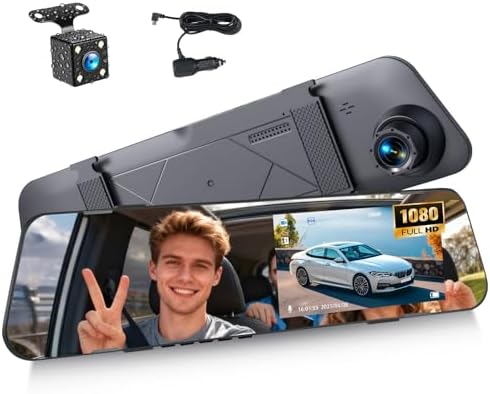
The SIXWIN mirror dash cam is a straightforward dual camera unit with a 4.5-inch screen. It records 1080P from both the front and rear lenses and offers four switching modes, including front only, rear only, and two split-screen arrangements. That flexibility is useful if you want to change the view depending on whether you are driving forward, backing up, or checking traffic from a particular angle.
Its biggest appeal is simplicity. The product is described as plug and play, and it includes a 6-meter power cable, so you can route power from your car without special tools. For drivers who want a no-fuss installation and do not need a large display or advanced driver assist features, this is an approachable choice. The reversing assistance activates when you shift into reverse, and guide lines help you judge distance during low-speed parking.
The 24-hour parking monitor is a notable feature for this price class. According to the product information, it continues to watch the area around the vehicle after the engine is off, powered by the car battery or an external source, and starts recording when it detects impacts or motion. Exposure compensation is also included to help with mixed lighting and nighttime footage.
The limitations are mostly about screen size and cabin presence. A 4.5-inch display is compact and out of the way, which many drivers prefer, but it is smaller than the 9.66-inch and 12-inch options and may be harder to read for passengers or in bright conditions. The product also does not offer the 4K detail or advanced ADAS features found in the QOZ and REXING models. It is best seen as a dependable, functional upgrade rather than a feature leader.
Pros:
- Plug-and-play design with a 6-meter power cable for simple installation
- Four screen modes cover front, rear, and split views
- 24-hour parking monitor adds protection when the car is parked
- Compact display stays out of the way on the windshield
Cons:
- The 4.5-inch screen is small and may be harder to read in bright light
- Lacks the higher resolution and driver assist tools of the top models
Verdict: The SIXWIN model is a sensible choice for drivers who want dual 1080P recording, an easy setup, and parking monitoring without a large screen. If you want a bigger display or advanced assist features, look toward the larger options in this list.
CAMECHO 4.5-Inch Strap-On Mirror Dash Cam: Easy Setup for Front and Rear Coverage

The CAMECHO mirror dash cam takes a different approach to installation. Its strap-on design is meant to fit over an existing rearview mirror, and the product states that no professional tools or wiring are required. For drivers who do not want to run cables or hire an installer, that is a clear advantage. It records a 1080P front view through a 150-degree lens and a 480P rear view, giving you coverage in both directions.
Day-to-day features are practical. Loop recording lets you choose 1, 3, or 5-minute segments and supports a TF card up to 64GB, so older clips are overwritten when storage fills. Reversing assistance switches to the rear camera when you shift into reverse and overlays guidelines that move with your steering wheel. Exposure compensation helps balance bright sunlight and dark roads, and the unit offers six on-screen languages along with 50Hz and 60Hz frequency compatibility.
The clearest tradeoff is the rear camera. At 480P, the rear image is noticeably less detailed than the 1080P rear feeds on the SIXWIN and REXING models, so it works best for reversing and general awareness rather than reading license plates from a distance. The front 1080P recording is adequate for everyday needs but does not reach the detail of the 4K models. Some drivers may also prefer a fixed-mount design over a strap-on unit, since the fit depends on your mirror shape.
Pros:
- Strap-on design requires no professional tools or wiring
- Front camera records 1080P through a 150-degree lens
- Dynamic parking guidelines follow your steering wheel when reversing
- Multi-language on-screen menus make the unit easy to use for many drivers
Cons:
- The 480P rear camera offers less detail than the other dual-camera options
- Strap-on fit may vary depending on mirror shape and size
Verdict: The CAMECHO model suits drivers who want the simplest possible setup and reliable front recording with a basic reversing view. If sharp rear detail or a fixed, wired installation matters more to you, a higher-resolution model from this list would be a better match.
How to Choose the Right Mirror Dash Cam With Dual Camera
Choosing a dual camera mirror dash cam is less about finding the single best model and more about matching features to your driving habits. A commuter who wants a backup view and basic evidence recording has different needs than a driver who tows a trailer, works long shifts, or parks on the street overnight. The sections below explain the factors that matter most so you can weigh each option with confidence.
Camera Resolution and Image Quality
Resolution determines how much detail you can see in your footage. A 4K front camera, like those on the QOZ and Zomolither models, captures more detail than a 1080p camera, which can make a difference when you need to read a license plate at a distance or identify road signs in a blurry moment. However, higher resolution also uses more storage and benefits from a good memory card. A 1080p front camera is still a solid choice for everyday recording, and it leaves more room for affordable storage. Pay attention to the rear camera as well, since a 480P or 1080P rear feed will look quite different in backing-up situations. Image quality also depends on the lens angle, the sensor, and how the unit handles low light and glare, so look for features like WDR and exposure compensation if you often drive at night or in tunnels.
Screen Size and Display Modes
Screen size is a personal decision that affects both usability and how the unit fits in your cabin. Larger displays, such as the 12-inch REXING M2 or the 9.66-inch Zomolither, are easier to read from the driver’s seat and offer more room for split-screen views. Smaller 4.5-inch screens are more discreet and take up less visual space, which many drivers prefer for a clean windshield area. Consider also how many display modes you need. Front only, rear only, and split-screen options help you change the view depending on whether you are driving forward, reversing, or checking traffic. Touch controls and swipe gestures can make adjustments quicker, but make sure the interface feels intuitive when you first set it up.
Rear Camera Coverage and Reversing Assistance
A rear camera is only as useful as its field of view and its guidance. Wide-angle rear lenses reduce blind spots, which is especially helpful for drivers of pickups, SUVs, and vehicles with tall cargo areas. Reversing assistance features such as parking guidelines help you judge distance during low-speed maneuvers. Some systems overlay guidelines that move with your steering input, which can be useful for tight parking spaces. Also think about the installation angle. Some units let you flip or adjust the image up, down, or sideways, which matters if your rear camera is mounted at an unusual angle or your vehicle has a different body style.
Mounting, Installation, and Fit
The way a mirror dash cam mounts affects both setup time and long-term comfort. Strap-on designs, such as the CAMECHO model, can be installed in minutes without tools or wiring, which is convenient for renters or drivers who prefer a quick setup. Plug-and-play models with a power cable, like the SIXWIN, offer simple installation with a little more cable routing. Units that include a hardwire kit, such as the REXING M2, are better suited to parking monitor features that need constant power. Before buying, measure your mirror and think about how the unit will sit against the windshield. A large display may need more careful placement to keep your view of the road clear, and a strap-on fit can vary depending on mirror shape.
Storage, Loop Recording, and Memory Cards
Dual camera systems record a lot of video, so storage management matters. Loop recording automatically overwrites the oldest unlocked files when the card is full, which keeps the device running without manual cleanup. Check which recording segment lengths are available, such as 1, 2, or 3-minute intervals, because shorter segments make it easier to find a specific clip. Also confirm the maximum supported memory card size. Several models in this lineup support cards up to 64GB, while the QOZ model supports up to 512GB. A G-sensor is valuable because it locks footage when it detects an impact, protecting the clip from being overwritten. Using a high-endurance memory card designed for continuous recording can help your device last longer, especially when recording in high resolution.
Parking Monitor and Power Options
If you park on the street or in a shared lot, a parking monitor can add meaningful protection. Parking modes typically use motion, vibration, or impact sensors to start recording while the car is off. The exact behavior depends on the model. Some units rely on the car battery or an external power source, and others require an accessory for full functionality. Think about how long you want the device to run while parked and whether you are comfortable with the power draw. A hardwire kit provides a more stable connection than a simple plug-in cable, but it requires more setup. Check the product details to see whether the parking feature is included or needs an add-on.
Driver Assistance and Smart Features
Some models go beyond recording and add driver assistance tools. Blind spot detection, lane change alerts, and ADAS warnings can add real value during highway driving or heavy traffic. These features are most useful when they are clear, responsive, and easy to understand. Because they depend on sensors and software, test them early and learn their limits. Features like GPS logging, app connectivity, and Wi-Fi file sharing also add convenience. If you plan to share clips or review footage on your phone, a Wi-Fi-enabled model may be worth the extra consideration. Choose the features that match how you actually drive rather than paying attention only to the longest feature list.
Frequently Asked Questions
What is a mirror dash cam with dual camera?
A mirror dash cam with dual camera combines a rearview mirror display with two lenses, one facing forward and one facing backward. It records both views at the same time, and in most models it also shows a live rear feed when you shift into reverse. This setup replaces your standard mirror, so you do not need a separate dashboard unit or extra space on the windshield.
Do I need a 4K front camera, or is 1080p enough?
A 4K front camera captures more detail, which can help when you need to read license plates or road signs from a distance. A 1080p camera is still sufficient for most drivers and generally uses less storage. If image detail is your top priority, the QOZ and Zomolither models are the strongest options in this lineup. If you mainly want a backup view and general recording, a 1080p model is a practical choice.
Can I install a mirror dash cam myself?
Yes, most mirror dash cams are designed for do-it-yourself installation. Strap-on models such as the CAMECHO unit can be set up without tools or wiring. Plug-and-play models, such as the SIXWIN, use a power cable that routes along your windshield and trim. Units with a hardwire kit, like the REXING M2, need a bit more work if you want constant power for parking monitoring. Take your time routing cables so they do not interfere with airbags, pillars, or your view.
What memory card should I use with a dual camera dash cam?
Choose a high-endurance microSD card designed for continuous recording. These cards are built to handle frequent rewriting, which is common with loop recording. Check the maximum card size supported by your model before buying. Several models here support cards up to 64GB, while the QOZ unit supports larger capacities up to 512GB. Format the card in the device when you first install it so the system can organize files correctly.
Does a parking monitor drain my car battery?
Parking monitors draw power while the car is off, so battery drain is a real consideration. Many systems include voltage protection or timed shutoffs to reduce the risk, but the exact behavior depends on the model and power source. If you park for long periods without driving, consider checking your battery regularly or using a power option designed for parking mode. Always read the product details on power management before enabling the feature.
Are blind spot and lane change alerts reliable?
Driver assistance alerts can help you notice traffic you might miss, but they should support your attention rather than replace it. The REXING M2 describes blind spot detection through radar sensors and Lane Change Assist, while the QOZ model includes ADAS warnings and steering and speed support. Test these features in a safe setting, learn how the alerts sound and look, and keep your eyes on the road and your mirrors as you normally would.
Which model is best overall?
The best choice depends on your priorities. The REXING M2 suits drivers who want a large screen and blind spot support. The QOZ model is the top pick for sharp 4K front detail and driver assistance. The Zomolither model offers a large screen with app access, while the SIXWIN and CAMECHO units are better for simple setups. Match the model to the features you will use every day.
Final Recommendation
For most drivers, the QOZ 4K+2.5K Rearview Mirror Dual Dash Cam offers the best balance of image quality, driver assistance, and display flexibility in this lineup. Its sharp front camera and rear detail make it a strong option if you want footage that holds up when you need to read plates or signs. If you prefer a larger screen and easy app access, the Zomolither model is an excellent alternative. The REXING M2 is the choice for drivers who want a 12-inch display and blind spot alerts, while the SIXWIN and CAMECHO models are sensible picks for simple, lower-cost setups where a compact unit matters most. Consider your driving habits, your mirror size, and your need for detail, and the right dual camera mirror dash cam will become clear.