
If your smoothies include frozen fruit, leafy greens, or ice, a powerful blender can help you get the texture you want without needing a separate appliance for every task. The best choice depends on more than the wattage on the box: pitcher size, speed controls, personal-blending options, and cleanup all matter. These five picks range from an all-in-one Ninja system to simpler countertop blenders, so you can match the features to your routine.
Quick Comparison
| Blender | Listed power | Capacity and standout features | Best for |
|---|---|---|---|
| Ninja CrushBOSS 3-in-1 Blender & Food Processor | 1850 peak watts | 72-ounce pitcher, 26-ounce tumbler, 64-ounce food processor | Blending plus meal prep |
| Ninja Detect Power Blender Pro | 1800 peak watts | 72-ounce pitcher, BlendSense, variable speed | Large smoothie batches |
| KitchenAid Pure Power Blender | 1700 peak watts | 68-ounce jar and two 16-ounce personal jars | Family and single-serve blends |
| Aeitto 1800W Professional Countertop Blender | 1800W maximum power | 68-ounce jar, three presets, seven speeds | Preset controls and easy cleanup |
| H-Duka 1800W Countertop Blender | 1800W; up to 25,000 RPM | 70-ounce pitcher, six presets, timer | Large batches and preset programs |
Our Picks: Best Most Powerful Blender For Smoothies reviews
1. Ninja CrushBOSS: Best All-in-One System for Blending and Meal Prep

The CrushBOSS combines a blender, food processor, and personal-drink setup around an 1850-peak-watt motor base. Its 72-ounce pitcher is made for larger batches, while the included 26-ounce tumbler gives you a way to blend a smaller drink for the road.
For smoothie making, the curved-square pitcher bottom is designed to help ingredients move through the blend, and the SmartMenu includes SmoothSense programs. The system also recognizes whether you are using a full-size or single-serve vessel and adjusts its program accordingly. Those features may be useful if you prefer guided settings over choosing every blending step yourself.
The food processor adds real range: the 64-ounce bowl, feed chute, blade assemblies, and disc cover tasks such as chopping, slicing, shredding, and dough mixing. That makes this the most versatile pick here, but the extra bowls, blades, and accessories mean more parts to organize and clean than with a blender-only model.
Pros:
- Includes a 72-ounce pitcher and a personal tumbler.
- Smart programs adjust for the selected vessel.
- Food processor bowl and multiple blade tools expand its uses.
- 1850 peak watts are the highest listed among these picks.
Cons:
- The many included parts require more storage and cleanup.
- It may be more appliance than you need if smoothies are your only goal.
Verdict: Choose the CrushBOSS if you want a high-powered smoothie blender that can also take on food processing and personal drinks.
2. Ninja Detect Power Blender Pro: Best for Large Smoothie Batches
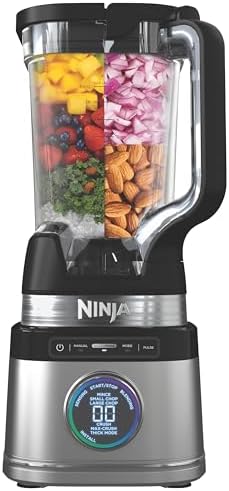
This Ninja pairs an 1800-peak-watt motor base with a 72-ounce pitcher, making it a straightforward option for blending several servings at once. Its Total Crushing and Chopping blade assembly is designed for ingredients such as ice, and the pitcher can also be used for chopping tasks.
BlendSense automatically adjusts speed and time, while the dial indicates the selected mode. You can also use variable speed for manual control in the full-size pitcher. This combination gives you a choice between guided blending and a more hands-on approach.
Compared with the CrushBOSS, the Detect Power Blender Pro is a more focused blender rather than a combined food processor system. It does not include a personal cup in the supplied product details, so it is less suited to making and taking an individual smoothie. The supplied listing data also marks this model as unavailable, so check its listing before planning a purchase.
Pros:
- Large 72-ounce pitcher suits family-sized batches.
- BlendSense adjusts blending speed and time automatically.
- Offers variable speed control in the full-size pitcher.
- Pitcher and blade assembly support both blending and chopping tasks.
Cons:
- No personal blending cup is listed as included.
- Availability may be a concern based on the supplied listing information.
Verdict: Consider this Ninja for large batches and automated blending, but confirm that it is available and suitable for your needs before choosing it.
3. KitchenAid Pure Power: Best for Switching Between Big and Small Servings
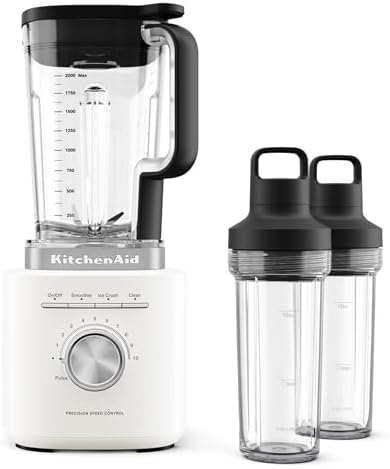
The Pure Power offers a 68-ounce jar for larger recipes and two 16-ounce personal blending jars for individual portions. That mix makes it a practical option for households where some people want a shared batch and others prefer a drink they can take along.
KitchenAid lists 1700 watts of peak input power and notes that the blender is UL rated at 1200 watts. That distinction matters when comparing wattage claims: peak input is not the same as operational power at the blade. The blender also has an asymmetric blade design, a variable-speed control knob, and a Smoothie Cycle.
The controls provide flexibility beyond preset blending, with the ability to choose a speed for different textures. The listed accessories include travel lids for the personal jars. Compared with the Ninja models, this one has a lower listed peak-watt figure, but its two personal jars give it a clear advantage for regular single-serving use.
Pros:
- Includes a 68-ounce jar and two 16-ounce personal jars.
- Smoothie Cycle offers a dedicated smoothie program.
- Variable speed lets you choose a blend texture.
- Travel lids are included for the personal jars.
Cons:
- The peak-watt figure should not be read as operational power at the blade.
- It has less listed peak power than the Ninja picks in this roundup.
Verdict: Pick the KitchenAid if you want one blender for both family-size batches and personal smoothies, with manual speed control available.
4. Aeitto 1800W Blender: Best for Simple Presets and Self-Cleaning

Aeitto’s countertop blender has a 68-ounce BPA-free jar and lists 1800W maximum power. Its three preset programs cover smoothies, juice, and crushed ice, while seven adjustable speeds give you more control when you do not want to use a preset.
The LED display shows speed, time, and program status. For cleanup, the blender has a one-touch self-cleaning mode; the supplied description says detachable parts other than the motor base are dishwasher-safe. These features make it a good fit if you value a visible control display and a quick rinse routine.
The product description also mentions soups and nut butters, but it does not provide specific details about a heating function or a dedicated nut-butter program. If those tasks are important to you, check the product listing for what each setting supports. Unlike the Ninja CrushBOSS, this is a blender-focused appliance without a food processor bowl or personal tumbler listed.
Pros:
- 68-ounce BPA-free jar suits larger batches.
- Includes smoothie, juice, and crushed-ice presets.
- Seven speeds provide manual adjustment.
- Self-cleaning mode and dishwasher-safe detachable parts simplify cleanup.
Cons:
- No personal blending cup or food processor is listed.
- Its maximum-power figure is not directly comparable to peak-watt ratings.
Verdict: Choose the Aeitto if you want a large-jar blender with simple presets, adjustable speeds, and a self-cleaning mode.
5. H-Duka 1800W Blender: Best for Preset Variety and a Large Pitcher

This H-Duka model pairs a 70-ounce BPA-free pitcher with an 1800W motor and a listed speed of up to 25,000 RPM. Its six programs cover juice, smoothies, ice crush, soup, sauce, and grinding. A multi-function knob allows speed adjustments, and a timer can be set from 15 to 90 seconds.
The product description lists 3D six-leaf stainless steel blades and a pulse self-cleaning mode. It also describes a safety-lock lid and overheat protection. Together, these are useful features for someone who wants a large-capacity blender with more preset choices than a basic smoothie-only machine.
The tradeoff is that the supplied details do not list a personal cup or a food processor attachment. The 1800W claim and RPM figure also do not tell the whole story about blending performance on their own, so consider the controls, pitcher size, and included accessories alongside those numbers.
Pros:
- 70-ounce BPA-free pitcher is sized for larger batches.
- Six presets cover smoothies and several other kitchen tasks.
- Timer and multi-speed control allow more adjustment.
- Pulse self-cleaning mode and dishwasher-safe parts are listed.
Cons:
- No personal blending cup is listed as included.
- It lacks the food-processing attachments found in the Ninja CrushBOSS.
Verdict: The H-Duka is worth considering if you want a large pitcher and a broad selection of preset programs in a blender-focused design.
How to Choose a Powerful Blender for Smoothies
Look beyond the wattage number
Power labels can describe different things, such as peak watts or maximum power. The KitchenAid listing, for example, distinguishes its 1700-watt peak input measurement from its 1200-watt UL rating. Use wattage as one point of comparison, not a promise of a particular smoothie texture. Blade design, controls, pitcher shape, and the ingredients you use all matter too.
Choose a pitcher size that fits your routine
A 68- to 72-ounce pitcher can be helpful when you make several servings at once, while a smaller personal jar may be more convenient for one drink. If you usually blend just for yourself, consider whether you want a dedicated personal container or are comfortable using and cleaning the full-size pitcher for a small serving.
Decide whether you want presets or manual control
Presets can make routine tasks easier by starting a program for smoothies or ice. Variable-speed controls are useful when you want to adjust the texture yourself. Some models offer both: the Ninja Detect Power Blender Pro has BlendSense and variable speed in its full-size pitcher, while the KitchenAid has a Smoothie Cycle and a speed knob.
Check what is included beyond the main pitcher
A personal cup can help you blend and take a drink with you. A food processor bowl and extra blades can add chopping, slicing, or dough-mixing options, but they also mean more pieces to store and clean. Compare the included accessories with the way you actually cook rather than choosing a system based only on the number of attachments.
Think about cleanup and storage
Check which pieces are dishwasher-safe and whether the blender has a self-cleaning setting. A large pitcher and several attachments may suit batch cooking but take more space than a simpler setup. If you plan to use your blender every day, easy cleanup can be as important as power.
Match the features to your main ingredients
If you often use frozen fruit or ice, look for a model whose listed blade assembly or programs address those ingredients. For greens, thick blends, or nut butters, prioritize adjustable controls and read the product details closely. The supplied descriptions list different capabilities, but they do not provide a shared performance test, so avoid treating the wattage figures as a direct ranking of results.
Frequently Asked Questions
Which blender in this list has the highest listed peak power?
The Ninja CrushBOSS has the highest listed peak figure at 1850 watts. Peak wattage is not the same measurement as operational power at the blade, so compare the full set of features rather than relying on this number alone.
Which blender is best for making several smoothies at once?
The Ninja Detect Power Blender Pro has a 72-ounce pitcher, while the CrushBOSS also has a 72-ounce pitcher. The KitchenAid, Aeitto, and H-Duka have jars or pitchers ranging from 68 to 70 ounces, which also suit larger batches.
Which option includes personal blending containers?
The KitchenAid includes two 16-ounce personal blending jars and travel lids. The Ninja CrushBOSS includes a 26-ounce tumbler. The supplied details for the other models do not list personal blending containers.
Do all five blenders have smoothie presets?
The product details specifically list a SmoothSense program for the CrushBOSS, a Smoothie Cycle for the KitchenAid, and smoothie presets for the Aeitto and H-Duka. The Ninja Detect Power Blender Pro lists BlendSense technology and single-touch programs, but its supplied description does not name a dedicated smoothie preset.
Is a higher wattage always better for smoothies?
Not by itself. The wattage figures may refer to different measurements, and the supplied product information does not provide a shared performance test. Consider the blade assembly, controls, pitcher size, and any programs designed for the ingredients you use.
Which blender is easiest to clean?
The Aeitto and H-Duka descriptions specifically list self-cleaning modes. The Ninja Detect Power Blender Pro says its containers, lids, and blades are top-rack dishwasher-safe, while the other models list their own included parts and cleaning details. Check the product page for the current care instructions for each component.
Which model should I choose if I want more than a blender?
The Ninja CrushBOSS is the clear fit for that purpose because it includes a 64-ounce food processor bowl, a multi-blade disc, and a dough blade alongside its blender pitcher and tumbler.
Final Recommendation
For the broadest set of uses, the Ninja CrushBOSS stands out with its 1850-peak-watt motor, full-size pitcher, personal tumbler, and food processor attachments. If you mainly make large batches, consider the Ninja Detect Power Blender Pro or one of the large-pitcher alternatives. For regular single-serving smoothies, the KitchenAid is a strong match because it includes two personal blending jars. Choose based on how much you blend, which accessories you will use, and how much control you want over each batch.