
Choosing the best non-toxic pans for cooking starts with knowing what “non-toxic” means to you. The options below include ceramic-coated pans marketed as free of certain chemicals and titanium pans described as having no chemical coating. They differ in size, cooking style, and care, so consider your stovetop, how you cook, and how much you value easy food release. Product descriptions make the safety claims summarized here; they are not independent test results.
Quick Comparison
| Pan | Material and style | Best suited for | Stovetop compatibility |
|---|---|---|---|
| SENSARTE Ceramic Frying Pan with Lid | Ceramic-coated skillet; multiple sizes listed | Everyday frying and eggs | All stovetops, including induction |
| SENSARTE 12-Inch Deep Ceramic Skillet | 5-quart ceramic-coated deep skillet with lid | Sautéing, simmering, and one-pan meals | All stovetops, including induction |
| SENSARTE 9.5-Inch Ceramic Omelet Pan | Ceramic-coated skillet | Eggs and smaller portions | All stovetops, including induction |
| TOPSIRS 12-Inch Titanium Pan | Pan described as pure titanium with no chemical coating | Shoppers looking for an uncoated option | Gas, induction, ceramic, and halogen |
| Roomena 12-Inch Titanium Pan with Lid | Titanium construction with hybrid nonstick technology | Versatile cooking with a covered-pan option | Gas, induction, electric, ceramic, halogen, and glass |
Our Picks: Best Non Toxic Pans For Cooking reviews
1. SENSARTE Ceramic Frying Pan: A Flexible Everyday Skillet

This ceramic-coated skillet is listed in several sizes, from a small pan to a larger 12.5-inch option. That range makes it a flexible pick if you want to choose a pan around your usual portions rather than committing to one size. The product description says its ceramic surface is made without intentionally added PFAS, PTFE, PFOA, lead, or cadmium.
The pan has a cast-aluminum body and an induction-compatible base, so it is designed for use on all stovetops, including induction. A tempered-glass lid is included, and the woodgrain-style Bakelite handle is described as heat resistant and comfortable to grip. The smooth surface is intended to release food with less oil and make cleanup easier.
For day-to-day use, this is the most straightforward choice in the group for frying, cooking eggs, or making pancakes. Its size options are useful, but the exact size you choose will affect how much food fits comfortably. The product description recommends hand washing to help extend the surface’s life, even though it also lists the pan as dishwasher safe. As with other coated cookware, gentle utensils and care are sensible ways to help preserve the cooking surface.
Pros:
- Multiple listed sizes for different portions and cooking needs
- Induction-compatible base for use across stovetop types
- Includes a tempered-glass lid
- Product description lists the ceramic surface as free of several specified chemicals and metals
Cons:
- Hand washing is recommended to help extend the nonstick surface’s life
- The product description does not specify an oven-safe temperature
Verdict: Choose this SENSARTE skillet if you want a familiar ceramic-coated frying pan with a lid and a choice of sizes.
2. SENSARTE 12-Inch Deep Skillet: A Roomy Pan for One-Pan Meals

This 12-inch SENSARTE pan is a deeper, more versatile take on a standard skillet. Its listed 5-quart capacity and included lid give it room for more than quick frying. The product description names sautéing, stir-frying, simmering, braising, boiling, and stewing among its intended uses.
The body is described as heavy-duty cast aluminum, with an induction base for use on gas, electric, ceramic, and induction stovetops. Its ceramic surface is marketed as free of PFOA, PTFE, PFAS, PFOS, lead, and cadmium. The lid is described as explosion-proof glass, while the woodgrain-style Bakelite handle is designed to stay cool during cooking.
The extra depth makes this the strongest fit among the ceramic choices for saucy meals or recipes that need more room than a shallow frying pan provides. That same depth may feel less convenient if you mainly cook a single egg or need a pan that is easy to toss or flip. The product description recommends hand washing to help extend the nonstick surface’s life, and it does not provide an oven-safe temperature.
Pros:
- Roomy 5-quart capacity and a lid for covered cooking
- Designed for a wide range of cooking methods
- Induction compatible and described for all stovetops
- No-rivet interior is intended to make cleaning easier
Cons:
- Its deep shape may be more pan than needed for simple, small portions
- Hand washing is recommended; no oven-safe temperature is listed
Verdict: Pick this deep skillet if you want one ceramic-coated pan for sautéing as well as covered, saucy dishes.
3. SENSARTE 9.5-Inch Omelet Pan: A Compact Pick for Eggs

This 9.5-inch ceramic-coated skillet is the smaller, simpler option in SENSARTE’s group. Its size suits omelets, eggs, and other modest portions, while the smooth cooking surface is designed for easy food release. The product description says the ceramic material is made without PFOA, PTFE, PFAS, lead, or cadmium.
The pan has a cast-aluminum body and an induction base, and it is described as compatible with all stovetops. Its woodgrain-style Bakelite handle is designed to stay cool during stovetop cooking. One useful distinction is its stated oven-safe temperature: the pan can go in an oven up to 550°F if you remove the handle first. Follow that instruction carefully, and check the product’s care information before using it in the oven.
This is a practical choice if you already have larger cookware and want a dedicated pan for quick breakfasts or smaller servings. Its compact cooking area is less suited to family-size batches. The description recommends hand washing to extend the pan’s life, and the handle must be removed for oven use, which makes it less convenient for recipes that move straight from stovetop to oven.
Pros:
- Compact size for eggs, omelets, and smaller portions
- Induction-compatible and described for all stovetops
- Product description specifies oven use up to 550°F with the handle removed
- Smooth ceramic surface is designed for easy food release
Cons:
- Smaller cooking area is not ideal for large batches
- The handle must be removed before oven use
Verdict: Choose this pan if you want a compact ceramic skillet mainly for eggs and small meals, with the added option of oven use after removing the handle.
4. TOPSIRS 12-Inch Titanium Pan: A Coating-Free Option

Unlike the ceramic-coated options, this 12-inch TOPSIRS pan is described as being made from high-purity titanium with no chemical coating. Its product description highlights a hand-forged, hammered surface intended to help food release through the pan’s texture rather than a conventional nonstick coating. It also describes the pan as scratch resistant and suitable for metal utensils.
The pan has a thickened composite base that is designed to distribute heat, and the listed compatible cooktops include gas, induction, ceramic, and halogen. The product description also calls it lightweight and suitable for frying foods such as eggs, fish, and steak. It is supplied with a lid according to the product title, but the description does not provide details such as its oven-safe temperature or specific cleaning instructions.
This option may appeal if avoiding a chemical nonstick coating matters more to you than choosing a ceramic surface. Keep in mind that the description’s “physical non-stick” claim is not the same as a guarantee of effortless release in every recipe. Compared with the ceramic pans, it has no stated nonstick coating and fewer care details to guide you, so check the manufacturer’s instructions before choosing utensils or cleaning methods.
Pros:
- Described as pure titanium with no chemical coating
- Hammered texture is intended to support physical food release
- Compatible with gas, induction, ceramic, and halogen stovetops
- Product description says the pan is designed to resist scratches and rust
Cons:
- Specific care and oven-use instructions are not included in the supplied description
- Food release may not feel like that of a conventional coated nonstick pan
Verdict: Consider this pan if a coating-free design is your priority and you are comfortable checking the care guidance before use.
5. Roomena 12-Inch Titanium Pan: A Covered Pan with Mixed Coating Claims
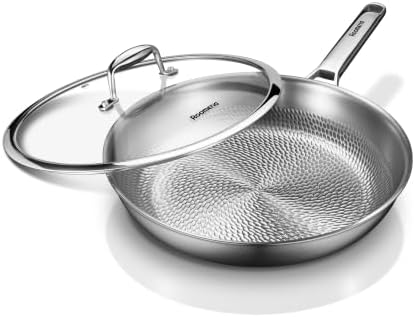
This 12-inch Roomena pan is described as titanium cookware with a reinforced, multi-layer construction, a composite base, and a lid. Its listed uses include frying, sautéing, broiling, braising, and searing. The description says it works on gas, induction, electric, ceramic, halogen, and glass cooktops, and calls the handle stay-cool and the pan oven safe.
There is an important detail to clarify before buying: the title describes the pan as pure titanium and PFAS-, PFOA-, and PTFE-free, while the product description also calls its food-release surface “hybrid nonstick technology.” Those statements do not clearly explain whether the cooking surface has a coating or what that coating contains. If you specifically want cookware with no added coating, confirm the construction and materials with the manufacturer before purchasing.
That uncertainty makes this a less straightforward choice than the TOPSIRS pan for someone focused on a coating-free surface. Its lid and broad stovetop compatibility may be useful, but the supplied description gives no oven-safe temperature or detailed care instructions. Clarify those points, along with the coating details, if they are important to your cooking routine.
Pros:
- 12-inch size with a lid for covered cooking
- Described as compatible with several common stovetop types, including induction
- Product description lists frying, sautéing, braising, and searing among its uses
- Oven-safe construction is stated, though a maximum temperature is not provided
Cons:
- The description does not clearly explain how “pure titanium” relates to its “hybrid nonstick technology”
- No maximum oven temperature or detailed care instructions are supplied
Verdict: Consider this pan only after confirming its cooking-surface construction if avoiding added coatings is a key reason for your purchase.
How to Choose a Non-Toxic Pan for Cooking
Decide What “Non-Toxic” Means for Your Kitchen
“Non-toxic” is a broad marketing term, not a single cookware material or universal certification. In this selection, the ceramic pans are described as free of certain specified chemicals and metals, while the TOPSIRS pan is described as titanium with no chemical coating. The Roomena description uses both pure-titanium and hybrid-nonstick language, so its surface construction needs clarification. Read the exact materials and claims for the pan you are considering, especially if you are avoiding a particular substance.
Choose Between Ceramic-Coated and Coating-Free Designs
Ceramic-coated pans are designed to offer easy food release, which can be useful for eggs and delicate foods. Their cooking surface is still a coating, and the SENSARTE descriptions recommend hand washing to help extend its life. A pan described as having no chemical coating may suit shoppers who prefer an uncoated cooking surface, but do not assume that it will release food just like a coated nonstick pan. Check the care and cooking instructions before deciding.
Match the Pan Size to Your Usual Portions
A smaller skillet can be easier to manage for eggs or a quick single-serving meal. A 12-inch pan gives you more cooking area, while the deep SENSARTE model also offers a listed 5-quart capacity for recipes with more liquid or ingredients. Think about how many portions you usually cook and how much storage space you have. A larger pan is not always the most convenient choice for everyday use.
Check Stovetop Compatibility
If you have an induction cooktop, confirm that the pan is described as induction compatible. All five products in this guide are listed for induction, but compatibility details for other surfaces vary by product. Check the product information against your exact stovetop type before ordering, especially if you use a less common cooktop.
Look Closely at Oven and Handle Instructions
Only the 9.5-inch SENSARTE pan lists a specific oven temperature in the supplied description: up to 550°F with its handle removed. The Roomena pan is described as oven safe, but no maximum temperature is given. The other descriptions do not specify an oven-safe temperature. If you often move pans from stovetop to oven, confirm both the temperature limit and whether the handle or lid can go in the oven.
Consider Cleaning and Long-Term Care
The ceramic SENSARTE pans are described as easy to clean, and their product information recommends hand washing to help preserve the nonstick surface. The titanium pan descriptions emphasize durability, but the TOPSIRS and Roomena details supplied here do not give full care instructions. Follow the manufacturer’s directions for cleaning and utensils instead of assuming that a durability claim means every utensil or cleaning method is suitable.
Check Product Claims That Seem to Conflict
Material wording matters if your goal is to avoid a particular coating. For example, a pan described as both “pure titanium” and “hybrid nonstick” may need more explanation than a pan whose surface is clearly identified. If a product description does not say exactly what touches your food, ask the manufacturer or look for complete materials information before buying.
FAQs
What does “non-toxic pan” mean?
It is a general term rather than a precise cookware category. Check the material and the specific substances the manufacturer says the pan does or does not contain. These product descriptions provide manufacturer claims, not independent verification.
Are ceramic-coated pans the same as uncoated pans?
No. Ceramic-coated pans have a cooking surface described as ceramic, while the TOPSIRS pan is described as having no chemical coating. If you want to avoid all added coatings, confirm the construction of any pan whose description uses terms such as “hybrid nonstick.”
Which pan in this selection is best for eggs?
The 9.5-inch SENSARTE ceramic skillet is specifically presented as an omelet pan, and the other SENSARTE ceramic models are also described as having smooth nonstick surfaces. The best fit depends on how many eggs or portions you cook at once.
Which option has the most room for one-pan meals?
The SENSARTE 12-inch deep skillet is listed at 5 quarts and is described for uses such as sautéing, simmering, braising, and stewing. Its depth and lid make it the most clearly specified option for larger or saucier dishes.
Can these pans be used on induction cooktops?
Each supplied product description lists induction compatibility. Still, confirm the product details for the exact model you plan to buy and make sure they match your cooktop.
Can the pans go in the oven?
The 9.5-inch SENSARTE pan is listed as oven safe up to 550°F with its handle removed. The Roomena pan is described as oven safe, but no temperature limit is supplied. The other product descriptions do not give an oven-safe temperature, so check the manufacturer’s instructions before placing them in an oven.
Which pan should I choose if I want to avoid a chemical coating?
The TOPSIRS pan is the clearest match in these descriptions because it is described as pure titanium with no chemical coating. The Roomena pan’s description is less clear because it also mentions hybrid nonstick technology, so confirm its construction before buying if this is a priority.
Conclusion
For a straightforward everyday ceramic skillet, the SENSARTE frying pan with lid offers a choice of sizes and broad stovetop compatibility. Choose the SENSARTE deep skillet for larger, saucier meals, or the 9.5-inch model for eggs and small portions. If you prefer a pan described as coating-free, the TOPSIRS titanium option is the clearest fit in this group. Before choosing the Roomena pan, clarify its mixed titanium and hybrid-nonstick claims. In every case, use the product’s full materials and care instructions to decide whether it matches your needs.