
An over-the-sink dish rack can make a small kitchen easier to manage by moving wet dishes off the counter and directing water into the sink. The right choice depends on more than capacity: you’ll need to check sink dimensions, faucet height, cabinet clearance, and whether an open rack or covered design suits your routine. Here are five options, with fit details and trade-offs to consider before you buy.
Quick Comparison
| Product | Design | Fit and standout details | Best for |
|---|---|---|---|
| Sakugi 2-Tier Expandable Rack | Open, two-tier rack | Adjusts from 30 to 33.9 inches; 304 stainless steel | Flexible sink fit and accessory storage |
| ADBIU Expandable Over-Sink Rack | Large adjustable rack | Listed dimensions are 32.6–39.4 inches long and 34.2–37.4 inches high | Kitchens with ample vertical clearance |
| Hdrriozu 3-Tier Rack with Cover | Three tiers with a cover | Dimensions are not provided in the supplied details | Shoppers who want covered dish storage |
| NestOrganix Expandable 2-Tier Rack | Open, two-tier H-frame | Expands from 26.57 to 35 inches; faucet limit is 16.1 inches | Buyers who need a shorter starting length |
| AZURAOKEY 3-Tier Rack with Cover | Three tiers with a dust-resistant cover | 33.46 inches long; faucet height limit is 18.9 inches | Large households seeking covered storage |
Our Picks: Best Over The Sink Dish Rack Cabinet reviews
1. Sakugi 2-Tier Rack: Adjustable Length and Stainless Steel

The Sakugi is an open two-tier drying rack designed to span the sink, with an adjustable length from 30 to 33.9 inches. Its 304 stainless-steel construction and black finish give it a more specific material description than several of the other options here. The rack is designed to let water drain into the sink instead of collecting on the counter.
Its included organizers make it useful for more than plates. The listed accessories include a utensil holder, cutting-board holder, knife holder, and five utility hooks, along with baskets for dishes and other kitchen items. That variety may help keep frequently used tools together, though you’ll want to plan where each attachment sits so it doesn’t interfere with the faucet or nearby cabinets.
Measure the sink before ordering: the listing advises that the sink width should be less than 33.9 inches and the faucet height less than 21 inches for a better fit. This rack is a strong option if you want adjustable length and several built-in organizers without choosing one of the taller, more imposing designs. Its two-tier layout may offer less overall storage than the three-tier options.
Pros:
- Adjustable from 30 to 33.9 inches
- Made from 304 stainless steel, according to the product details
- Includes utensil, knife, and cutting-board holders plus utility hooks
- Designed to drain directly into the sink
Cons:
- Requires careful checking of sink width and faucet height
- Two tiers may provide less storage than a taller three-tier rack
Verdict: Choose the Sakugi if its size suits your sink and you want a stainless-steel rack with a useful mix of included organizers.
2. ADBIU Expandable Rack: A Large Option for Tall, Open Kitchens

The ADBIU is intended for shoppers who need a substantial amount of above-sink storage. Its listed dimensions are 32.6 to 39.4 inches long, 11.8 inches wide, and 34.2 to 37.4 inches high. The height and length are adjustable, and its removable accessories include holders for dishes, bowls, utensils, glasses, a cutting board, detergent, and paper towels.
There is an important listing inconsistency to keep in mind: the product title describes a two-tier rack, while the supplied description calls it a three-tier version. The description also warns that the rack can be too large or too tall for some kitchens and recommends checking for at least 20 inches of clearance above the sink area. Confirm the current product configuration and dimensions on the product page before ordering.
The rack is described as metal with a black finish and is marketed for heavy-duty use. Its adjustability may help it fit a wider sink area than shorter models, but it is not the best choice for a low cabinet or a compact kitchen. Compared with the Sakugi, it offers more adjustment and a larger overall footprint, but demands more careful planning.
Pros:
- Adjustable length and height for a range of setups
- Comes with multiple removable storage accessories
- Wide listed length range for larger sink areas
- Accessories can be arranged to suit your kitchen needs
Cons:
- Its listed height may not fit kitchens with low cabinets
- The title and description conflict about the number of tiers
Verdict: Consider the ADBIU only if you have generous vertical clearance and have verified the rack’s exact configuration and measurements.
3. Hdrriozu 3-Tier Rack: Covered Storage for Dishes
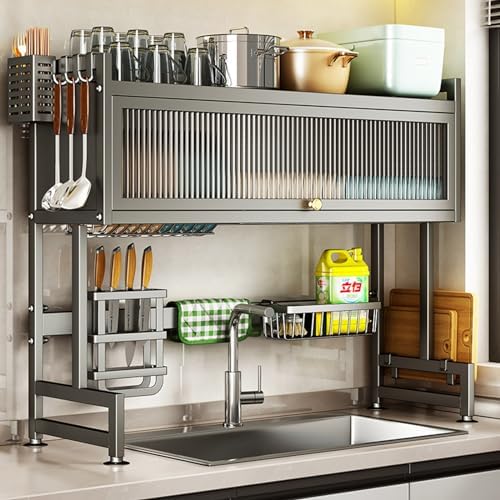
The Hdrriozu is a three-tier over-the-sink rack with a cover. The cover is intended to help keep dust off clean dishes, while the open rack design allows air to circulate. Its listed capacity is meant to accommodate dishes, glasses, bowls, and cutlery, making it a potential fit for households that want more than a simple plate stand.
The product description highlights a rust-resistant coating and installation with basic tools. However, the supplied details do not give the rack’s overall dimensions, sink-size range, faucet clearance, or a specific list of included accessories. Those details matter with an over-sink rack, especially when it has several tiers, so check them on the product page and measure your space before choosing it.
Compared with the AZURAOKEY, this model also has a cover, but the supplied information does not specify its material or exact measurements. That makes the Hdrriozu harder to compare on fit and construction. It may suit you if the cover is a priority, provided the product’s dimensions work with your sink and cabinets.
Pros:
- Three-tier layout is designed to hold a range of dishes and cutlery
- Cover is intended to protect clean dishes from dust
- Product details describe a rust-resistant coating
- Installation is described as straightforward with basic tools
Cons:
- Dimensions and faucet-clearance limits are not provided in the supplied details
- Included accessories are not itemized
Verdict: The Hdrriozu is worth considering if you want a covered three-tier rack, but verify its fit and included parts before buying.
4. NestOrganix Expandable Rack: Two Tiers with a Stable H-Frame

The NestOrganix is an open two-tier rack with an H-shaped frame. Its length expands from 26.57 to 35 inches, giving it a shorter starting length than the Sakugi and a useful range for some smaller sink setups. The listed overall dimensions are 35 inches long, 10.63 inches wide, and 21.26 inches high.
The product details call out a faucet-height limit of 16.1 inches and at least 25 inches of clearance. It is made from metal and is designed to drain into the sink. Storage is described for dishes, cups, knives, utensils, and cutting boards, though the supplied information does not itemize a set of included holders as fully as the Sakugi listing does.
This rack may be easier to fit in a kitchen where a taller three-tier unit would feel too large, but its faucet limit is lower than those listed for the Sakugi and AZURAOKEY. Measure from the counter or sink area as directed by the product listing and check the space around your faucet before choosing it.
Pros:
- Expands from 26.57 to 35 inches
- Two-tier design takes up less vertical space than the taller options
- H-shaped frame is designed for added stability
- Designed to direct drainage into the sink
Cons:
- Faucet height must be 16.1 inches or less
- At least 25 inches of clearance is specified
Verdict: Pick the NestOrganix if you want a two-tier rack with a shorter adjustable length and your faucet meets its clearance limit.
5. AZURAOKEY 3-Tier Rack: Covered Storage with a Carbon-Steel Frame

The AZURAOKEY is a three-tier drying rack made from carbon steel with a black finish. It includes a dust-resistant cover, which may be useful if clean dishes stay on the rack between meals. The product description says the cover allows air circulation while helping shield dishes from dust and splashes.
At 33.46 inches long, this rack is not length-adjustable according to the supplied details. The listed faucet-height limit is 18.9 inches, so measure carefully before ordering. Its three levels are intended to hold larger bowls, plates, cups, utensils, soap, brushes, and sponges, making it a storage-focused choice for busy kitchens or larger households.
Unlike the Sakugi, the AZURAOKEY’s main distinction is its cover and three-tier layout rather than a stated adjustable length or stainless-steel construction. The product is described as a rack or storage shelf, not a sealed cabinet, so expect an open-air drying setup with a cover rather than enclosed cupboard storage.
Pros:
- Three tiers provide space for dishes and cleaning items
- Includes a dust-resistant cover
- Product details specify carbon-steel construction
- 33.46-inch length and 18.9-inch faucet limit are provided
Cons:
- Length is listed as fixed, not expandable
- May not suit sinks or faucets outside its stated measurements
Verdict: Choose the AZURAOKEY if you want a covered three-tier setup and its fixed length and faucet clearance match your kitchen.
How to Choose an Over-the-Sink Dish Rack Cabinet
Measure the sink and the space around it
Start with the usable width over your sink, then compare it with the rack’s minimum and maximum length. Also check the rack’s front-to-back width and whether its support points can sit securely on the surfaces around your sink. A rack that is too long, too narrow, or poorly positioned may be awkward to use even if its listed length seems close.
Check faucet height and cabinet clearance
Measure from the surface where the rack will sit to the top of your faucet, and look at the product’s stated faucet-height limit. If you have a cabinet above the sink, check the full vertical space it leaves. Tall, multi-tier racks can block cabinet access or leave too little room to load dishes, so compare the complete height—not just the number of tiers.
Choose the right capacity for your routine
A two-tier rack may be easier to fit and reach, while a three-tier model can provide more places for dishes and kitchen items. Think about what you wash most often: plates and bowls, glasses, utensils, or cutting boards. Consider whether the included holders match those items, since a large frame without the right organizers may not use your space efficiently.
Decide whether you want a cover
A cover can help shield clean dishes from dust and splashes, but it also adds another part to handle when loading or removing dishes. Covered racks are not the same as sealed kitchen cabinets; check the product design and how it allows air to move. If you prefer quick access and a simple open layout, an uncovered rack may be a better match.
Compare materials and care needs
Look for a clear description of the frame material and finish. The Sakugi specifies 304 stainless steel, while the AZURAOKEY specifies carbon steel; other listings describe metal or a rust-resistant coating. These descriptions do not make all racks equivalent, so follow the product’s care instructions and keep the rack clean and dry as recommended by its maker.
Review the accessories and assembly details
Included holders can make a rack more useful, but the accessory mix varies. Check whether you need a utensil cup, knife holder, cutting-board slot, hooks, or a detergent holder, and confirm which parts come in the package. Also consider the assembly information: a large adjustable frame may take more planning to place than a simpler two-tier design.
Frequently Asked Questions
Will an over-the-sink dish rack fit any kitchen sink?
No. Each rack has its own length, width, height, and clearance limits. Measure your sink, faucet, and nearby cabinets, then compare those measurements with the product specifications before ordering.
Does an over-the-sink rack keep the counter completely dry?
These racks are designed to drain over or into the sink, which can reduce water pooling on the counter. The exact result depends on placement, how dishes are loaded, and the rack’s design, so make sure it sits correctly over the basin.
Are covered dish racks enclosed cabinets?
Not necessarily. The covered models in this list are described as racks with covers, not sealed cabinets. Their covers are intended to help protect dishes, but you should check the product details to understand how the cover fits and how air circulates.
Which option is best for a small kitchen?
A two-tier rack with an adjustable length may be easier to fit than a tall three-tier model. The NestOrganix starts at 26.57 inches, while the Sakugi adjusts from 30 inches. Still, compare your exact faucet and cabinet clearances before choosing either one.
What should I know about the ADBIU rack’s listed size?
The supplied description lists a length of 32.6 to 39.4 inches and a height of 34.2 to 37.4 inches, while the title describes a two-tier rack and the description calls it three-tier. Verify the current dimensions and configuration on the product page, and make sure you have enough vertical clearance.
Is stainless steel always the best material for a dish rack?
Material is one factor, but the finish, care instructions, fit, and layout also matter. The Sakugi listing specifies 304 stainless steel; other options describe coated metal or carbon steel. Compare the stated materials and follow the maker’s care directions.
Final Recommendation
The Sakugi is the most balanced place to start if you want an adjustable two-tier rack, a clearly stated 304 stainless-steel frame, and several included organizers. For covered storage, compare the AZURAOKEY and Hdrriozu, but confirm dimensions before buying. If you have a large, open kitchen, the ADBIU offers a much taller, broader layout, though its listing has conflicting tier details. Measure first: the best rack is the one that fits your sink, faucet, and cabinet clearance without getting in your way.