
If you run a small band, a DJ setup, a church sound system, or a rented event rig, a subwoofer can make a big difference. Full-range speakers handle vocals and midrange well, but they often struggle with deep kick drums, bass lines, and low-end rumble. A powered subwoofer with a built-in crossover solves that problem by splitting the audio signal for you. It sends the low frequencies to the sub and passes the higher frequencies to your main speakers. That means fewer cables, less guesswork, and a simpler setup. This guide covers four Behringer PA subwoofers that include built-in crossover circuitry, so you can find the right fit for your room, your budget, and your type of performance.
| Product | Amplifier Power | Driver Size | Crossover Feature | Best For |
|---|---|---|---|---|
| Behringer EUROLIVE B1200D-PRO | 500 Watt | 12″ | Built-in stereo crossover with high-pass filtered outputs and variable high-cut filter | Small venues, portable setups, and compact spaces |
| Behringer EUROLIVE VQ1500D | 500 Watt | 15″ | Built-in active stereo crossover with subwoofer level control | Bands, DJs, and mid-sized gatherings |
| Behringer EUROLIVE B1500XP | 3000 Watt | 15″ TURBOSOUND speaker | Built-in crossover with high-power Class-D amplification | Large rooms and high-volume events |
| Behringer PA Subwoofer SAT 1008 SUBA | 600 Watt | 8″ | Built-in stereo crossover for satellite speaker systems | Compact satellite setups, small rooms, and playback use |
Our Picks: Best Pa Subwoofers With Built In Crossover reviews
Behringer EUROLIVE B1200D-PRO: A Compact Sub for Tight Spaces

The B1200D-PRO is an active 500-watt subwoofer built around a 12-inch driver. It is the smallest of the group that uses a 12-inch speaker, and that size is a practical advantage. It is easier to carry, easier to place, and less intrusive on a crowded stage or in a small room. If you need solid low end without taking up much floor space, this model deserves a close look.
The most useful feature is the built-in stereo crossover. The high-pass filtered outputs let you run a full-range speaker from the same unit, so you do not need a separate crossover box. A variable high-cut filter gives you more control over how much low end the sub handles. That flexibility matters because every room behaves differently. A carpeted room with soft furniture may need less bass than a bare hall with hard walls.
The cabinet and amplifier are built for regular use. The Class-D amplifier includes thermal and clip limit protection, which helps guard the speaker when you push it hard during a long set. In everyday use, many owners appreciate that the sub feels straightforward to set up. You connect your mixer, run the outputs to your main speakers, and adjust the filters until the bass blends smoothly. The main trade-off is output. At 500 watts with a 12-inch driver, this model is a strong choice for small to mid-sized spaces, but it is not designed to fill a large outdoor event on its own.
Pros:
- Compact 12-inch design that is easy to transport and position
- Built-in stereo crossover removes the need for an external crossover
- Variable high-cut filter offers useful tuning control for different rooms
- Thermal and clip limit protection helps guard the amplifier during long use
Cons:
- Output may feel limited for very large rooms or outdoor crowds
Verdict: The B1200D-PRO is a smart pick for small bands, mobile DJs, and venues where space and portability matter most. It is not the loudest option here, but it gives you clean, controllable bass in a compact package.
Behringer EUROLIVE VQ1500D: A Versatile 15-Inch Workhorse

The VQ1500D steps up from the B1200D-PRO with a 15-inch long-excursion transducer and the same 500-watt output class. The bigger driver gives it more room to move air at low frequencies, which many listeners notice as a fuller, more physical bass presence. It is a sensible middle choice for bands that play clubs, weddings, and community events where the bass needs to be felt as well as heard.
This model has a built-in active stereo crossover with high-pass filtered outputs. It also adds a subwoofer level control, which lets you balance the sub against your full-range speakers without digging through the mixer. That control is handy during soundcheck. You can dial in the bass quickly, then leave it alone once the mix sounds right. The high-temperature voice coil and the amplifier’s over-excursion, thermal, and clip limit protection add confidence during longer sets with heavy low-end content.
The main consideration is weight and size. A 15-inch cabinet is noticeably larger and heavier than a 12-inch model, so you should plan for it. Some users find it manageable with a bit of planning, while others would rather have the smaller B1200D-PRO for frequent load-ins. The VQ1500D also trails the B1500XP in raw power. For most mid-sized spaces, though, its 500 watts combined with the bigger driver offer a strong balance of punch and control.
Pros:
- 15-inch long-excursion driver delivers fuller, more impactful low end
- Built-in active stereo crossover simplifies connections
- Subwoofer level control makes balancing with main speakers quick and easy
- Multiple protection features help support steady performance during long sets
Cons:
- Larger and heavier than the 12-inch options, which can make transport harder
Verdict: The VQ1500D is one of the most practical choices for working bands and mobile DJs. It offers a strong step up in bass impact without jumping to a high-power system, and it is easy to dial in on the fly.
Behringer EUROLIVE B1500XP: Serious Power for Large Rooms

The B1500XP is the most powerful model in this lineup, with a 3000-watt Class-D amplifier paired with a 15-inch TURBOSOUND speaker. If your events regularly fill large halls, outdoor stages, or busy dance floors, this is the sub that gives you the most headroom. The power rating alone signals its purpose. It is built for high sound pressure levels and deep, controlled bass at volume.
The design includes an internal switch-mode power supply, which the manufacturer describes as helpful for noise-free audio, strong transient response, and lower power consumption. That combination matters on a job site, where clean power and fast response help the bass stay tight during fast-moving music. The amplifier also includes over-excursion, thermal, RMS, and clip limit protection, which is important when you are running a high-output system for hours.
There is a practical catch. This model is listed as currently unavailable, so you should check the listing before planning a purchase around it. It is also the heaviest and most demanding option here. You will need a stable stand or placement, a solid power plan, and a clear idea of how much sound you actually need. Many buyers who choose this model are running larger systems where the extra power is an advantage. For a small room, it can be more than you need. Its built-in crossover and high-pass outputs still make it easy to integrate with full-range speakers, even at this power level.
Pros:
- 3000-watt Class-D amplifier provides the most headroom in this lineup
- Switch-mode power supply supports clean audio and efficient power use
- Comprehensive protection, including RMS limiting, helps support demanding use
- Built-in crossover works well with full-range PA speakers
Cons:
- Currently unavailable and more power than most small venues require
Verdict: If you need the most volume and the cleanest handling of heavy bass in this group, the B1500XP is the top choice. If it is out of stock when you shop or your rooms are small, one of the 500-watt models will likely serve you better.
Behringer PA Subwoofer SAT 1008 SUBA: A Budget-Friendly Satellite Partner
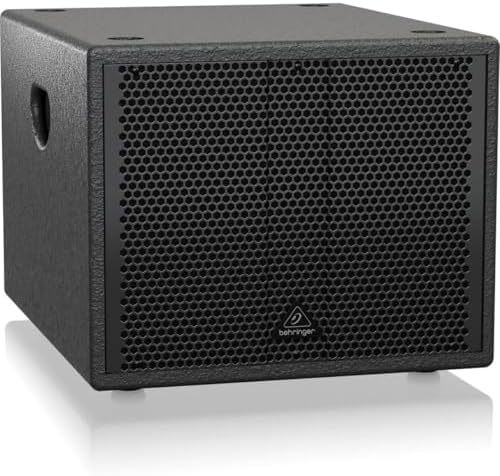
The SAT 1008 SUBA is the smallest sub in this group, with an 8-inch long-excursion driver and a 600-watt Class-D amplifier. It is designed to pair with compact satellite speakers, which makes it a natural fit for small live setups, background music systems, and playback in modest rooms. Its size makes it easy to place under a table, beside a stage riser, or in a corner where a larger cabinet would get in the way.
Despite its size, the 8-inch driver is more capable than you might expect. It is designed to deliver a noticeable low-end boost without overwhelming smaller main speakers. The stereo crossover handles the split between the sub and your satellites, so the setup stays simple. The amplifier includes over-excursion, thermal, RMS, and clip limit protection, which helps protect the driver and amp during extended use.
The trade-off is depth and volume. An 8-inch driver cannot move the same amount of air as a 12-inch or 15-inch speaker, so the bass will feel lighter in large spaces. Some owners find it ideal for smaller rooms, but it may leave you wanting more if your audience expects strong, room-filling low end. It works best as a compact, practical companion rather than a main bass source for big events.
Pros:
- Compact size fits easily into small stages, rooms, and satellite setups
- Stereo crossover keeps connections simple when paired with satellite speakers
- 600-watt Class-D amplifier offers solid output for its size
- Protection features help support steady operation in regular use
Cons:
- The 8-inch driver has less low-end depth and volume than larger models
Verdict: The SAT 1008 SUBA is a practical, space-saving choice for small rooms, background sound, and compact satellite systems. If you need heavy bass for large crowds, step up to one of the 12-inch or 15-inch models instead.
How to Choose the Right PA Subwoofer With a Built-In Crossover
Understanding What the Built-In Crossover Does
A crossover divides the audio signal by frequency. Low frequencies go to the subwoofer, and higher frequencies go to your main speakers. A built-in crossover does this work inside the subwoofer, so you do not need a separate device in your signal chain. For most people, this is the biggest advantage of this type of product. It reduces the number of parts you must buy, store, and connect. Look for high-pass filtered outputs, since these let you send a full signal to a full-range speaker while keeping its low end clean. Also check whether the crossover is stereo, which is helpful if you run two full-range speakers.
Matching Power and Driver Size to Your Room
Wattage gets most of the attention, but driver size matters just as much. A larger driver can move more air, which usually translates into fuller bass at lower frequencies. Higher wattage gives the amplifier more headroom, meaning it can handle louder peaks without strain. Still, more power does not always mean better sound. A 3000-watt sub in a small room can be overkill and may require more care in placement. As a rough guide, smaller 8-inch and 12-inch models suit small rooms, portable acts, and casual playback. 15-inch models work well for bands, DJs, and mid-sized events. The highest-output models suit large halls and outdoor shows where the crowd is far from the stage.
Thinking About Portability and Setup
Your setup routine should influence your choice as much as your performance needs. If you load in and out of venues often, a lighter cabinet will save your back and your time. A 12-inch model is usually easier to manage than a 15-inch model, and the 8-inch option is the lightest. Consider where the sub will sit, too. A subwoofer on the floor behaves differently than one on a stand or a riser. Make sure you have room for the cabinet, a clear path for cables, and a safe place to plug in power. Thinking through these details before you buy prevents frustrating problems during a live show.
Checking Protection and Build Quality
Protection circuits help keep your speaker and amplifier safe when you push them. Look for thermal protection, which guards against overheating, and clip limit protection, which helps prevent harsh distortion from damaging the driver. Some models also include over-excursion protection and RMS limiting. These features matter most when you run a sub for long periods or at high volume. Build quality is also important. A sturdy cabinet, a durable grille, and well-made connectors will hold up better over time. When you compare products, pay attention to how each feature supports the way you plan to use the sub.
Balancing the Sub With Your Main Speakers
A subwoofer is only as good as its blend with your full-range speakers. Some models offer a subwoofer level control, which lets you adjust how much bass the sub contributes compared with the main speakers. This control is useful because the right balance changes from room to room. If the bass is too strong, vocals may sound muddy. If it is too weak, the mix may feel thin. Plan to spend a few minutes during soundcheck making adjustments. A variable high-cut filter, like the one on the B1200D-PRO, adds another layer of control for tuning the low end to your space.
Deciding Between Budget and Performance Needs
Price is part of every buying decision, but it should not be the only factor. A lower-cost model can be a smart choice if your needs are modest. A higher-power model may pay off if you play larger venues or need extra headroom for demanding music. Think about how often you will use the sub, what size rooms you play, and how much bass your audience expects. Buying a bit more capacity than you need can be wise if you plan to grow. Buying far more than you need can waste money and create setup challenges. Match the product to your real use, not to the biggest number on the spec sheet.
Frequently Asked Questions
Do I need a separate crossover if I buy one of these subwoofers?
No. Each model in this guide includes a built-in crossover. That means you can connect your mixer or amplifier, send the outputs to your full-range speakers, and let the subwoofer handle the low frequencies. This saves money and reduces the number of parts you need to carry.
What do high-pass filtered outputs do?
High-pass filtered outputs send your main speakers only the higher frequencies. This keeps deep bass from reaching speakers that are not built to handle it. It also helps your full-range speakers sound clearer, since the sub takes care of the low end.
Which model is best for a small band or DJ?
The EUROLIVE B1200D-PRO and VQ1500D are both strong options. The B1200D-PRO is easier to carry and fits small spaces well. The VQ1500D offers a bigger driver and more low-end impact, which suits bands and DJs who play mid-sized venues.
Is more wattage always better?
Not necessarily. Higher wattage gives the amplifier more headroom, but a very powerful sub in a small room can be too much. Choose the wattage that matches your typical venue size and volume needs. Extra power is most useful when you regularly play large spaces or outdoor events.
Can a 15-inch subwoofer be used in a small room?
Yes, but you may need to adjust the level and placement carefully. A 15-inch model can produce strong bass, so using the level control and filters helps keep the low end balanced. If your room is very small, a 12-inch or 8-inch model may be easier to manage.
Why is one of these models listed as unavailable?
Availability on Amazon can change based on stock and seller supply. The B1500XP is currently listed as unavailable, so check the product page before you plan a purchase. If it is not in stock, the VQ1500D offers a similar 500-watt class option with a 15-inch driver.
Is the SAT 1008 SUBA suitable for larger events?
It is better suited to small rooms, compact satellite systems, and playback use. Its 8-inch driver has less depth and volume than larger models, so it may not fill a large space on its own. For bigger events, a 12-inch or 15-inch model will give you more presence.
Final Recommendation
For most small to mid-sized setups, the Behringer EUROLIVE VQ1500D offers the best balance of bass impact, built-in crossover convenience, and practical control. It suits bands, DJs, and community events without requiring the bulk or power of the highest-output model. If you need a more compact option, the B1200D-PRO is a smart, portable choice with useful tuning controls. The B1500XP is the top pick for large rooms and high-volume events, provided it is in stock and your venues justify the extra power. The SAT 1008 SUBA works well as a budget-friendly companion for small rooms and satellite speakers. Match your choice to your space, your transport needs, and the volume your audience expects, and you will get clean, controlled bass that complements your main speakers.