
For two people, the best rice cooker is usually one that makes enough for dinner without taking over your counter or leaving you with more leftovers than you want. The options below range from compact one-button models to a programmable cooker with fuzzy logic. Compare their stated capacities and controls, then choose based on how much rice you make and whether you want to cook grains and other dishes too.
Quick Comparison
| Rice Cooker | Stated Capacity | Standout Feature | Best For |
|---|---|---|---|
| Dash Mini Rice Cooker | 1 cup uncooked; makes 2 cups cooked | Removable ceramic nonstick pot | Small portions and tight spaces |
| Toshiba Mini Rice Cooker | 3 cups uncooked; 6 cups cooked | Fuzzy logic and 8 cooking functions | Flexible cooking and meal planning |
| Bear Mini Rice Cooker | Listed as a 2-cup model | One-button operation and a stated 25-minute quick-cook cycle | Simple cooking in a dorm or RV |
| AROMA Mini Rice Cooker | 2 cups uncooked; 4 cups cooked | PFAS-free ceramic-coated pot | Two-person meals and easy operation |
| Zojirushi 3-Cup Rice Cooker | 3 rice-cooker cups uncooked | Simple single-switch control | Basic rice cooking with a familiar brand |
Our Picks: Best Rice Cooker For 2 Persons reviews
Dash Mini Rice Cooker: A compact choice for small portions

The Dash Mini is sized for modest portions: its description says that 1 cup of uncooked rice makes 2 cups cooked. That can suit two people when rice is a side dish, or one person who wants a simple serving with little leftover. It may feel limiting if you like large portions or want extra rice for another meal.
A removable ceramic nonstick pot makes serving and cleanup more convenient than working around a fixed cooking bowl. The glass lid lets you see the food as it cooks, and the cooker switches to Keep Warm after cooking. Its one-switch interface also keeps the controls uncomplicated.
Beyond rice, the product description lists oatmeal, quinoa, brown rice, pasta, soups, and banana bread among its possible uses. Those options make it more versatile than a rice-only appliance, though its small size remains the main constraint. It is a practical pick for a dorm, office, small apartment, or travel setup where counter space and portion size matter.
Pros:
- Compact size for small kitchens or travel
- Removable ceramic nonstick pot and glass lid
- Automatic Keep Warm function
- Can be used for several foods beyond rice
Cons:
- Small stated yield may not suit two large appetites
- One-switch controls offer less programming flexibility
Verdict: Choose the Dash if you want a straightforward cooker for small servings and value a removable ceramic pot more than extra capacity or programmable settings.
Toshiba Mini Rice Cooker: Flexible settings for rice and more

The Toshiba is the most feature-rich choice in this group. It is rated for 3 cups uncooked rice, or 6 cups cooked, so it offers more capacity than many two-person households need for a single meal. That extra room can be useful if you want leftovers or cook for additional people now and then.
Its eight functions include settings for white rice, quick cook, brown rice, mixed grain, slow cook, porridge, cake, and egg. Fuzzy logic adjusts cooking time and temperature based on moisture, while the LED display, 24-hour delay timer, and Keep Warm/Reheat function add scheduling and serving flexibility. The inner pot has a nonstick coating; the product instructions call for hand washing it with mild soap and a soft cloth.
The extra settings and larger capacity make this a better fit for someone who wants one appliance for varied meals than for someone seeking the smallest, simplest rice maker. It also has removable steam components and a detachable power cord, but it involves more parts and controls than the one-switch Dash or Zojirushi.
Pros:
- Eight cooking functions for rice, grains, and other foods
- Fuzzy logic adjusts cooking time and temperature
- Delay timer and Keep Warm/Reheat function
- Capacity can accommodate extra servings or leftovers
Cons:
- More capacity and controls than some two-person households need
- Nonstick inner pot is not listed as dishwasher safe
Verdict: Pick the Toshiba if you want programmable options and room to cook beyond a small two-person portion; choose a simpler model if you mainly want basic rice with minimal setup.
Bear Mini Rice Cooker: A simple option for a compact kitchen
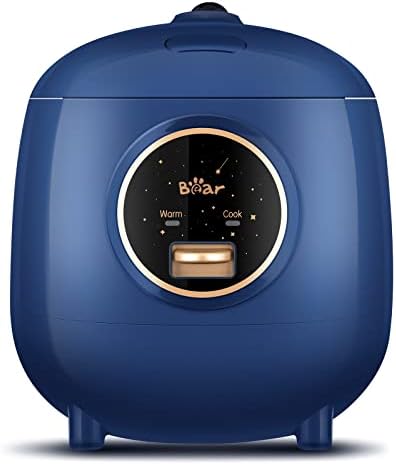
The Bear is designed as a small, portable cooker for one or two people, with a one-button interface and an automatic Keep Warm function. Its product description lists a 25-minute quick-cook cycle and 3D heating intended to distribute heat across the cooking pot. These details make it appealing if you want a basic appliance without a multi-step control panel.
There is a capacity wording mismatch in the supplied product information: the title describes it as a 2-cup-uncooked cooker, while the description says it makes up to 2 cups of cooked rice. Because those figures imply different yields, check the included measuring cup and pot markings before planning portions. This is especially important if you need a predictable amount for two people.
The removable inner lid and nonstick pot are intended to make cleanup easier, and the listed kit includes a measuring cup and rice paddle. The product description also positions it for dorms, small kitchens, RVs, and travel. Compared with the Dash, it emphasizes a stated quick-cook cycle; compared with the Toshiba, it has a simpler control setup and fewer listed functions.
Pros:
- One-button operation with automatic Keep Warm
- Compact design intended for small living spaces
- Product description lists a 25-minute quick-cook cycle
- Includes a measuring cup and rice paddle
Cons:
- Capacity details are not consistent across the supplied listing information
- Fewer listed cooking functions than the Toshiba
Verdict: The Bear suits shoppers who want a compact, simple cooker, but confirm its usable capacity before buying if serving size is a deciding factor.
AROMA Mini Rice Cooker: A clear capacity match for two

AROMA’s mini model has a clearly stated capacity of 2 cups uncooked rice, yielding up to 4 cups cooked. That gives two people more room than the Dash’s stated 2-cup cooked yield, while remaining smaller than the Toshiba. It is a sensible middle ground if you want enough for a shared meal without moving up to a larger cooker.
The cooker uses a one-touch design and automatically switches from Cook to Keep Warm. Its CoreCoat ceramic-coated inner pot is described as naturally nonstick and made without PFAS. A measuring cup and serving spatula are included, and the product description lists dishes such as jambalaya, steamed vegetables with rice, and cake among its uses.
AROMA keeps operation simple, so it is less suited to shoppers who want separate settings for different rice types or a delay timer. The Toshiba offers more control options, while the AROMA provides a more straightforward capacity-and-function combination for everyday meals. The brand also offers a digital recipe booklet after product registration, according to the supplied description.
Pros:
- Clearly stated 2-cup uncooked, 4-cup cooked capacity
- Ceramic-coated pot described as PFAS-free
- Automatically switches to Keep Warm
- Includes a measuring cup and serving spatula
Cons:
- One-touch operation provides fewer controls than the Toshiba
- Does not list a delay timer or separate rice-type settings
Verdict: Choose the AROMA if you want a clearly specified capacity for two and an uncomplicated cooker with a ceramic-coated pot.
Zojirushi 3-Cup Rice Cooker: A no-frills cooker with a larger pot

This Zojirushi keeps the controls simple with a single switch, a see-through glass lid, and a nonstick inner cooking pan. Stay-cool handles are designed to help with carrying the cooker. Its straightforward setup may suit you if you want basic rice cooking rather than multiple presets.
The listed capacity is three rice-cooker cups of uncooked short-grain white rice. These are not standard US measuring cups: the supplied cup holds 6 ounces, or about three-quarters of a US cup. The product information says one of these rice-cooker cups of raw rice makes about two to three rice-cooker cups cooked. That distinction matters when comparing this model with cookers that state capacity in standard cups.
The product data does not list multiple cooking programs, a delay timer, or an automatic Keep Warm feature, so it is less flexible on paper than the Toshiba. Its 3-cup capacity may also be more than a couple needs for one meal. For someone who values simple operation and does not need extra settings, though, the basic design may be a good fit.
Pros:
- Simple single-switch operation
- See-through glass lid and nonstick inner pan
- Stay-cool handles for carrying
- Includes a rice measuring cup
Cons:
- Rice-cooker cup measurements differ from standard US cups
- Fewer listed functions than the Toshiba
Verdict: Consider the Zojirushi if you prefer a basic cooker and are comfortable measuring with its included 6-ounce cup; look elsewhere for programmable settings or clearly stated standard-cup yields.
How to Choose a Rice Cooker for Two People
Match the capacity to your usual portions
Think about whether rice is the main part of your meal or a side dish, and whether you want leftovers. A small cooker can be a good fit for modest servings, while a model with a larger stated yield gives you more flexibility. Compare cooked yields when possible, since some product capacities refer to uncooked rice and others use a cooker-specific measuring cup.
Check how the cooker measures rice
Do not assume that every included cup matches a standard US measuring cup. For example, the Zojirushi’s supplied cup holds 6 ounces, about three-quarters of a US cup. Using the cooker’s own measuring cup and the pot’s water marks can help you follow its intended ratios. If you are comparing models, check whether their capacity is listed as uncooked or cooked rice.
Decide how much control you need
A one-switch model is straightforward if you mainly cook rice and want fewer settings to manage. A programmable cooker may be worth considering if you want specific functions for brown rice, mixed grains, porridge, slow cooking, or other foods. Extra settings can add flexibility, but they may not be useful if you rarely cook anything beyond basic rice.
Consider the pot and cleanup
Inner-pot materials and removable parts affect daily cleanup. The Dash has a removable ceramic nonstick pot, while the AROMA lists a ceramic-coated pot described as PFAS-free. The Toshiba has a nonstick inner pot and removable steam components; its supplied care information says to wash the pot by hand. Check the cleaning instructions for the model you choose.
Look for the features you will actually use
Keep Warm can help when you are not ready to serve as soon as cooking ends. A delay timer may help with meal scheduling, while a quick-cook setting can be useful when time matters. These features are not included on every model, so compare the function list with your normal routine instead of paying attention to the number of settings alone.
Think about where you will store and use it
A compact cooker can be easier to fit in a dorm, small apartment, RV, or office kitchen. If the cooker will travel, pay attention to its portability and how much counter or storage space you can spare. A larger-capacity model may be more useful for batch cooking, but it can be unnecessary if you only need one small meal at a time.
Frequently Asked Questions
What size rice cooker is best for two people?
It depends on portion size and whether you want leftovers. A cooker with a stated yield of around 2 to 4 cups cooked may suit modest meals for two, while a larger model can work better for bigger appetites or batch cooking. Check whether the listed capacity refers to uncooked or cooked rice.
Is the Dash Mini large enough for two people?
The Dash description says that 1 cup of uncooked rice makes 2 cups cooked. That may be enough when rice is a side dish, but it could be limiting if you want larger portions or leftovers.
Which cooker has the most cooking options?
The Toshiba lists eight functions, including settings for white rice, quick cook, brown rice, mixed grain, slow cook, porridge, cake, and egg. Its description also lists a delay timer and Keep Warm/Reheat function.
Do all rice cooker cups equal a standard US cup?
No. The Zojirushi includes a 6-ounce rice-cooker cup, which is about three-quarters of a US measuring cup. Check the included measuring cup and follow the cooker’s own instructions when measuring rice and water.
Which of these cookers has a ceramic-coated pot?
The Dash has a removable ceramic nonstick pot, and the AROMA uses a ceramic-coated inner pot described as PFAS-free. The supplied descriptions list a nonstick coating for the Toshiba and Zojirushi.
Can a mini rice cooker make foods other than rice?
Several models list other uses. The Dash description includes oatmeal, quinoa, pasta, and soup; the Toshiba lists functions such as porridge, cake, and slow cook; and the AROMA description mentions jambalaya, steamed vegetables with rice, and cake. Follow each model’s instructions for the dish you plan to make.
Which rice cooker is the simplest to operate?
The Dash, Bear, and AROMA are described with one-switch or one-button operation. The Zojirushi also uses a single switch. The Toshiba has a control panel and multiple functions, so it offers more options rather than the most basic setup.
Final Recommendation
For many two-person households, the AROMA Mini is the clearest all-around fit: its stated 2-cup uncooked, 4-cup cooked capacity gives you a useful middle ground, and its one-touch operation keeps cooking simple. Choose the Dash for smaller portions and a removable ceramic pot, the Toshiba for more cooking functions, or the Zojirushi for basic single-switch operation. If you are considering the Bear, confirm its capacity details before choosing it for a specific portion size.