
Stainless steel cookware can handle a firm scrub, but the wrong abrasive may leave marks. The best option depends on the mess and the finish: a mineral cleaning disc offers more controlled abrasion, while metal scrubbers are better suited to tougher jobs where the cookware maker allows them. Below, we compare five options and explain how to use them with care.
Quick Comparison
| Product | Best for | Type | Important caution |
|---|---|---|---|
| Steelé Mineral Sponge | Everyday stains and burnt-on residue | Reusable mineral disc | Use only on approved stainless steel surfaces |
| Steelé Mini Pre-Cut Mineral Sponge | Rims, rivets, and tight corners | Ten small mineral discs | Not for coated or delicate surfaces |
| uwoneg Steel Sponge | Curved surfaces and heavy-duty scrubbing | Flexible steel scrubber | Check cookware guidance and test a hidden area |
| FENQAROVIX Stainless Steel Scrub Sponges | Tough residue and household scrubbing | Four reusable metal scrubbers | Not for nonstick, glass, or other fragile finishes |
| Fuller Brush Stainless Steel Scrubbing Sponges | Flexible, heavy-duty cleaning | Three coiled stainless steel scrubbers | Metal scrubbers may be too abrasive for some finishes |
Our Picks: Best Sponge For Stainless Steel Cookware reviews
Steelé Mineral Sponge: Best Overall for Stainless Steel

This is not a traditional sponge. It is a thin disc made from finely grated natural mineral stone bonded to a flexible rubber backing. Its design aims to lift stains and stuck-on grease with water and light pressure, without relying on steel wool or harsh cleaning chemicals.
The five-inch disc bends around curves and corners, and you can cut it into smaller pieces with kitchen scissors. The brown side is for cleaning; the black side is for buffing. Rinse it after use and let it air-dry before storing it in its resealable pouch.
Its main advantage over the metal scrubbers below is that the product is specifically described for stainless steel cookware and other listed stainless steel surfaces. It is not a universal kitchen scrubber, though: the instructions exclude nonstick, enameled, ceramic, aluminum, copper-clad, glass, coated surfaces, and stainless baking sheets. Use it wet, along the grain, with light pressure, and test an inconspicuous spot first.
Pros:
- Flexible disc can bend around cookware curves.
- Can be cut into smaller pieces for different jobs.
- Two-sided design separates cleaning from buffing.
- Rinses and air-dries for reuse.
Cons:
- Its approved use is limited to specific stainless steel surfaces.
- Requires careful use: wet only, light pressure, and a hidden-spot test.
Verdict: Choose the Steelé Mineral Sponge if you want a reusable, flexible option designed for stainless steel and are willing to follow its surface restrictions.
Steelé Mini Mineral Discs: Best for Rims and Rivets

This set uses the same mineral-disc concept as the full-size Steelé option, but the discs come pre-cut into ten two-inch rounds. The smaller size is intended for detailed spots such as handle rivets, rolled rims, corners, lids, and small saucepans.
Because each piece is ready to use, you do not need to cut a larger disc down. The compact size can make it easier to work around fittings and narrow edges, although it will cover less area per pass than the full-size disc. Like the larger version, it has a brown cleaning side and a black buffing side and is meant to be rinsed and air-dried for reuse.
The same surface warnings apply. These discs are described for stainless steel cookware, sinks, utensils, and grills—not nonstick or coated cookware, glass, aluminum, ceramic, or stainless baking sheets. Keep the disc wet, use light pressure along the grain, and test a hidden area first.
Pros:
- Pre-cut pieces fit small and detailed areas.
- Ten discs are included in the pouch.
- Two-sided design offers cleaning and buffing surfaces.
- No scissors are needed to prepare the pieces.
Cons:
- Small discs are less convenient for cleaning a wide pan surface.
- Not suitable for many common cookware and kitchen finishes.
Verdict: Pick the mini discs if you already want a mineral scrubber and need better access to rims, rivets, and other tight spots.
uwoneg Steel Sponge: Best for Flexible, Heavy-Duty Scrubbing
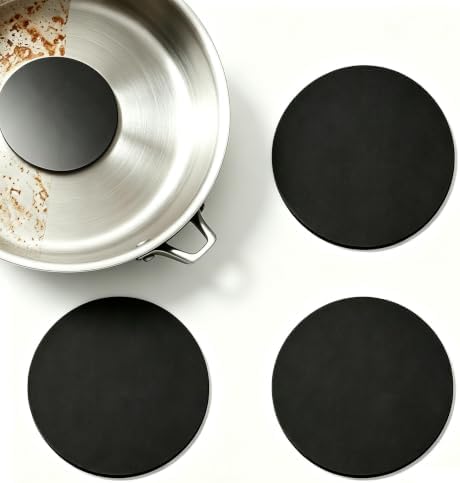
This three-piece set is presented as a reusable steel scrubber for burnt-on food and grease. The flexible material can bend to reach curved areas and corners, which may be useful when cleaning cookware with shaped sides or hard-to-reach edges.
Compared with the mineral discs, this is a metal-based option rather than a stone-and-rubber disc. That makes it a more traditional choice for demanding scrubbing, but it also calls for extra care. The product description says it is intended for stainless steel cookware, sinks, appliances, and grills; it does not provide the same detailed surface-by-surface instructions as the Steelé products. Check your cookware maker’s cleaning guidance and test a hidden spot before scrubbing visible areas.
Pros:
- Three scrubbers are included.
- Flexible design can follow curved surfaces and corners.
- Made for stubborn residue and heavy-duty cleaning tasks.
- Reusable and can be rinsed after use.
Cons:
- Metal scrubbing may be too abrasive for some finishes.
- Its care instructions are less specific than those for the mineral discs.
Verdict: Consider the uwoneg set for flexible, tougher scrubbing on suitable stainless steel, but choose a less abrasive tool if protecting a delicate finish is your main concern.
FENQAROVIX Stainless Steel Scrub Sponges: Best Four-Pack for Tough Messes

This four-pack uses a stainless steel scrubbing material and is sized for substantial cleaning jobs. The description emphasizes burnt residue, grease, and other tough grime, with water as the cleaning liquid. Each scrubber measures about 4.92 inches square, so it offers a larger hand-sized surface than the small Steelé discs.
The larger size may be convenient for broad, sturdy surfaces, but it is not a good match for every pan. The manufacturer specifically warns against using these on nonstick or coated cookware, ceramic, glass stovetops, plastic, acrylic, or other scratch-prone surfaces. As with any metal scrubber, confirm that your stainless cookware can be cleaned this way before use.
Pros:
- Four scrubbers provide spares for separate cleaning jobs.
- Large format suits broad scrubbing areas.
- Designed for burnt food, grease, and heavy-duty cleaning.
- Can be rinsed and reused.
Cons:
- Not intended for many delicate or coated surfaces.
- May be more abrasive than needed for routine washing.
Verdict: This pack makes sense if you need several substantial metal scrubbers for approved surfaces, but it is not the safest all-purpose choice for mixed cookware.
Fuller Brush Stainless Steel Scrubbing Sponges: Best Three-Piece Metal Set

Fuller Brush describes these as flexible scrubbers made from coiled stainless steel, with a set containing three pieces. They are intended for grease, grime, and baked-on food on stainless steel pots and pans, as well as tasks such as cleaning grill racks and sinks.
The coiled construction is designed to make the scrubbers flexible, and the set may suit people who prefer a metal scourer over a mineral disc. The product description says the scrubbers are not too abrasive, but that should not be taken as a guarantee for every pan finish. Follow your cookware’s care instructions, and avoid using any metal scrubber on a surface that can scratch or is coated.
Pros:
- Includes three flexible stainless steel scrubbers.
- Designed for baked-on food, grease, and grime.
- Can also be used on suitable sinks and grill racks.
- Coiled construction is intended to flex during use.
Cons:
- Metal construction may be unsuitable for delicate finishes.
- Does not offer the surface-specific cautions provided for the Steelé discs.
Verdict: Choose Fuller Brush if you want a three-piece metal scourer set for approved heavy-duty jobs, not as a universal scrubber for every pan in your kitchen.
How to Choose a Sponge for Stainless Steel Cookware
Match the scrubber to your pan’s finish
“Stainless steel” does not mean every pan surface can take the same treatment. Read the care instructions for your cookware before using an abrasive tool. Nonstick coatings, enamel, ceramic, glass, and other delicate finishes can be damaged by scrubbers meant for bare stainless steel. When in doubt, use a soft dish sponge and ask the cookware maker for guidance.
Choose the right level of abrasion
For ordinary food residue, start with the least abrasive tool that can do the job. A mineral disc is designed to remove stains with water and light pressure, while a metal scrubber is positioned for tougher cleaning. Stronger abrasion is not always better: it can leave marks if the surface or technique is not a good match.
Consider the shape and size
A full-size disc or broad scrubber covers more area, while a small pre-cut disc can reach around rivets, rolled rims, and corners. If your cookware has tight details, a smaller piece may be easier to control. For large, flat areas, a small disc may take longer to use.
Use the right technique
Follow the product instructions instead of pressing harder to speed up cleaning. For the Steelé mineral discs, wet the disc, use light pressure along the grain, and keep it off hot cookware. Test any abrasive tool on a hidden area first. Rinse reusable scrubbers after use and let them dry as directed.
Think about reuse and storage
All five options are described as reusable, but their shapes and materials differ. The mineral discs can be rinsed and air-dried, and the Steelé products include resealable pouches. The metal scrubbers are also intended for repeated use. Store any scrubber so it can dry between uses, and replace it if it becomes damaged or no longer cleans well.
Frequently Asked Questions
What is the best sponge for stainless steel cookware?
For a flexible option specifically described for stainless steel cookware, the Steelé Mineral Sponge is the most versatile pick in this group. It can bend and be cut to size, but it has strict surface limits and should be used wet with light pressure.
Can I use a metal scrubber on stainless steel pans?
Some metal scrubbers are intended for stainless steel, but suitability depends on the pan’s finish and care instructions. Check the cookware maker’s guidance and test a hidden spot before using a metal scrubber on a visible area.
Can I use these scrubbers on nonstick cookware?
Do not use the Steelé discs or the FENQAROVIX scrubbers on nonstick cookware. The supplied product information also warns against using the Steelé discs on several other coated or delicate surfaces. For any product, follow its instructions and your cookware’s care guidance.
How do I use the Steelé mineral disc?
Use it wet with light pressure along the grain, and never on a hot surface. Test a hidden spot first. The brown side is for cleaning, while the black side is described for buffing.
Are the Steelé mini discs different from the full-size disc?
They use the same mineral-disc concept, but the mini version comes as ten pre-cut two-inch rounds. It is intended for smaller areas such as rims, rivets, corners, and small saucepans, while the full-size disc covers more area and can be cut down as needed.
Can these scrubbers remove rainbow heat tint?
The Steelé product descriptions say the mineral discs can help lift rainbow heat tint from stainless steel with water and light pressure. Results can vary by surface condition and technique, so test an inconspicuous area first and follow the use instructions.
How should I care for a reusable scrubber?
Rinse it after use and let it dry between uses. The Steelé discs are specifically described as air-dry products. Check the instructions for any scrubber you choose, and do not store it while wet in a closed pouch.
Final Recommendation
The Steelé Mineral Sponge is the strongest all-around choice here for people seeking a reusable scrubber with specific stainless steel instructions. Its flexible disc and cut-to-size design make it adaptable, but the surface restrictions matter. Choose the Steelé Mini Pre-Cut Mineral Sponge for detailed areas, or consider a metal scrubber when you need heavier-duty cleaning and your cookware’s care guidance allows it.