
Choosing the best stainless steel meat saw blades comes down to matching the teeth per inch (TPI) and blade length to the food you plan to cut. A coarse blade can move through large bones and frozen blocks quickly, while a finer tooth pattern may suit smaller portions and cleaner cuts. These five options are designed for reciprocating saws and cover a range of blade styles, from single-purpose packs to mixed sets.
Before buying, check that the blade fits your saw and plan to keep the saw and blades dedicated to food use. Stainless steel is rust-resistant, not maintenance-free, so clean and dry blades after use.
Quick Comparison
| Product | Blade Setup | Best For | Notable Feature |
|---|---|---|---|
| RIZAKA 12-Inch 3/8/10 TPI Set | Six 12-inch blades; 3, 8, and 10 TPI | Mixed butchering jobs | Three tooth patterns and a storage case |
| MRCGTCE 12-Inch 8 TPI Blades | Five 12-inch blades; 8 TPI | General-purpose cutting | Simple, uniform blade pack |
| LEILUO 12-Inch 3 TPI Blades | Five 12-inch blades; 3 TPI | Large bones and carcasses | Coarse teeth and a storage case |
| RIZAKA 3-Length 3/6/8 TPI Set | Six blades in 6-, 9-, and 12-inch lengths | Varied cut sizes and tight spaces | Three blade lengths and tooth patterns |
| RIZAKA 3/5/8 TPI Set | Six blades in 9.5- and 12-inch lengths | Frozen meat, bones, and mixed tasks | Coarse, medium, and finer tooth options |
Our Picks: Best Stainless Steel Meat Saw Blades reviews
RIZAKA 12-Inch Blades: Best Variety of Tooth Patterns

This six-blade set gives you three tooth patterns in one consistent 12-inch length: two blades each at 3, 8, and 10 TPI. The listing positions the coarse 3 TPI blades for large bones and thick cuts, the 8 TPI pair for general butchering, and the 10 TPI pair for finer work such as fish or cured ham.
The blades are described as unpainted, food-grade stainless steel, with no coating to chip during cutting. Their 12-inch length offers reach for larger cuts, but it may be more blade than you need for small portions or confined work. The included case helps keep the different tooth patterns organized.
This is the most flexible pick if your cutting tasks vary and you want to switch between blade styles without buying separate packs. Keep in mind that the kit does not include shorter blades, so it is less tailored to tight spaces than the RIZAKA set with multiple lengths.
Pros:
- Three tooth patterns for different kinds of cuts
- All six blades are 12 inches long
- Unpainted stainless steel construction
- Storage case included
Cons:
- No shorter blade for tight or small-scale work
- May offer more tooth-pattern choice than you need for one regular task
Verdict: Choose this set if you want a versatile 12-inch kit for switching between large bones, general butchering, and finer cuts.
MRCGTCE 12-Inch 8 TPI Blades: Best Uniform Pack

This five-pack keeps things simple: every blade is 12 inches long and has an 8 TPI tooth pattern. That makes it a straightforward option if you prefer to keep one blade style on hand for meat, fish, and other food-cutting jobs rather than choosing between several tooth counts.
The listing describes the blades as unpainted stainless steel and identifies them for frozen food, meat, fish, ham, turkey, and bone. It also lists compatibility with major reciprocating saw brands. Check your saw’s manual and blade-shank requirements before use rather than relying on brand name alone.
Because the pack contains only 8 TPI blades, it lacks the coarse teeth that the 3 TPI options in this roundup are designed to provide for large bones. It also does not include a case in the supplied product details. This is a practical pick when a uniform set matters more than having multiple blade styles.
Pros:
- Five matching blades in one pack
- 12-inch length for larger cuts
- Unpainted stainless steel construction
- 8 TPI pattern offers a middle-ground option in this selection
Cons:
- No alternate tooth patterns for different tasks
- No storage case is listed in the supplied details
Verdict: Pick this pack if you want several matching 12-inch blades and do not need a range of tooth patterns.
LEILUO 12-Inch 3 TPI Blades: Best for Coarse Cutting

LEILUO’s five-blade pack focuses on a single coarse tooth pattern: 3 TPI. The product description says the deep gullets are intended to clear cut material while working through large carcasses, bones, and frozen meat. Its 12-inch length is suited to larger cuts where extra reach can be useful.
The blades are described as uncoated stainless steel, and the set includes a reusable plastic case with a hanging hook. The listing also identifies a standard 1/2-inch shank for fitting many reciprocating saws. Confirm compatibility with your specific saw before starting a food-cutting job.
A coarse 3 TPI blade is not the most flexible choice for every task. This pack does not offer a finer tooth pattern for smaller cuts or work where you want a less aggressive blade. Compared with the mixed RIZAKA sets, it makes more sense when coarse cutting is your main need.
Pros:
- Coarse 3 TPI pattern intended for large bones and carcasses
- Five blades in the pack
- 12-inch reach for larger cuts
- Reusable case included
Cons:
- Only one tooth pattern is included
- May be less suited to small or delicate cuts than finer-tooth options
Verdict: Choose LEILUO if your priority is a set of coarse, long blades for larger butchering and frozen-food tasks.
RIZAKA Three-Length Set: Best for Varied Cut Sizes
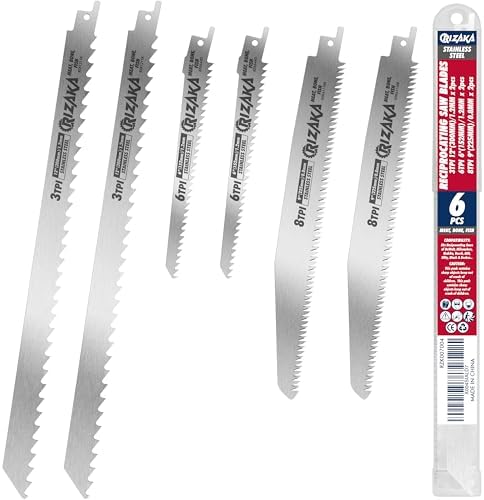
This RIZAKA kit pairs three tooth patterns with three blade lengths: two 12-inch 3 TPI blades, two 9-inch 8 TPI blades, and two 6-inch 6 TPI blades. The listing describes the longest, coarsest pair for large bones and frozen blocks, the 9-inch pair for fish and finer trimming, and the shorter blades for smaller portions and tighter spaces.
The blades are described as rust-resistant, unpainted stainless steel, and the six-piece set comes with a storage case. Having different lengths can be helpful when a full-size blade feels awkward for a smaller cut. As with any reciprocating blade, the best fit depends on both your saw and the space you need to work in.
The trade-off is that you get only two blades of each type, rather than a larger stack of one preferred style. If nearly all your work involves large bones, a pack focused on 3 TPI blades may be a better match. For varied cutting jobs, this is the most adaptable option in the roundup.
Pros:
- Three blade lengths for different work areas and cut sizes
- Three tooth patterns in one kit
- Unpainted stainless steel construction
- Storage case included
Cons:
- Only two blades of each length and tooth pattern
- Not as specialized as a pack devoted to one cutting task
Verdict: This is the strongest fit if your butchering jobs range from large frozen cuts to smaller work in tighter spaces.
RIZAKA 3/5/8 TPI Set: Best for Coarse-to-Finer Options

This six-piece RIZAKA set includes two 12-inch 3 TPI blades, two 9.5-inch 5 TPI blades, and two 9.5-inch 8 TPI blades. That spread gives you a coarse option for larger bones and frozen blocks, plus two shorter patterns for other meat and food-prep tasks.
The listing describes the blades as food-grade stainless steel and includes a storage case. It also lists compatibility with major reciprocating saw brands. As with the other multi-pattern kits, confirm the shank and operating instructions for your saw before use.
This set sits between the single-pattern packs and the RIZAKA kit with three different lengths. It gives you a wider range of tooth counts than the 3/5/8 TPI kit’s lengths might suggest, but it has no 6-inch blade for especially tight spaces. If you want tooth variety but do not need three blade lengths, it is a useful middle ground.
Pros:
- Three tooth patterns for different cutting needs
- Two blade lengths in the set
- Includes a storage case
- Designed for frozen meat, bone, and other listed food-cutting tasks
Cons:
- No short 6-inch blade for tight spaces
- Only two blades of each tooth pattern
Verdict: Choose this set if you want several tooth counts and a coarse 12-inch option without needing three separate blade lengths.
How to Choose Stainless Steel Meat Saw Blades
Match the TPI to the Cut
TPI means teeth per inch. In this group, 3 TPI is the coarsest option and is described for large bones and thick or frozen cuts. Higher counts, such as 8 or 10 TPI, offer more teeth along the blade and are positioned for general butchering or finer work. Choose based on the foods and cuts you handle most often, and consider a mixed set if your tasks vary.
Pick a Blade Length That Fits Your Work
A 12-inch blade offers reach for larger cuts, but a shorter blade may be easier to manage in a tight area. The products here range from 6 to 12 inches. If you want one length for larger jobs, a single-length pack may suit you; for varied cuts and spaces, look for a kit with more than one length.
Check Your Saw’s Compatibility
These products are made for reciprocating saws, and several listings describe a universal fit or compatibility with major brands. Still, check your saw’s manual and the blade’s shank details before ordering. A brand name alone does not confirm that a particular blade will fit or work as intended with your tool.
Look for Unpainted Stainless Steel
All five options are described as stainless steel, and several specify unpainted or uncoated blades. A blade without a coating avoids the concern of paint chipping during cutting. Stainless steel can resist rust, but it should still be cleaned and dried after use rather than left wet or stored dirty.
Consider How Many Blades You Need
A pack with one tooth pattern can be a sensible choice if you have a consistent task and want matching replacements. Mixed sets offer more flexibility, but you may have fewer blades of each type. Think about whether you value a larger supply of one blade style, a choice of tooth patterns, or different lengths.
Plan for Food-Safe Use and Storage
Use a reciprocating saw and blades that are kept for food processing, not ones that have also been used on wood or other materials. Follow the tool and blade care instructions, and clean and dry the blades after use. A case can help keep sharp teeth protected and organized between jobs.
Frequently Asked Questions
What TPI is best for cutting meat and bone?
It depends on the cut. The product descriptions generally position 3 TPI for large bones and thick or frozen cuts, while 8 and 10 TPI options are intended for more general or finer work. A mixed set is useful if you expect to handle several kinds of food.
Are these blades made for reciprocating saws?
Yes. The listed products are reciprocating saw blades. Check the shank details and your saw’s manual to confirm compatibility before use.
Are stainless steel meat blades rustproof?
No. Stainless steel is rust-resistant, but that does not mean it cannot stain or corrode. Clean and dry the blade after use, then store it in a dry place.
Should I use the same saw for food and construction work?
For food hygiene, keep the saw and blades dedicated to food cutting. Do not use a blade for food if it has also been used on wood or other non-food materials.
Is a longer blade always better?
No. A 12-inch blade can provide reach for larger cuts, while shorter blades may be easier to handle in tight spaces. Choose a length that suits your work area and the size of the cuts you make.
Which set is best if I want several blade lengths?
The RIZAKA 3/6/8 TPI set includes 6-, 9-, and 12-inch blades. It is the clearest choice here if having different blade lengths is your main priority.
Final Recommendation
For the widest mix of blade lengths and tooth patterns, the RIZAKA 3/6/8 TPI set is the most adaptable choice in this group. If you prefer a single length with several tooth styles, consider the RIZAKA 12-inch 3/8/10 TPI set. For a focused pack, choose the LEILUO 3 TPI blades for coarse cutting or the MRCGTCE 8 TPI blades for a uniform set. Match the blade to your task, confirm saw compatibility, and keep your food-cutting equipment clean and separate from general-purpose tools.