
Spin comes from more than a high-grip rubber: blade feel, sponge, control, and your technique all affect how much rotation you can put on the ball. The best table tennis racket for spin should help you brush the ball cleanly while still giving you enough control to place serves, returns, and topspin shots. These five paddles take different approaches, from tacky rubber for controlled spin to carbon construction built for a livelier response.
Quick Comparison
| Racket | Best for | Notable features | Style |
|---|---|---|---|
| Idoraz Professional Ping Pong Paddle | Spin and speed in one paddle | ITTF-approved 2.0 mm rubber; tacky surface | Fast, balanced play |
| AirBlades The Peace Maker ALC | Topspin with a responsive feel | Seven-ply blade; ALC carbon; 2.1 mm sponge | Powerful, competition-focused |
| EastPoint 5.0 Professional Paddle | Spin and precise placement | Tack rubber; ultra-sponge backing; seven-ply blade | Firm, aggressive play |
| STIGA Cybershape Eclipse | Competitive play and consistent contact | Five-ply blade; 2.0 mm sponge; Cybershape design | Quick, controlled offense |
| Killerspin Jet 600 Spin N2 | Intermediate players building spin | Five-ply wood blade; Nitrx-4Z rubbers | Balanced attack and control |
Our Picks: Best Table Tennis Racket For Spin reviews
Idoraz Professional Paddle: Tacky Rubber for Spin and Pace

The Idoraz is a well-rounded option for players who want a ready-to-play paddle with spin-focused rubber. Its description lists ITTF-approved 2.0 mm rubber and a tacky surface, both aimed at helping you grip and brush the ball. The manufacturer also lists speed, spin, and control ratings, though it does not explain the rating scale, so treat those numbers as product specifications rather than direct comparisons with other paddles.
The paddle is designed to combine quick shots with a stable feel, rather than focusing only on slow, high-rotation play. That balance can be useful if you want to serve with spin and then follow up with a faster drive. A soft sponge-grip handle is intended to add comfort and control, and the included carrying case gives you a way to store and transport the paddle.
This is a practical pick for players moving beyond a basic recreational paddle who want spin-friendly rubber without choosing a highly specialized setup. Its stated speed may be less appealing if your main goal is a forgiving, slower paddle for learning control. The description also provides limited detail about the blade construction, which makes it harder to assess the paddle’s feel against models with specified ply designs.
Pros:
- Tacky rubber is designed to help generate spin.
- 2.0 mm sponge aims to balance pace and touch.
- Includes a carrying case.
- Offers a stated 30-day return guarantee from the brand.
Cons:
- The manufacturer does not explain the scale behind its speed, spin, and control ratings.
- Blade construction details are not provided.
Verdict: Choose the Idoraz if you want tacky, spin-oriented rubber in a fast, balanced paddle and value an included case.
AirBlades The Peace Maker ALC: Carbon Construction for Topspin

The Peace Maker ALC is built around a seven-ply blade: a Paulownia wood core, Ayous layers, Limba outer layers, and two ALC carbon layers. AirBlades describes this blend as offering responsiveness and a softer feel for control and topspin. Its 2.1 mm high-elasticity sponge is intended to support a lively response when you attack the ball.
Spin is only useful when you can direct it, so the paddle’s ergonomic curved handle is a notable part of its design. The shape is intended to sit comfortably in the hand and support blocks, returns, drives, and smashes. It comes with a protective hard case, and the brand states that it offers a lifetime workmanship warranty.
This model is aimed at a broad range of players, but its carbon construction and emphasis on power may suit an attacking player best. If you are still learning to control the paddle angle or keep the ball on the table, a more restrained option may be easier to manage. The description gives no numerical speed or spin rating, so compare it by its materials and intended playing feel rather than by a rating scale.
Pros:
- Seven-ply construction combines wood and ALC carbon layers.
- 2.1 mm sponge is designed for a responsive, spin-friendly feel.
- Curved ergonomic handle is intended to support a secure grip.
- Includes a hard case and a stated lifetime workmanship warranty.
Cons:
- Its power-oriented design may take practice to control for newer players.
- The provided description does not include numerical spin or speed ratings.
Verdict: The Peace Maker ALC is a strong match for players who want a carbon-and-wood blade with a focus on topspin, responsiveness, and a protective case.
EastPoint 5.0: Tack Rubber for Aggressive Spin and Placement

The EastPoint 5.0 pairs spin-and-control tack rubber with ultra-sponge backing. Its seven-ply blade is described as having a firmer response for quick, aggressive play. That combination is designed for players who want to add rotation to attacking shots while still aiming for precise placement.
The flared concave handle is intended to provide a secure hold and is described as suitable for shakehand and penhold grips. That makes the paddle a flexible option if you are shopping for different playing styles or want one paddle for a household with more than one player. The product is positioned for both casual and competitive games.
Compared with the Idoraz, EastPoint emphasizes a seven-ply blade and aggressive response, but it does not provide thickness or numerical speed and spin ratings in the supplied details. That makes direct performance comparisons difficult. Players who prefer a softer, more controlled feel may also want to consider whether a firm response suits their stroke and experience level.
Pros:
- Tack rubber and sponge backing are designed for spin and control.
- Seven-ply blade is built for a firmer, attacking response.
- Handle design accommodates shakehand and penhold grips.
- Suitable for casual play as well as more competitive games.
Cons:
- The description does not state sponge thickness or numerical performance ratings.
- Its firm, aggressive feel may not be the first choice for players seeking a slower setup.
Verdict: Consider the EastPoint 5.0 if you want tacky rubber, a firm seven-ply blade, and a handle designed for more than one grip style.
STIGA Cybershape Eclipse: An Unusual Blade for Precise Attacks

The Cybershape Eclipse stands out for its hexagon-shaped blade, which STIGA says creates a larger hitting area than a standard paddle. The design is intended to help with contact consistency and ball placement. Its five-ply blade and 2.0 mm sponge aim to balance fast returns with controlled touch.
STIGA also lists its WRB weight-balance system, which is designed to support faster swings and blade recovery. The rubber is described as ITTF-approved and uses ACS and Nano technologies. These features make the Eclipse a competition-focused option for players who want a quick paddle that can still support spin and controlled shots.
The distinct blade shape is not the conventional choice, so it may appeal most to players who are open to adapting to a different paddle profile. The product description does not provide a numerical spin rating or detailed guidance on how the shape feels in different grips. It is also a more specialized design than the straightforward wood-blade options in this group.
Pros:
- Distinctive blade shape is designed to provide a larger hitting area.
- 2.0 mm sponge aims to balance speed and touch.
- WRB system is designed for quicker recovery and ball sensitivity.
- ITTF-approved rubber is positioned for competition use.
Cons:
- The unusual blade shape may not suit players who prefer a traditional paddle profile.
- The supplied details do not include a numerical spin rating.
Verdict: Pick the STIGA Cybershape Eclipse if you want a competition-oriented paddle with a distinctive blade shape and features aimed at quick, precise play.
Killerspin Jet 600 Spin N2: A Balanced Step Up for Spin
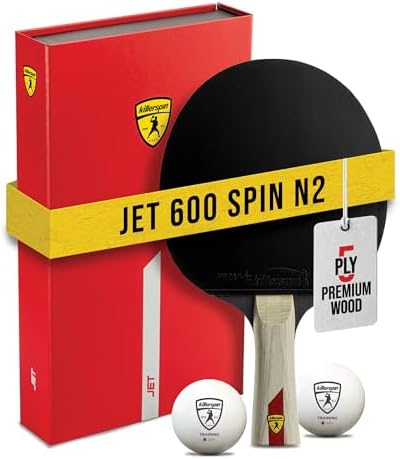
The Jet 600 Spin N2 is built around a five-ply wood blade and Nitrx-4Z high-grip rubbers. Killerspin positions it as a tournament-level paddle for intermediate and advanced players who want a mix of spin, speed, and control. Its stated performance ratings favor spin while keeping speed and control in the mix, making this a more balanced choice than a paddle focused only on maximum pace.
The flared handle is designed for a secure, comfortable grip, and the package includes a memory-book-style case and two training balls. Those accessories make it convenient to store or give as a gift. The paddle’s wood construction also makes it a straightforward alternative to the carbon-layer design of the AirBlades model.
Its balanced profile may work well if you want to build spin without giving up attacking options. However, the product is aimed at players with some experience, and its stated control rating is not as high as its spin rating. Beginners who mainly need help keeping shots on the table may prefer a more control-first paddle. The description does not specify rubber thickness.
Pros:
- High-grip Nitrx-4Z rubbers are intended to support spin and precision.
- Five-ply wood blade balances power and touch.
- Flared handle is designed for a secure grip.
- Includes a storage case and two training balls.
Cons:
- Designed for intermediate to advanced players rather than a control-first beginner setup.
- Rubber thickness is not stated in the supplied details.
Verdict: The Jet 600 Spin N2 is a sensible upgrade for an intermediate player who wants high-grip rubber and a balanced wood-blade feel.
How to Choose a Table Tennis Racket for Spin
Look for rubber that matches your stroke
Spin depends on how well the rubber grips the ball as you brush it. Tacky and high-grip surfaces are common choices for players who want to create more rotation, but a grippy surface alone will not do the work for you. Your stroke, timing, and contact angle matter too. The Idoraz and EastPoint descriptions specifically call out tacky rubber, while Killerspin highlights its high-grip Nitrx-4Z rubbers.
Balance spin with control
A fast paddle can make attacking shots feel more direct, but it can also be harder to manage when you are still developing your touch. Consider how often you use serves, pushes, blocks, and controlled topspin compared with hard drives. If placement and consistency matter most, favor a balanced setup. If you already control your shots well, a more responsive or power-focused paddle may suit your game.
Compare sponge thickness carefully
Sponge thickness can affect how a paddle responds at contact, but numbers alone do not tell the whole story. The options here list 2.0 mm sponge for Idoraz and STIGA, and 2.1 mm for AirBlades. EastPoint and Killerspin do not state a thickness in the supplied product details. Use thickness as one comparison point, not a guarantee of how much spin you will produce.
Choose a blade feel you can handle
Blade construction shapes the paddle’s feel and response. A wood blade may appeal if you prefer a more traditional setup, while the AirBlades model combines wood with ALC carbon layers. The STIGA has a five-ply blade and a distinctive hexagon shape. If you have a chance to try different paddle styles, pay attention to how easily you can control returns and place the ball—not just how fast a hard shot feels.
Make sure the handle suits your grip
A secure handle helps you swing naturally and adjust your racket angle. EastPoint describes its flared concave handle as suitable for shakehand and penhold grips, and the AirBlades handle has a curved ergonomic design. Handle comfort is personal, so consider your grip style and how the paddle feels in your hand before choosing based on performance features alone.
Check what comes with the paddle
A case can help protect the rubber and make the paddle easier to carry. Idoraz and AirBlades include cases, and Killerspin includes a storage case plus two training balls. Also compare the details that are missing: some product descriptions do not state rubber thickness, blade weight, or a measurable spin scale. When those details matter to you, check the product listing before buying.
Frequently Asked Questions
What makes a table tennis racket good for spin?
Spin-friendly rubber that grips the ball is a key feature, but your technique matters just as much. A paddle should also give you enough control to direct the ball, especially when serving, returning, and placing topspin shots.
Is tacky rubber always the best choice for spin?
Not for every player. Tacky rubber is designed to grip the ball, which can help with spin, but the best feel depends on your stroke and comfort. A highly responsive setup may be difficult to control if you are still learning basic timing and placement.
Which paddle in this list has the clearest spin-focused design?
Idoraz and EastPoint both specifically describe tacky rubber for spin. Killerspin also highlights high-grip rubber. Their other features differ, so compare blade construction, handle design, and stated performance style before choosing.
Is a carbon-fiber paddle better for spin than a wood paddle?
Not automatically. The AirBlades combines wood layers with ALC carbon and is designed for responsiveness and topspin, while the wood-blade options focus on their own mixes of speed, control, and grip. The best choice depends on the feel and response you can use consistently.
Can a beginner use these paddles?
Some are described as suitable for players at different levels, while others are aimed more at intermediate or advanced play. A beginner should put control and comfort first. A paddle with a fast or aggressive feel may require more practice to keep shots consistent.
Does an ITTF-approved paddle guarantee more spin?
No. ITTF approval indicates that the listed rubber is approved for competition use, but it does not guarantee a certain amount of spin. Rubber grip, paddle feel, and your technique all affect the result.
Which racket is the best all-around choice for spin?
The Idoraz is a strong all-around option if you want tacky rubber, a 2.0 mm sponge, and a balance of speed and control. For a more advanced, carbon-layer build, consider the AirBlades; for a wood-blade option with high-grip rubber, compare the Killerspin Jet 600 Spin N2.
Final Recommendation
For a balanced, spin-focused paddle, the Idoraz Professional Ping Pong Paddle stands out for its tacky ITTF-approved rubber, stated 2.0 mm thickness, and included case. Players seeking a more responsive carbon-and-wood construction should look at the AirBlades The Peace Maker ALC, while the Killerspin Jet 600 Spin N2 offers a wood-blade alternative with high-grip rubber and a spin-forward profile. Choose the paddle that fits your experience and control needs, since equipment can support spin but cannot replace sound technique.