
Choosing the best travel adapter for South Africa starts with matching the outlet: these picks use a Type M plug, with three large round pins. The right choice depends on whether you need a simple compact adapter or several outlets and USB ports for a group of devices. Keep in mind that a plug adapter changes the plug shape, not the voltage. Check each device’s power label before you travel, especially for hair dryers and styling tools.
Quick Comparison
| Product | Best for | Connections | Key note |
|---|---|---|---|
| TESSAN Type M Adapter, 2-Pack | Charging several devices | 4 AC outlets, 3 USB ports | Two adapters; USB-C output is listed as 15W in the description |
| Ceptics Compact Type M Adapter | Light packing and basic plug conversion | Two North American plug inputs | Small, grounded design; no USB ports |
| OREI Type M Adapter, 3-Pack | Travelers who need several adapters | Two US inputs per adapter | Compact three-pack; no USB ports |
| TESSAN Type M Adapter with 2 USB-C Ports | Sharing outlets and USB-C charging | 4 AC outlets, 2 USB-C, 1 USB-A | Seven connections; no surge protection |
| Ceptics Type M Adapter with QC 3.0 and PD | USB fast charging in a compact adapter | 2 AC inputs, 1 USB-A, 1 USB-C | USB charging supports up to 18W when used individually |
Our Picks: Best Travel Adapter For South Africa reviews
1. TESSAN Type M Adapter: Best for Charging Several Devices

This TESSAN adapter is designed for travelers who want to connect several devices at one Type M wall outlet. Each adapter has four AC outlets and three USB ports, including one USB-C port. The four-sided layout is intended to help keep plugs from crowding one another, and the two-pack gives you an extra adapter for another room or travel companion.
There is a small specification detail to check before buying: the product title refers to PD 20W, while the supplied description lists the USB-C output as 15W maximum. Treat the detailed output information as the safer guide, and check the product listing for the current specification if USB-C charging speed matters to you. The adapter does not provide surge protection.
This is a useful choice for a hotel room where several phones, chargers, or other small devices need power at once. It is not a voltage converter, so appliances must support the voltage used at your destination. If an appliance label says only 110V or 125V, this adapter alone is not suitable.
Pros:
- Four AC outlets and three USB ports on each adapter
- Two adapters are included for sharing or backup
- Four-sided design can help reduce plug crowding
- Compact, cord-free format is easy to pack
Cons:
- No surge protection
- USB-C output is described as 15W maximum despite the 20W wording in the title
Verdict: Choose this two-pack if you want to power multiple devices from a Type M outlet and do not need surge protection or voltage conversion.
2. Ceptics Compact Type M Adapter: Best for Simple, Lightweight Packing
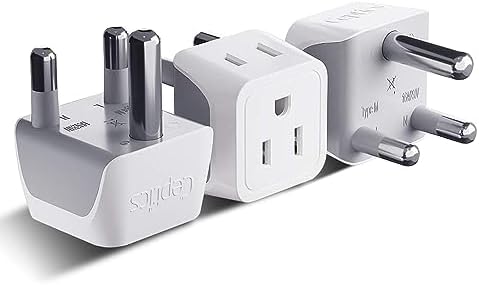
The Ceptics adapter keeps things simple: it converts a Type M wall outlet to accept North American two- or three-prong plugs. Its compact body measures 1.5 by 1.5 by 1.75 inches, according to the supplied product information, and it has a grounded design. Unlike the multi-port models in this list, it has no USB ports or collection of extra AC outlets.
That straightforward format may suit you if you already carry a USB charger or only need to connect one or two compatible devices. The adapter accepts two North American plugs, including polarized plugs. Its stated maximum load rating is 10–15A at 250V; follow the product’s instructions and the requirements of the device you connect.
The main trade-off is convenience: you will need separate chargers for USB devices, and the adapter does not convert voltage. The product includes a limited lifetime warranty, as described in the supplied listing information. Compared with the TESSAN and OREI multi-packs, this is a smaller, more focused option rather than a charging hub.
Pros:
- Compact dimensions suit travelers trying to save bag space
- Accepts North American two- and three-prong plugs
- Grounded design
- Limited lifetime warranty is listed by the manufacturer
Cons:
- No USB charging ports
- Does not convert voltage
Verdict: Pick this Ceptics model if you want a small Type M adapter for compatible US plugs and do not need built-in USB charging.
3. OREI Type M Adapter: Best Value for a Three-Adapter Kit
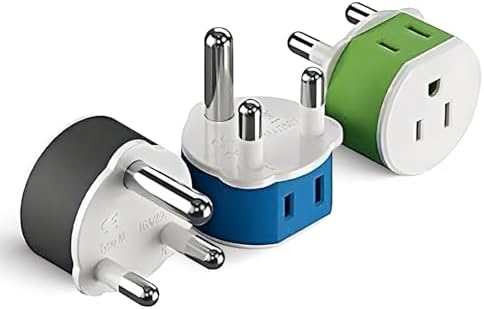
The OREI set includes three Type M adapters, each with two North American inputs. One input accepts a US two- or three-prong plug, while the other is for a two-prong plug. The small adapter measures about 2.2 by 1.75 by 1.75 inches, based on the supplied product description.
A three-pack can be practical if you are traveling with family, need adapters in more than one room, or want to keep one in a spare bag. Each adapter has a stated maximum load rating of 10A at 250V. The product information also identifies the adapters as CE approved and RoHS compliant.
This set does not have USB ports, and it will not convert voltage. You will need to bring your own charging bricks for phones and other USB devices. Compared with the Ceptics single adapter, OREI gives you more units; compared with the TESSAN models, it offers fewer built-in charging options on each unit.
Pros:
- Three adapters included in the set
- Two US plug inputs on each adapter
- Compact design is easy to pack
- Listed with a limited lifetime warranty
Cons:
- No USB ports
- Does not convert voltage
Verdict: Choose the OREI set if you need several basic Type M adapters and are comfortable using separate USB chargers.
4. TESSAN Type M Adapter with Two USB-C Ports: Best for Shared Charging

This TESSAN adapter combines four AC outlets with two USB-C ports and one USB-A port. Its seven connections can help when several travelers need to charge devices at the same time. The product description lists a maximum of 2,500W for the AC outlets, a maximum of 15W for USB-C, and up to 2.4A for USB-A.
The four-sided layout is designed to make room for plugs on different faces, which can be helpful when several chargers are connected. The adapter measures 3.39 by 2.36 by 2.68 inches and weighs 4.84 ounces, according to the supplied specifications. It has no surge protection, so it is not the right pick if surge protection is a requirement for your setup.
Its two USB-C ports may be more convenient than a model with only one, especially when you and a travel companion use USB-C devices. Still, the listed 15W maximum is modest compared with some dedicated charging equipment. As with the other adapters here, it changes plug shape only; check device voltage support before connecting appliances.
Pros:
- Four AC outlets, two USB-C ports, and one USB-A port
- Can connect up to seven devices at once, within its stated limits
- Four-sided design helps separate plugs
- USB-C ports provide a convenient way to charge compatible devices
Cons:
- No surge protection
- USB-C output is listed at a maximum of 15W
Verdict: This is a strong fit for a shared hotel-room charging setup if you want two USB-C ports and understand that the adapter does not convert voltage or provide surge protection.
5. Ceptics Type M Adapter with QC 3.0 and PD: Best for Compact USB Fast Charging

This Ceptics model pairs a Type M plug with two US AC inputs, one USB-A port, and one USB-C port. The supplied description says the USB-A and USB-C ports support Quick Charge 3.0 and Power Delivery when used individually, with up to 18W of USB output. It is listed as a two-pack, so you can keep a second adapter as a spare or use it in another room.
The adapter measures 1.18 by 1.78 by 2.89 inches, according to the product information. Its mix of AC and USB connections is useful if you want to charge a phone or tablet while also plugging in another compatible device. The description notes a total maximum of 3.1A for the USB ports and says the fast-charging features apply when the ports are used individually.
Despite the fast-charging features, this is not a voltage converter. The listing specifically warns against using it with 110V-only devices such as some hair tools and clippers. Its USB output is also not a replacement for a high-power laptop charger. Compared with the TESSAN multi-outlet adapters, this Ceptics option is smaller and offers fewer total connections, but includes stated QC 3.0 and PD charging support.
Pros:
- Two AC inputs plus USB-A and USB-C charging
- QC 3.0 and PD support when the USB ports are used individually
- Compact design and two adapters included
- Two-year replacement support is listed by the manufacturer
Cons:
- USB output is limited to a stated maximum of 18W
- Does not convert voltage for 110V-only devices
Verdict: Choose this two-pack if compact size and USB fast-charging support matter more to you than having a large number of outlets.
How to Choose a Travel Adapter for South Africa
Match the adapter to a Type M outlet
South Africa commonly uses Type M outlets, which have three large round pins. The adapters in this guide are designed for Type M outlets. Check the plug type required for each stop on your trip, especially if you will visit more than one country, and do not assume that a general-purpose adapter will fit every outlet.
Check voltage support before packing appliances
A travel adapter changes the shape of the plug; it does not change the electrical voltage. Read the label on each device or charger. If it states a range such as 100–240V, it is designed to work across that range with the correct plug adapter. If it is marked only for 110V or 125V, do not connect it through one of these adapters without a suitable voltage converter. Hair dryers, straighteners, and curling irons deserve special attention.
Choose the number and type of connections you need
For one or two basic plugs, a compact adapter such as the Ceptics model may be enough. If you have several USB devices, look at models with built-in USB-A or USB-C ports. For a group or a room with many devices, an adapter with multiple AC outlets can reduce the need to pack separate adapters. Check the USB output details, since port count alone does not tell you how quickly a device will charge.
Consider grounding and device requirements
If your device has a three-prong plug, choose an adapter that accepts a grounded North American plug and follow its load limits. Not every adapter accepts every plug shape, and a two-prong-only input is not a substitute for a grounded connection. Confirm that the adapter and your device are suitable for the equipment you plan to use.
Decide whether you need one adapter or a set
A single compact adapter can be easier to pack if you travel alone and have few devices. Two- or three-packs make sense for travel companions, multiple rooms, or a spare. Remember that extra adapters do not increase the capacity of a wall outlet; stay within each product’s stated limits and avoid connecting more equipment than it is designed to handle.
Check for protection features and output limits
Some adapters in this guide explicitly state that they do not have surge protection. If surge protection matters for your equipment, do not assume it is included just because an adapter has several outlets. Also check the stated maximum load and USB output, and use a separate charger when you need more power than the adapter’s USB ports provide.
Frequently Asked Questions
What plug type do I need for South Africa?
These products are Type M travel adapters, designed for outlets that accept the Type M plug. Confirm the outlet type for your exact destination and accommodation before you leave.
Will a travel adapter convert voltage?
No. The products listed here change the plug shape but do not convert voltage. Check the input range printed on each device. If a device is not compatible with the local supply, you may need a separate voltage converter or a different device.
Can I use a US hair dryer with one of these adapters?
Only if the hair dryer supports the voltage at your destination. If its label says only 110V or 125V, a plug adapter alone is not enough. Check the dryer’s label and instructions before use.
Which adapter is best for charging several devices?
The TESSAN models offer the most built-in connections in this guide. One has four AC outlets and three USB ports; the other has four AC outlets, two USB-C ports, and one USB-A port. Compare their USB output details and choose the port mix that fits your devices.
Are USB-C ports on a travel adapter suitable for a laptop?
Do not assume so. The USB-C outputs listed here are limited to 15W or 18W, depending on the model, which may not meet a laptop’s charging needs. Check your laptop’s required input and use its compatible charger if needed.
Do these adapters have surge protection?
The TESSAN models in this guide are described as having no surge protection. The supplied details for the other models do not establish that surge protection is included, so check each product’s specifications rather than relying on the adapter’s appearance or number of outlets.
Can I use one adapter in every country?
No. Plug types vary by country, and a Type M adapter is not a universal adapter. Check the required plug type for each place on your itinerary and bring the correct adapter for those outlets.
Final Recommendation
For most travelers who want to charge several devices, the TESSAN Type M two-pack with four AC outlets and three USB ports is a practical starting point. If you need two USB-C ports, consider the other TESSAN model, while the Ceptics compact adapter suits travelers who prefer a simple, small plug converter. Whichever you choose, verify voltage compatibility and load limits before connecting your devices.