
Uranium glass is easiest to spot when it fluoresces under ultraviolet light. For most collectors, a 365nm flashlight is a strong place to start: its beam is less visibly purple than a 395nm light, which can make the glass’s glow easier to see. A filtered 365nm model can further reduce visible violet light. Our top pick is a rechargeable dual-wavelength flashlight, while the other options offer a filtered beam, a two-pack, or the convenience of replaceable batteries.
Quick Comparison
| Product | Wavelengths | Power | Best for |
|---|---|---|---|
| DARKBEAM Dual-Wavelength Rechargeable UV Flashlight | 365nm and 395nm | Rechargeable | Versatility and longer listed runtime |
| DARKBEAM Filtered UV Flashlight 2-Pack | 365nm and 395nm | Rechargeable | Keeping a spare or sharing a set |
| HSXMN Dual-Wavelength UV Flashlight | 365nm and 395nm | AAA batteries | Trips where you want replaceable batteries |
| DARKBEAM Filtered 365nm Mini UV Flashlight | Filtered 365nm | Rechargeable | Compact, single-wavelength use |
| DARKBEAM Filtered 365nm UV Flashlight with Pocket Clip | Filtered 365nm | Rechargeable | Portable collecting and inspection |
Our Picks: Best Uv Light For Uranium Glass reviews
Best Overall: DARKBEAM Dual-Wavelength Rechargeable UV Flashlight

This DARKBEAM flashlight combines 365nm and 395nm light, with separate switches for selecting either wavelength or using both. For uranium glass, start with 365nm; the 395nm mode gives you another option for other fluorescent materials and general blacklight tasks.
The flashlight has an aluminum-alloy body, an adjustable focus, and a built-in rechargeable battery. DARKBEAM lists a runtime of up to 13–15 hours and a full charge time of 5–7 hours. Those figures make it a practical pick if you want one light for a collection and other household or hobby uses, though actual runtime can vary with use.
Compared with the single-wavelength options below, this model is more flexible but also has more controls and a larger flashlight-style design. Its 365nm beam is not meant to look bright to your eyes, so judge it by how objects fluoresce rather than by the visible brightness of the beam. Avoid looking directly into the light.
- Pros:
- Offers 365nm, 395nm, and dual-light modes.
- Rechargeable, with a listed runtime longer than the mini models.
- Adjustable focus and a power-level display.
- Aluminum-alloy body and IPX4 water resistance listed.
- Cons:
- The larger feature set may be more than you need for checking glass alone.
- Charging takes several hours according to the listed specifications.
Verdict: Choose this model if you want a rechargeable 365nm light for uranium glass and value the option to switch to 395nm for other tasks.
Best Two-Pack: DARKBEAM Filtered UV Flashlight Set

This set is listed as a two-pack of compact DARKBEAM flashlights. The product description highlights a filtered 365nm light, which reduces visible violet light from the beam and can help keep the light on the object being inspected. That can be useful when you want to see fluorescence without as much purple spill.
The lights are rechargeable by USB-C and have aluminum-alloy bodies. The listing gives a runtime of about one hour and a charging time of about one hour, so plan to recharge between longer outings. The product title and description refer to both 365nm and 395nm, but check the current listing details to confirm the controls and modes included in the set before ordering.
Two compact lights can be handy if you want a spare or plan to keep one in another location. The trade-off is shorter listed runtime than the larger dual-light pick, and this set may be unnecessary if you only need one flashlight for occasional checks.
- Pros:
- Two flashlights in the listed set.
- Filtered 365nm light helps reduce visible violet spill.
- Compact aluminum-alloy design.
- USB-C rechargeable.
- Cons:
- Listed runtime is about one hour per charge.
- More light output options may be unnecessary for a uranium-glass-only collection.
Verdict: Pick this set if you want two compact lights and prefer the added flexibility of a filtered 365nm option.
Best for Replaceable Batteries: HSXMN Dual-Wavelength UV Flashlight

The HSXMN combines 365nm and 395nm light in one handheld flashlight. Its half-press tail switch changes wavelengths, while a full press turns the light on or off. The adjustable focus can move between a wider beam and a narrower spot, giving you some flexibility when inspecting glass at different distances.
Unlike the rechargeable options in this guide, this model runs on AAA batteries, which are not included. That means you can swap in fresh batteries instead of waiting for a recharge, but you will need to keep batteries on hand. The aluminum-alloy body and IPX4 water resistance are listed features for use in damp outdoor conditions.
For uranium glass, use the 365nm setting first. The 395nm setting produces a more visible purple beam and may suit other blacklight tasks. This is a sensible choice for collectors who prefer replaceable batteries, but it does not have a built-in rechargeable battery.
- Pros:
- Includes both 365nm and 395nm modes.
- Uses replaceable AAA batteries rather than requiring a recharge.
- Half-press switching and adjustable focus are straightforward features.
- Aluminum-alloy body and IPX4 water resistance are listed.
- Cons:
- AAA batteries are not included.
- Does not offer USB charging.
Verdict: Choose the HSXMN if you want two wavelengths and the ability to replace batteries in the field or at home.
Best Compact Filtered Pick: DARKBEAM Mini 365nm UV Flashlight
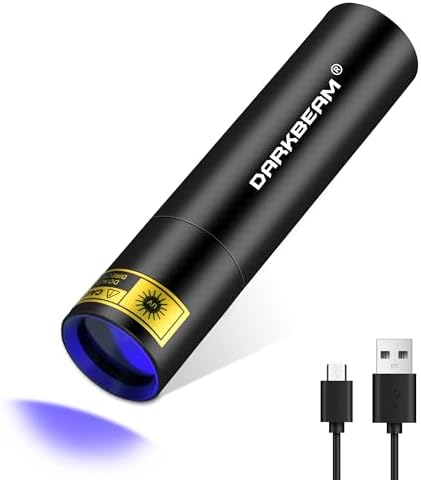
This small DARKBEAM flashlight focuses on one wavelength: filtered 365nm UV. Its optical filter is designed to reduce visible purple light, a useful feature when you want to inspect fluorescence without as much distracting color from the flashlight itself.
The model has a rechargeable battery, USB-C charging, and an aluminum-alloy body. DARKBEAM lists about one hour of runtime and about one hour to charge. It is designed as a compact everyday light, but its single-wavelength setup is less versatile than the dual-mode options in this list.
Because it does not include a 395nm setting, this is a more focused choice for collectors who mainly want to inspect glass and other materials under 365nm light. If you need broader coverage for different blacklight tasks, consider a dual-wavelength model instead.
- Pros:
- Filtered 365nm beam reduces visible violet light.
- Small, pocket-friendly design.
- Rechargeable by USB-C.
- Aluminum-alloy body.
- Cons:
- Only offers 365nm light.
- Listed runtime is about one hour.
Verdict: This is a good fit if your priority is a compact, filtered 365nm flashlight rather than a multi-purpose UV light.
Best Pocket Clip: DARKBEAM Filtered 365nm Flashlight

This DARKBEAM model is another single-wavelength option, with a filtered 365nm LED and a pocket clip. The filter is intended to reduce visible violet light, which can make it easier to focus on fluorescence from glass and other materials. It is compact enough to carry in a pocket, bag, or toolbox.
The flashlight recharges by USB-C and has a power indicator: the product description says red means it needs charging and green means it is fully charged. The listed runtime is about one hour. As with the other 365nm choices, the beam may appear dim to your eyes; that is not a reliable measure of how well the light will reveal fluorescence.
This model is similar in purpose to the DARKBEAM mini above. The pocket clip is the clearest practical difference in the supplied details, while neither model offers a 395nm mode. Choose between them based on which design and listing details suit how you plan to carry and use the light.
- Pros:
- Filtered 365nm light helps limit visible violet spill.
- Pocket clip supports convenient carry.
- USB-C rechargeable, with a charge-status indicator.
- Compact aluminum-alloy construction.
- Cons:
- Does not include a 395nm mode.
- Listed runtime is about one hour.
Verdict: Choose this flashlight if you want filtered 365nm light in a compact design with a pocket clip.
How to Choose a UV Light for Uranium Glass
Start with the wavelength
For uranium glass, 365nm is a practical starting point. A 395nm flashlight produces more visible purple light, while a 365nm beam is less visible to your eyes. Some collectors prefer 365nm because it can make fluorescence easier to distinguish from the flashlight’s own visible light. Results can vary with the glass, the lighting around you, and the particular flashlight.
Consider a filter
A filtered 365nm flashlight is designed to reduce visible violet light in the beam. That can help you focus on the glass’s glow, especially in a dim room. A filter does not guarantee that every piece will fluoresce strongly, and a filtered light is not automatically the best match for every other blacklight task.
Decide whether you need one or two wavelengths
If you mainly inspect uranium glass, a single-wavelength 365nm model may be enough. A dual-wavelength light adds a 395nm setting for other uses, but it can mean more controls and a less focused feature set. Think about whether you will use the flashlight for anything beyond your glass collection.
Choose a power source that fits your routine
Rechargeable models can be convenient when you have access to USB power, but they need time to charge and have a limited runtime between charges. A battery-powered model can be ready again when you swap in fresh batteries, though you will need to supply those batteries yourself. Compare the listed runtime and charging details with how long you expect to use the light at a time.
Check size, focus, and controls
A compact flashlight is easy to carry to antique shops, flea markets, or a friend’s collection. A larger model may offer additional modes or a more adjustable beam. Simple controls can matter when you are handling glass with the other hand, so check whether the flashlight uses separate switches, a tail button, or another control layout.
Use UV light carefully
Do not stare into a UV beam or point it at someone’s eyes. Keep the light aimed at the object you are inspecting, and follow the safety guidance supplied with the product. When checking glass, reduce room lighting if practical so you can see fluorescence more clearly without needing to look toward the beam.
Frequently Asked Questions
Is 365nm or 395nm better for uranium glass?
A 365nm light is a common starting choice because its beam is less visibly purple. A 395nm light may still reveal fluorescence, but its visible violet light can make it harder to separate the object’s glow from the beam. Individual pieces and lighting conditions can affect what you see.
Does uranium glass always glow under a UV flashlight?
Not every piece will appear equally bright, and appearance can depend on the glass and the light used. If a piece does not glow strongly, try inspecting it in a darker setting and check that the flashlight is operating in its 365nm mode, if it has one.
Is a filtered 365nm flashlight worth choosing?
A filter is intended to reduce visible violet light, which may make the fluorescence easier to see. Consider a filtered model if you want a cleaner-looking beam for inspection. A dual-wavelength flashlight may be more useful if you also want a 395nm setting for other tasks.
Why does a 365nm flashlight look dim?
365nm UV is less visible to the human eye than the violet light from a 395nm flashlight. The flashlight can therefore look dim even when it is illuminating an object. Avoid judging its performance by looking into the beam; inspect the object’s response instead.
Can I use one of these lights for other purposes?
The dual-wavelength options are described for other blacklight tasks, including detecting some stains and fluorescent materials. The filtered 365nm models are also listed for uses such as inspecting reactive minerals or curing UV resin. Follow the product instructions for any task beyond checking glass.
Should I buy a rechargeable or battery-powered flashlight?
Choose rechargeable if USB charging suits your routine and you are comfortable planning around its runtime. Choose a battery-powered model if you prefer to carry spare batteries and avoid waiting for a recharge. The HSXMN in this guide uses AAA batteries, which are not included.
Final Recommendation
For most collectors looking for one versatile light, the DARKBEAM dual-wavelength rechargeable flashlight is the strongest all-around choice because it offers 365nm and 395nm modes and has the longest listed runtime among these picks. If reducing visible violet light is your main priority, consider one of the filtered 365nm models. For uranium glass specifically, start with 365nm, inspect the glass in a dim setting, and use the flashlight according to its safety instructions.