A water cooler with a built-in ice maker can give you chilled, hot, and sometimes room-temperature water plus fresh ice from one appliance. The main choices are how the cooler gets its water—such as a top-loading bottle, bottom-loading bottle, or plumbed-in line—and how much ice it can make. Below, we compare five options and explain what to check before choosing one for your kitchen, office, or break room.
Quick Comparison
| Product | Water Setup | Water Options | Ice Output | Best For |
|---|---|---|---|---|
| ICEPURE 3-in-1 Water Cooler with Ice Maker | Top-loading bottle | Hot and cold | Up to 33 lb per day | A straightforward, versatile home or office setup |
| ICEPURE 4-in-1 Bottom Loading Water Cooler | Bottom-loading bottle; manual top refill also supported | Hot, cold, and room temperature | Up to 33 lb per day | Easy bottle changes and four functions |
| Frigidaire 3-in-1 Hot or Cold Top-Load Water Cooler | Top-loading 5-gallon bottle | Hot and cold | Up to 33 lb per day | A compact footprint with ice-status indicators |
| VECYS 4-in-1 Water Dispenser with Ice Maker | Bottom-loading 3- to 5-gallon bottle | Hot, cold, and room temperature | Up to 22 lb per day | Bottom loading and a self-cleaning function |
| SOOPYK Bottleless Water Cooler with Ice Maker | Plumbed water line; no filter included | Hot, cold, and room temperature | Up to 27 lb per day | A permanent water-line connection |
Our Picks: Best Water Cooler With Built In Ice Maker reviews
1. ICEPURE 3-in-1 Water Cooler: A Flexible Top-Loading Pick

This ICEPURE combines a water cooler, hot-water dispenser, and bullet-ice maker in one freestanding unit. It takes standard 2-, 3-, or 5-gallon bottles, so you can choose a bottle size that suits your household or workplace. Its top-loading design is simple to understand, though replacing a full bottle means lifting it into place.
The ice maker produces nine bullet-shaped cubes per cycle and is listed for up to 33 pounds of ice per day. The advertised cycle time is 6 to 11 minutes. A child lock for the hot-water function and a removable drip tray add practical safety and cleaning features. ICEPURE also lists operating noise below 43 dB, which may matter if the unit will sit near a living or working area.
This is a strong fit if you want the core hot-water, cold-water, and ice functions without a bottom-loading mechanism or a water-line installation. Keep in mind that daily ice output is a production figure, not a promise that a large batch will stay frozen inside the machine. The supplied details do not specify a built-in freezer for storing ice long term.
Pros:
- Works with 2-, 3-, and 5-gallon bottles.
- Provides hot water, cold water, and bullet ice.
- Lists up to 33 pounds of ice production per day.
- Has a child lock and removable drip tray.
Cons:
- Top-loading bottles require lifting.
- Ice may need to be moved to a freezer for longer storage.
Verdict: Choose this ICEPURE if you want a versatile top-loading cooler with a high stated ice output and can manage bottle lifting.
2. ICEPURE 4-in-1 Bottom Loader: Best for Easier Bottle Changes

This ICEPURE adds room-temperature water to the hot, cold, and ice functions, making it the most flexible water menu among the two ICEPURE models here. Its bottom-loading design keeps the bottle out of sight and avoids lifting a heavy container onto the top of the cooler. It is designed for standard 3- and 5-gallon bottles and also supports manual top refilling for emergency use.
The built-in ice maker is listed to produce nine cubes in as little as seven minutes, with a maximum stated output of 33 pounds per day. The manufacturer notes that the unit does not have a built-in freezer. When the removable ice basket fills, transfer the ice to a freezer if you want to keep it for later. The removable basket and drip tray make routine cleaning more manageable.
This model is worth considering if you want bottom loading and regularly use room-temperature water as well as hot and cold. Its additional convenience comes with an important limitation: the ice maker produces ice, but the machine is not designed for long-term frozen storage. Compare its dimensions and clearance needs with your available space before buying, as the supplied product information does not include measurements.
Pros:
- Bottom-loading design avoids lifting bottles overhead.
- Offers hot, cold, and room-temperature water alongside ice.
- Supports standard 3- and 5-gallon bottles and manual top refilling.
- Removable ice basket and drip tray simplify cleaning.
Cons:
- Does not include a built-in freezer for storing ice.
- The supplied product details do not list the unit’s dimensions.
Verdict: This is a practical choice if easy bottle replacement and room-temperature water matter more to you than keeping ice frozen inside the dispenser.
3. Frigidaire 3-in-1: A Compact Top-Load Cooler with Ice Alerts
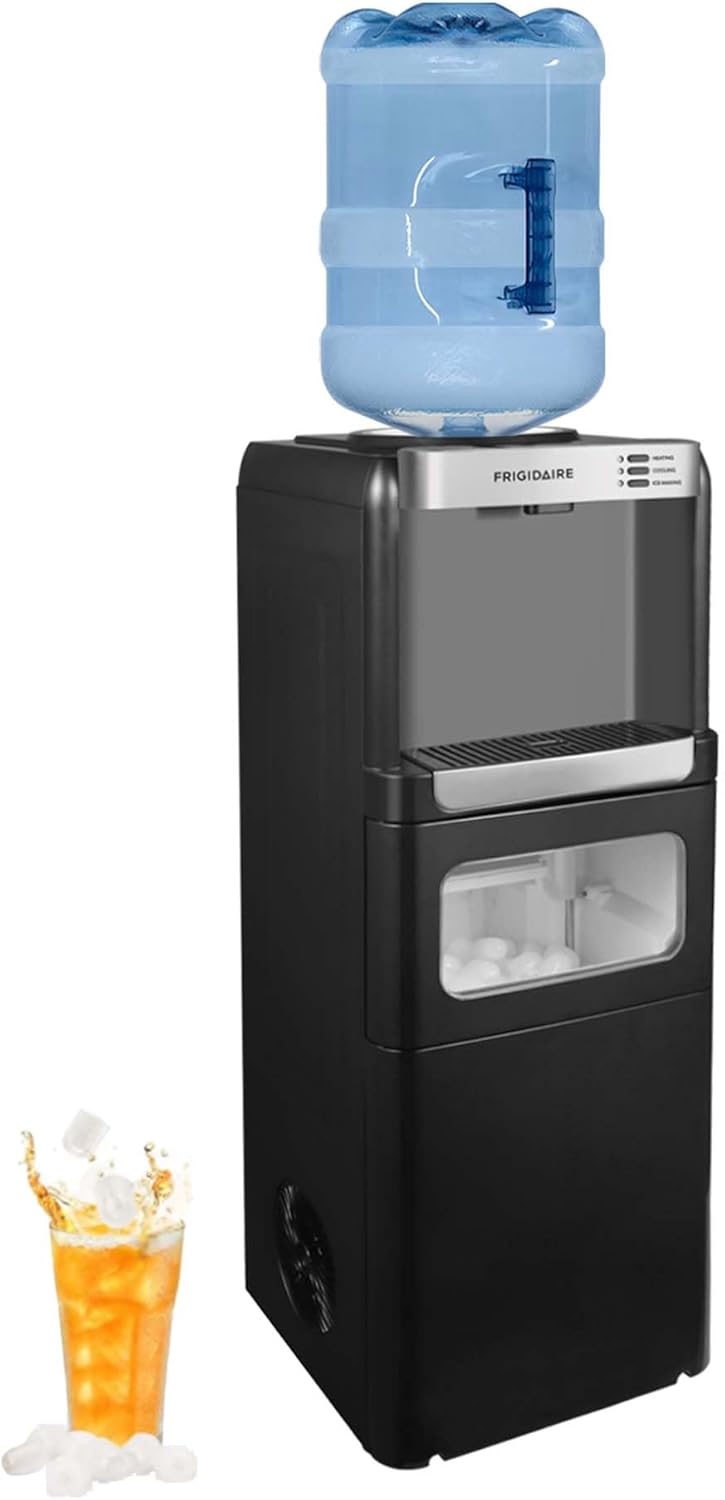
Frigidaire’s freestanding model combines a top-loading 5-gallon water cooler, hot-water dispenser, and built-in bullet-ice maker. At a listed 12 inches wide and 12 inches deep, it has a relatively small footprint for a full-height dispenser. Its top-loading setup is straightforward, but you will need to lift the bottle when it is time for a replacement.
The ice maker is listed for up to 33 pounds per day and nine cubes per cycle, with cycles taking about 7 to 11 minutes. Indicator lights show water shortage, ice-making status, and when the ice basket is full. The unit also returns melted ice water to make more ice, a feature intended to reduce water waste and support continued production.
This model suits a home or office where you want familiar hot and cold taps plus ice, and where checking status lights is helpful. The product listing describes it as compact, but the full height is 33 inches, so make sure you have room for the whole appliance and access to the top-loading bottle. Its provided specifications list hot and cold settings; they do not list a room-temperature water option.
Pros:
- Compact listed footprint of 12 by 12 inches.
- Includes indicators for water shortage, ice-making, and a full basket.
- Reuses melted ice water to make more ice.
- Offers hot water, cold water, and bullet ice.
Cons:
- Accepts 5-gallon bottles, which must be lifted into place.
- Does not list a room-temperature water setting.
Verdict: Consider the Frigidaire if you want a space-conscious top-loader with clear ice-status indicators and do not need room-temperature water.
4. VECYS 4-in-1: Bottom Loading with Self-Cleaning

The VECYS combines hot, cold, and room-temperature water with fresh bullet ice. Its bottom-loading system is designed for 3- to 5-gallon bottles, so changing a bottle does not require lifting it onto the top of the unit. The manufacturer also highlights internal 304 stainless-steel water pipes and a self-cleaning function.
Unlike several options in this roundup, this model is listed for up to 22 pounds of ice per day rather than 33. That may be enough for routine household use, but it is a lower stated output to consider if you expect frequent gatherings or heavy ice demand. It is also a larger, substantial appliance: the listed dimensions are 18 inches deep, 14 inches wide, and 44 inches tall, and the weight is about 47 pounds.
The listing describes an energy-saving mode, a two-step hot-water safety lock, and ETL approval. These are useful features to compare, but real-world experiences suggest it is sensible to check that hot-water performance and the controls meet your needs after setup. The product’s reported strengths include straightforward installation and quiet ice making, while one reported concern involved hot water not reaching the expected temperature.
Pros:
- Bottom loading accommodates 3- to 5-gallon bottles.
- Provides hot, cold, and room-temperature water plus ice.
- Includes a self-cleaning function and a two-step hot-water lock.
- Uses listed 304 stainless-steel internal water pipes.
Cons:
- Stated ice output is lower than the 33-pound-per-day models in this list.
- Its 44-inch height and substantial weight require careful space planning.
Verdict: The VECYS is a good fit if you want bottom loading, four water-and-ice functions, and a self-cleaning feature, and its lower stated ice output works for your needs.
5. SOOPYK Bottleless Cooler: Best for a Plumbed-In Water Supply

The SOOPYK differs from the bottled-water coolers in this list because it connects to a water line. It dispenses hot, cold, and room-temperature water and makes bullet ice. The product includes a water line, connector, Teflon tape, and an instruction manual, but it does not include a water filter. That means you should consider your water source and whether you need a separate filtration system before choosing it.
The listing states that it can make up to 27 pounds of ice per day and hold up to 5.3 pounds in its internal bin. Importantly, the bin does not keep ice frozen. It stops making ice when the bin is full, so you will need to use the ice or move it to a freezer for longer storage. The cooler measures about 12.2 inches deep, 14.5 inches wide, and 40.8 inches tall.
A bottleless connection can be convenient if you have a suitable water line and want to avoid changing water jugs. On the other hand, installation and ongoing water quality need more thought than with a bottle-fed unit. Some users report that the setup instructions are not very clear, so plan to allow extra time for installation. The supplied experiences also point to the importance of checking the ice-bin drain arrangement for your intended location.
Pros:
- Connects to a water line instead of requiring 3- or 5-gallon bottles.
- Offers hot, cold, and room-temperature water as well as ice.
- Includes water-line connection materials.
- Has an automatic stop when the ice bin is full.
Cons:
- No water filter is included.
- The ice bin does not keep ice frozen, and setup instructions may take extra attention.
Verdict: Choose the SOOPYK if you have a suitable water connection and prefer a bottleless cooler, but account for the separate filtration and ice-storage needs.
How to Choose a Water Cooler with a Built-In Ice Maker
Choose the Water Supply Style That Fits Your Space
Top-loading models use bottles placed on the unit, which makes the water source easy to see but requires lifting a full bottle during replacement. Bottom-loading models keep the bottle inside the cabinet and reduce overhead lifting, though you still need room to access the lower compartment. A bottleless model connects to a water line and avoids bottle changes, but it needs a suitable connection and may require separate filtration. Consider how you will refill the machine before comparing other features.
Check Which Water Temperatures You Actually Need
Some units provide hot and cold water, while others add a room-temperature option. If you mainly want cold drinking water and ice, a simpler setup may be enough. If you also make tea, instant meals, or drinks that do not need chilled water, hot and room-temperature settings can be more useful. Check the listed options carefully: not every model offers all three water temperatures.
Compare Ice Output with Your Typical Demand
Daily ice production figures help you compare models, but they do not tell the whole story. These appliances make ice in batches and have a storage basket or bin with a limit. Think about how much ice your household or office uses at once, and remember that high daily production does not mean the machine stores that amount. The models in this list are listed for between 22 and 33 pounds per day.
Find Out Whether Ice Stays Frozen
Do not assume a built-in ice maker includes a freezer. Some machines make ice and hold it temporarily, but do not keep it frozen. For example, the ICEPURE bottom-loading model and SOOPYK bottleless model explicitly state that they lack frozen storage. If you want to keep ice for later, check the product details and plan to transfer it to a freezer when needed.
Measure the Space and Plan for Access
Check the height, width, and depth of the cooler, along with the space needed to load a bottle, open a lower cabinet, or remove the ice basket. Leave practical room around the unit for cleaning and airflow, following the maker’s instructions. The listed sizes vary: the Frigidaire is 33 inches tall, while the VECYS is 44 inches tall, so “compact” can still mean a full-height appliance.
Look for Safety and Cleaning Features
Hot-water locks can help reduce the risk of accidental dispensing, especially in homes with children. Removable drip trays and ice baskets make it easier to clean areas that can collect water or ice residue. Some models also list a self-cleaning function. These features do not remove the need to follow the care instructions, so check how the manufacturer recommends cleaning and maintaining the unit.
Consider Noise, Controls, and Installation
An ice maker runs through repeated cycles, so noise can matter if the cooler will be near a bedroom, shared office, or quiet room. One ICEPURE model lists operation below 43 dB, while the other product descriptions do not provide a comparable noise figure. Also consider whether you prefer indicator lights, simple controls, or a water-line installation. For bottleless units, allow time to connect the water supply and confirm whether you need to arrange your own filtration.
Frequently Asked Questions
Do water coolers with built-in ice makers keep the ice frozen?
Not always. Some models make ice but do not include a freezer to keep it frozen over time. Check the product details for ice-storage information, and be prepared to move ice to a freezer if the unit does not keep it frozen.
How much ice can these water coolers make?
The models in this roundup list daily output from 22 to 33 pounds. Actual usefulness depends on how quickly you use the ice, the machine’s cycle time, and the size of its ice basket. A daily output figure is not the same as the amount the machine can store at once.
Do all of these models provide hot, cold, and room-temperature water?
No. The ICEPURE bottom-loading model, VECYS, and SOOPYK list hot, cold, and room-temperature water. The ICEPURE top-loading model and Frigidaire list hot and cold water, but do not list a room-temperature setting in the supplied product details.
What is the difference between top-loading and bottom-loading coolers?
A top-loading cooler holds the bottle above the dispenser, so you can see the water supply but must lift the bottle during replacement. A bottom-loading cooler stores the bottle inside the base, which reduces overhead lifting. Both styles still require replacing or refilling the bottle.
Is a bottleless water cooler a good choice?
It can be convenient if you have a suitable water line and want to avoid replacing large bottles. Before choosing one, check what installation materials are included and whether a filter is supplied. The SOOPYK model listed here is bottleless but does not include a filter.
Are these units suitable for an office?
They can work in an office, break room, or other indoor space if the available room, water supply, and ice output suit your needs. For a shared space, compare the ice basket capacity, noise information, safety lock, and ease of cleaning before deciding.
Final Recommendation
For a strong balance of bottle flexibility and stated ice output, the ICEPURE 3-in-1 top-loading model is a sensible pick if lifting bottles is not a concern. If easier bottle replacement and room-temperature water are priorities, consider the ICEPURE 4-in-1 bottom loader, while keeping in mind that it does not have a built-in freezer. Choose the Frigidaire for its listed compact footprint and status indicators, the VECYS for bottom loading and a self-cleaning function, or the SOOPYK if you specifically want a bottleless, plumbed-in setup.
