
Choosing the best water filter for lead removal means looking beyond a broad “better-tasting water” claim. Check whether the filter is certified to reduce lead, how much water it can hold, and how often its filter needs replacing. The options below range from small pitchers to a whole-house system, so the right pick depends on whether you want drinking water at one tap or filtered water throughout your home.
Remember that these products are described as reducing lead, not removing every trace of it. Follow the filter’s replacement instructions, and consider having your water tested so you know what is present and whether your chosen filter suits your needs.
Quick Comparison
| Product | Type and capacity | Lead information | Best for |
|---|---|---|---|
| Brita UltraMax 27-Cup Water Dispenser | Countertop or refrigerator dispenser; 27 cups | Reduces 99% of lead; WQA and NSF/ANSI certified | Households that want a large reservoir and fewer filter changes |
| Brita Everyday Elite Water Filter Pitcher | Refrigerator-friendly pitcher; 10 cups | Reduces 99% of lead; product information lists WQA and NSF/ANSI standards for Brita Elite filtration | Smaller kitchens and everyday drinking water |
| ZeroWater 22-Cup Ready-Read Dispenser | Water dispenser; 22 cups | IAPMO certified to reduce lead, PFOA/PFOS, chromium, and mercury | Shoppers who want a TDS meter and broad dissolved-solids reduction |
| iSpring Heavy Metals Whole House Filter System | Three-stage whole-house system | Product information says the GAC and KDF stage reduces lead; no lead certification is specified in the supplied details | People seeking filtration at multiple household taps |
| Culligan ZeroWater 10-Cup Pitcher | Pour-through pitcher; 10 cups | IAPMO certified to reduce lead and Total PFAS | Compact storage and a built-in TDS testing feature |
Our Picks: Best Water Filter For Lead Removal reviews
Best Large-Capacity Pick: Brita UltraMax 27-Cup Water Dispenser

The Brita UltraMax is a large filtered-water dispenser with a convenient spigot. Its 27-cup capacity gives you more water on hand than a standard pitcher, and its listed design can sit on a countertop or in a refrigerator. That makes it a practical fit for households that refill bottles throughout the day or prefer not to top up a small pitcher often.
The included Brita Elite filter is listed as reducing 99% of lead and more than 30 other contaminants. Brita says the filter lasts up to 120 gallons, or about six months, and identifies WQA and NSF/ANSI certification for the stated contaminant-reduction claims. The longer stated filter life is a key advantage over options that do not provide the same replacement interval in the supplied details.
The trade-off is its size: a 27-cup dispenser takes up more room than a 10-cup pitcher, and a full reservoir may be less convenient to move. It is also a pour-and-dispense system rather than a filter connected to your plumbing, so you still need to refill it manually.
Pros:
- Large 27-cup capacity for households with higher water needs
- Elite filter is listed as reducing 99% of lead
- WQA and NSF/ANSI certification is specified for its reduction claims
- Filter life is listed as up to 120 gallons or about six months
Cons:
- Requires more counter or refrigerator space than a small pitcher
- Needs manual refilling and regular filter replacement
Verdict: Choose the Brita UltraMax if you want a high-capacity dispenser with a clearly stated lead-reduction claim and a long listed filter life.
Best Compact Everyday Pitcher: Brita Everyday Elite

This 10-cup Brita pitcher offers the same Elite filter approach in a smaller, refrigerator-friendly format. The product details give its dimensions as 10.7 inches high, 5.4 inches wide, and 10.1 inches deep, which can help you check whether it will fit your shelf before buying. An easy-fill lid is designed to make refilling simpler.
Brita lists the Elite filter as reducing 99% of lead, along with chlorine that affects taste and odor and several other contaminants. The supplied product information says to replace the filter about every six months and notes an electronic indicator for reminders. As with the larger dispenser, the filter is the main reason to consider this model for lead reduction; the smaller container is better suited to moderate daily use than serving a large group at once.
Compared with the UltraMax, this pitcher uses less storage space but holds much less water. It also requires more frequent refilling if several people rely on filtered water throughout the day. Check that you are buying the Elite version of the filter, since the product’s lead-reduction claim applies to that filter.
Pros:
- Compact 10-cup size designed to fit in most refrigerators
- Elite filter is listed as reducing 99% of lead
- Easy-fill lid and electronic filter reminder
- Filter replacement interval is listed at about six months
Cons:
- Smaller capacity means more frequent refills than the UltraMax
- Not the best fit if you need a large volume of filtered water ready at once
Verdict: The Brita Everyday Elite is a sensible choice if you want a compact pitcher and an Elite filter with a stated lead-reduction claim.
Best Large Dispenser with a TDS Meter: ZeroWater 22-Cup Ready-Read
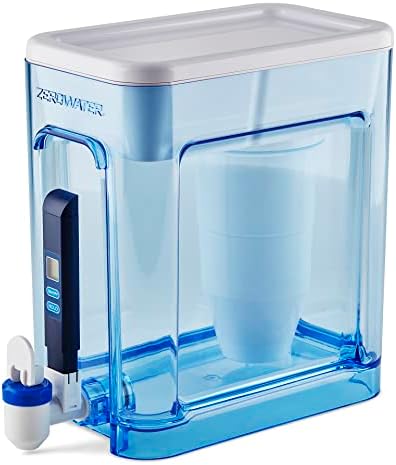
This ZeroWater dispenser holds 22 cups and includes a five-stage filter and an integrated TDS meter. The meter checks total dissolved solids, or TDS, and the product instructions say to change the filter when the reading reaches 006. That gives you a specific indicator to watch, though a TDS reading is not a direct measurement of lead.
The filter is listed as IAPMO certified to reduce lead, PFOA/PFOS, chromium, and mercury. Its five-stage filtration is also described as removing virtually all TDS. That broader dissolved-solids focus sets it apart from the Brita pitchers, which emphasize a longer stated filter life and a lead-reduction claim without an included TDS meter.
A meter can be useful if you want a signal for filter replacement, but the supplied information does not give a set gallon or month lifespan for this filter. The 22-cup reservoir also needs manual filling, so consider your available space and how often you are comfortable refilling it.
Pros:
- 22-cup capacity suits households that want a larger supply
- IAPMO certified to reduce lead and several other listed contaminants
- Includes a TDS meter and a stated meter reading for filter replacement
- Five-stage filtration is designed to reduce total dissolved solids
Cons:
- The meter measures TDS, not lead specifically
- The supplied details do not state a fixed filter lifespan in gallons or months
Verdict: Pick the ZeroWater dispenser if you want a large pitcher-style system with IAPMO lead-reduction certification and a TDS-based filter indicator.
Best Whole-House Option: iSpring Heavy Metals Three-Stage System

Unlike the pitchers and dispensers here, this iSpring system is designed to filter water for the whole home. It uses three stages: a 5-micron sediment filter, a GAC and KDF composite filter, and a CTO filter. The product description says the middle stage reduces lead and other listed substances, while the stages also address sediment, chlorine, and odors.
The system’s clear first-stage housing lets you see the sediment filter, and the manufacturer lists a capacity of 30,000 gallons and a service life of up to six months. Those figures are product specifications, not a guarantee of the time it will last in every home. The system is also described as retaining essential minerals and not reducing TDS.
There is an important qualification for lead-focused shoppers: the supplied product details do not identify a third-party lead certification. That makes this option harder to compare with the Brita and ZeroWater products, which provide specific certification information for lead reduction. Whole-house installation also involves more setup than placing a pitcher in the refrigerator. Check the full installation requirements and confirm the system is appropriate for your water before choosing it.
Pros:
- Designed to treat water for multiple household taps
- Three filtration stages address sediment, chlorine, and other listed substances
- Clear first-stage housing helps you monitor the sediment filter
- Product information lists a 30,000-gallon capacity and up to six months of use
Cons:
- Supplied details do not specify third-party certification for lead reduction
- More involved than using a pour-through pitcher, and it does not reduce TDS
Verdict: Consider the iSpring if you want a whole-house system, but verify its lead performance and installation suitability for your water before relying on it for lead reduction.
Best Compact Pitcher with TDS Testing: Culligan ZeroWater 10-Cup

This 10-cup pour-through pitcher combines a smaller footprint with Culligan’s ZeroWater five-stage filtration technology. Its product details say the filter is IAPMO certified to reduce lead, Total PFAS, chlorine, mercury, and other contaminants. The pitcher also includes a TDS meter to check dissolved solids and help signal when a filter change is needed.
The 10-cup size may suit a smaller refrigerator or a household that does not need a large reserve of filtered water. The TDS feature gives you a convenient way to check a general dissolved-solids reading, but it should not be treated as a lead test. The product description says a reading of 0 means the filter is removing virtually all TDS; it does not mean that a meter has measured lead directly.
Compared with the 22-cup ZeroWater dispenser, this model saves space but offers less capacity. The supplied details do not state a fixed filter replacement interval in gallons or months, so plan to follow the included instructions and use the meter as directed.
Pros:
- Compact 10-cup pitcher format
- IAPMO certified to reduce lead and Total PFAS
- Includes a TDS meter for checking dissolved-solids readings
- Five-stage filtration is described as reducing 99.9% of dissolved solids
Cons:
- Smaller capacity than the 22-cup ZeroWater dispenser
- TDS readings do not directly measure lead levels
Verdict: The Culligan ZeroWater pitcher is a good space-conscious choice if you want IAPMO-certified lead reduction and a TDS meter in a smaller format.
How to Choose a Water Filter for Lead Removal
Look for lead-specific certification
Start with the exact contaminant claim, not a general promise to improve water quality. Check that the product information identifies lead and names a certification or testing standard for that reduction claim. In this lineup, the Brita Elite options identify WQA and NSF/ANSI certification, while the ZeroWater and Culligan ZeroWater filters identify IAPMO certification. The supplied details for the iSpring system state that it reduces lead but do not specify a third-party lead certification.
Match the filter to your water source and needs
A pitcher or countertop dispenser filters water you pour into it, which can be a straightforward choice when your main concern is drinking water. A whole-house system is designed to serve multiple taps, but it requires a different installation approach. Before buying, confirm that the product’s stated contaminants and intended use fit your situation. If you are unsure what is in your water, testing can help you make a more informed choice.
Choose a capacity you will actually use
A small pitcher takes up less room but needs refilling more often. A 22- or 27-cup dispenser gives you a larger supply, but it takes up more refrigerator or counter space. Think about how many people will use the water and whether you have a convenient place to keep the filter system.
Check filter life and replacement signals
Replacement schedules vary across these products. Brita lists its Elite filter life as up to 120 gallons, or about six months, for the UltraMax and about six months for the Everyday pitcher. The ZeroWater options include TDS meters, with the 22-cup model instructing you to change the filter at a reading of 006. A TDS meter is a general dissolved-solids indicator, not a direct lead test. Follow the instructions for your specific filter rather than assuming one schedule applies to every model.
Understand what the filter does not tell you
A lead-reduction claim does not mean a filter removes every trace of lead in all conditions. A TDS reading also cannot tell you the amount of lead in your water. Keep the filter maintained, use replacement cartridges made for your model, and seek reliable water testing or local guidance if you need to understand your water’s lead level.
Consider the effort of installation and upkeep
Pitchers and dispensers need manual filling and cartridge changes. A whole-house setup may require more planning and installation work, but it is designed to filter water at multiple household taps. Consider how much setup you are willing to manage, the space available, and how you will keep track of maintenance.
Frequently Asked Questions
Which water filter in this list has a stated 99% lead-reduction claim?
Both Brita Elite options in this list are described as reducing 99% of lead: the 27-cup UltraMax dispenser and the 10-cup Everyday pitcher. Check the certification details and use the correct Elite replacement filter.
Does a TDS meter test for lead?
No. A TDS meter measures total dissolved solids, not lead specifically. It can provide a general reading related to dissolved material in water, but it should not replace a lead-specific water test.
Does a water filter remove all lead?
The products here are described as reducing lead, not removing every trace under all conditions. Results depend on using the correct filter and maintaining it as directed. If you need to know the lead level in your water, arrange appropriate testing.
Is a pitcher or a whole-house system better for lead reduction?
It depends on what you want to filter. Pitchers and dispensers treat the water you put into them, while a whole-house system is designed to serve multiple taps. Compare the exact lead claim and certification for the model, and confirm it fits your water and installation needs.
How often should I replace the filter?
Follow the instructions for your specific model. The Brita Elite filters in this list have a stated interval of about six months, and the UltraMax version is also listed for up to 120 gallons. The ZeroWater models include TDS meters and replacement guidance, but their supplied details do not give a fixed month-based lifespan.
Is a larger dispenser worth choosing over a smaller pitcher?
A larger dispenser can reduce how often you need to refill it, but it takes up more space. Choose one based on your household’s water use and the room available in your refrigerator or on your counter.
What is the best overall choice for lead reduction?
The Brita UltraMax stands out for its 27-cup capacity, stated 99% lead reduction, WQA and NSF/ANSI certification information, and listed filter life of up to 120 gallons. If you need a smaller pitcher, consider the Brita Everyday Elite or Culligan ZeroWater 10-cup pitcher, while checking each filter’s certification and replacement instructions.
Final Recommendation
For most households seeking a large supply of filtered drinking water, the Brita UltraMax is the strongest all-around fit in this group: it combines a 27-cup capacity with a clearly stated lead-reduction claim and certification information. Choose the Brita Everyday Elite if refrigerator space matters more, or the ZeroWater options if you value their TDS meters and broader dissolved-solids focus. For any lead concern, match the filter to your water, maintain it as directed, and use water testing when you need to know the actual lead level.