
Choosing the best water filter for office use comes down to how many people will use it, how much counter or refrigerator space you have, and which water concerns matter most. A small pitcher can suit a shared fridge, while a larger dispenser or gravity system may work better for a team. Here are five options, from simple carbon filters to reverse osmosis, with the trade-offs to consider before you buy.
Quick Comparison
| Product | Type and capacity | Notable feature | Best suited for |
|---|---|---|---|
| Purewell 3-Stage Gravity Water Filter | Gravity system; capacity not stated | Stainless-steel housing and no electricity required | Offices wanting a larger shared water station |
| Waterdrop WFD-40L Water Filter Dispenser | 35-cup dispenser | 200-gallon filter life and replacement indicator | Shared kitchens with refrigerator space |
| ZeroWater 32-Cup Water Filter Dispenser | 32-cup dispenser | Five-stage filter and included TDS meter | People who want to monitor dissolved solids |
| Waterdrop PT-05B-L Water Filter Pitcher | 7-cup pitcher | 200-gallon filter life and compact size | Small teams or individual desks |
| DREO Countertop Reverse Osmosis System | 3-liter tank plus 1.1-liter pitcher | RO filtration with TDS and filter-life monitoring | One or two people seeking reverse osmosis filtration |
Our Picks: Best Water Filter For Office Use reviews
Purewell 3-Stage Gravity Filter: A No-Power Shared Station

The Purewell is a gravity-fed water filter with two chambers: you pour tap water into the upper chamber, and filtered water collects below. It does not need electricity, which makes it useful in a break room without an open outlet or as a shared water station that can sit away from a sink.
Its three-stage filter combines a hollow-fiber membrane, a silver-ion membrane, and activated carbon. The supplied product information says the filter has a 0.01-micron pore size and a flow rate of up to four gallons per hour. The carbon filter is described as NSF/ANSI 42 certified, and the system as NSF/ANSI 372 certified. Those certifications relate to specific claims, so check the manufacturer’s documentation if you need confirmation that a particular contaminant is reduced.
The stainless-steel body and spigot give it a more durable, shared-station feel than a plastic pitcher. The product data says its two carbon filters can provide up to 6,000 gallons combined, though actual life may vary with water quality. It also needs enough counter space for the stacked chambers. Avoid topping up the upper chamber when the lower chamber is full, as the manufacturer warns that this can cause leakage.
Pros:
- Works without electricity.
- Stainless-steel housing and spigot.
- Large stated combined filter capacity.
- Gravity design can serve as a shared station.
Cons:
- Requires more counter space than a pitcher.
- Needs careful filling and chamber management.
Verdict: Choose the Purewell if your office needs a no-power shared filter and has room for its two-chamber design.
Waterdrop WFD-40L: A High-Capacity Fridge Dispenser

This Waterdrop model is a slim dispenser designed to store in a refrigerator. It holds up to 35 cups overall, with 19 cups in the body, so it can keep more filtered water ready than a standard pitcher. Its sliding lid helps make refilling straightforward, and a filter indicator signals when it is time to replace the cartridge.
The carbon-fiber filter is certified to NSF/ANSI 42 and 372, according to the supplied product details. The manufacturer says it reduces residual chlorine and helps reduce odor and certain listed substances. It also states a filter life of up to 200 gallons or two months, depending on use and water conditions. Importantly, this system does not lower total dissolved solids (TDS).
For an office, its main advantage is keeping a larger supply chilled without requiring a countertop water connection. The trade-off is that the dispenser is still a substantial container to lift and refill. Check the refrigerator’s shelf and door dimensions before choosing it; the product listing gives dimensions of about 14.37 by 5.55 by 9.95 inches.
Pros:
- 35-cup capacity for a shared refrigerator.
- Space-saving shape for its capacity.
- Filter replacement indicator is built in.
- Stated filter life of up to 200 gallons or two months.
Cons:
- Does not reduce TDS.
- Needs enough refrigerator space and regular refilling.
Verdict: Pick the WFD-40L if your office has a shared fridge and wants a large supply of chilled, filtered water without an installed system.
ZeroWater 32-Cup Dispenser: A TDS-Monitoring Option
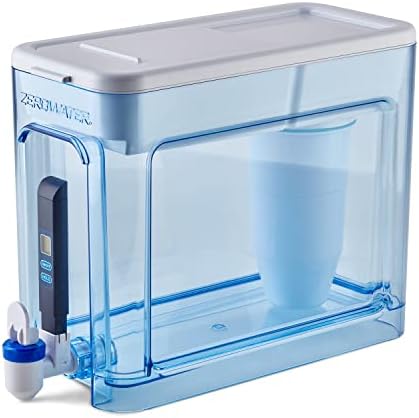
ZeroWater’s 32-cup dispenser is intended for people who want to track dissolved solids in their water. It includes a five-stage filter with ion-exchange technology and a TDS meter, which lets you check the displayed reading before pouring. The product instructions say to change the filter when the meter reads 006.
The supplied product information says the filter is IAPMO certified to reduce PFOA/PFOS, lead, chromium, and mercury. It also says the system removes virtually all TDS. That focus sets it apart from the two Waterdrop carbon-filter options here, which do not lower TDS. A low TDS reading is not, by itself, a complete measure of water safety, so use the meter as an indicator rather than a substitute for water-quality information.
The 32-cup capacity may work well in a shared kitchen, but the dispenser needs room on a counter or shelf and will need refilling as the team uses it. Filter replacement is another ongoing task; the meter provides a clear signal, but it does not eliminate the cost or effort of changing cartridges.
Pros:
- Large 32-cup capacity.
- Includes a TDS meter for checking readings.
- Five-stage filtration with ion-exchange technology.
- Product data lists specific certified contaminant-reduction claims.
Cons:
- Requires counter or shelf space.
- Filter changes are guided by the meter and may require regular attention.
Verdict: Choose ZeroWater if TDS reduction and an included meter are priorities, and your office can accommodate a larger dispenser.
Waterdrop PT-05B-L: A Compact Pitcher for Small Teams

This seven-cup pitcher is the simplest fit for a small office, personal desk, or kitchenette where storage space is limited. It has a handle for carrying and a mechanical filter-life recorder, so you can track use without relying on an electronic indicator.
The pitcher is made from food-grade, BPA-free plastic. Its activated-carbon-fiber filter is certified to NSF/ANSI 42 and 372, according to the supplied description. Waterdrop says it helps reduce chlorine, taste, and odor, and lists a filter life of up to 200 gallons or three months depending on local water conditions and use. Like the larger Waterdrop dispenser, it does not lower TDS.
The small size makes it easier to fit in a shared refrigerator, but it also means you will refill it more often than a 32- or 35-cup dispenser. The product information recommends using a compatible replacement filter, so confirm the model when ordering cartridges. This is a practical choice for a few people, not a high-volume office water station.
Pros:
- Compact seven-cup size.
- Certified to NSF/ANSI 42 and 372, as stated in the product data.
- Mechanical filter-life recorder.
- Stated filter life of up to 200 gallons or three months.
Cons:
- Small capacity means more frequent refills.
- Does not reduce TDS.
Verdict: The PT-05B-L is a sensible pick for one or a few coworkers who want a compact pitcher rather than a shared high-capacity dispenser.
DREO Countertop RO System: Advanced Filtration for One or Two People
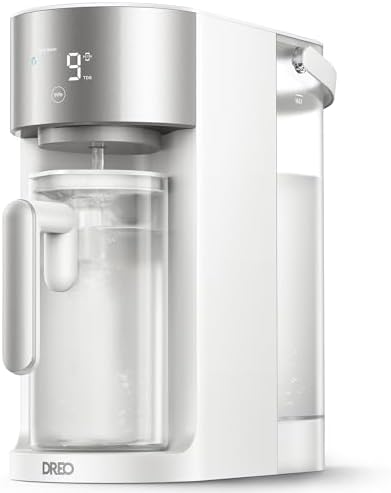
The DREO is a countertop reverse osmosis system with a 3-liter tank and a 1.1-liter pitcher. Its product information describes a seven-in-one filtration process using a 0.0001-micron RO membrane. The system is designed for countertop use rather than installation under a sink, which may suit an office where a permanent plumbing change is not practical.
DREO says the system was tested by SGS against NSF/ANSI 58 standards and can reduce listed substances including lead, hexavalent chromium, chlorine, PFOS, PFOA, and fluoride under laboratory conditions. It also displays raw- and filtered-water TDS readings and provides filter-life reminders. Treat these as manufacturer-provided specifications, and check the product documentation for the exact test conditions and claims.
The listed footprint is about 14.51 by 6.73 by 13.35 inches, so measure the available counter space before buying. The product description says it has an auto-fill sensor and self-cleaning function, and gives a 3:1 pure-to-drain ratio. It is described as suitable for daily use by one or two people, so a larger team may find its tank and pitcher require frequent attention. Reverse osmosis also produces wastewater, even with the stated ratio.
Pros:
- Countertop design avoids a permanent under-sink installation.
- RO filtration with TDS and filter-life monitoring.
- Includes a tank and separate pitcher.
- Product data lists an auto-fill sensor and self-cleaning function.
Cons:
- Better suited to one or two people than a busy team.
- Needs counter space and produces wastewater.
Verdict: Select the DREO if you want countertop reverse osmosis and TDS monitoring for a small office, but consider a higher-capacity option for a larger group.
How to Choose a Water Filter for Office Use
Match capacity to the number of people
Think about how many coworkers will use the filter and how often they drink water. A seven-cup pitcher is easier to store but will need more frequent refills. Larger dispensers can keep more water ready, while the Purewell’s gravity design offers a shared station without electricity. The DREO is specified for daily use by one or two people, so it may be less convenient for a busy team.
Check the space and placement
Measure the intended spot before you choose a model. A refrigerator dispenser needs a shelf that fits its dimensions and enough room to lift it out for refilling. A countertop system needs a stable surface and access for filling and cleaning. Gravity systems can take up more vertical and counter space than pitchers, so consider where coworkers will pour water without creating a bottleneck.
Decide which filtration claims matter to you
Filters do not all make the same claims. Carbon filters such as the Waterdrop models focus on chlorine, taste, and odor, while ZeroWater and the DREO emphasize TDS reduction. Purewell describes a hollow-fiber membrane and carbon stages. If you are concerned about a specific contaminant, check the product’s certification and documentation for that exact reduction claim rather than relying on broad terms like “purifier” or “multi-stage.”
Consider filter life and replacement access
A filter’s stated lifespan can be given in gallons, months, or both, and actual life may vary with water conditions and use. Compare the replacement schedule with how much water your office expects to use. Also confirm that replacement cartridges are available for the exact model. An indicator or recorder can help track filter use, but it does not replace following the manufacturer’s replacement guidance.
Think about power, plumbing, and upkeep
Gravity filters work without electricity, while countertop reverse osmosis systems have additional components and functions to manage. Pitchers and dispensers are straightforward to refill but need regular washing and filter changes. For a shared office, pick a design that someone can maintain easily, and make sure its filling and cleaning routine will not be overlooked.
Understand what a TDS reading can tell you
A TDS meter measures total dissolved solids, not every possible contaminant or the overall safety of the water. ZeroWater and DREO include TDS monitoring, while the Waterdrop models described here do not lower TDS. Use a meter as one piece of information, and consult local water-quality information or appropriate testing if you have a specific concern.
Frequently Asked Questions
Which type of water filter is easiest to use in a small office?
A compact pitcher is usually the easiest to place and move, but it holds less water. For a small team that shares a refrigerator, a larger dispenser can reduce how often you refill. The right choice depends on available space and how many people will use it.
Do these filters need to be connected to plumbing?
The products described here are pitchers, dispensers, gravity systems, or countertop units. The supplied product details do not describe any of them as under-sink installations. Check each product’s instructions for setup and power requirements before purchase.
Which option reduces TDS?
The ZeroWater dispenser is described as removing virtually all TDS, and the DREO reverse osmosis system includes TDS monitoring and is designed to reduce dissolved substances. The two Waterdrop models explicitly state that they do not lower TDS.
Can a TDS meter confirm that water is safe to drink?
No. A TDS reading measures dissolved solids, but it does not identify every substance in the water or confirm that water is safe. For a specific concern, check the relevant product test information and local water-quality data.
How often should I replace a filter?
Follow the instructions for your specific model. The stated guidance varies: the Waterdrop filters have a stated life of up to 200 gallons, while Purewell gives a combined capacity for its two carbon filters. ZeroWater provides a meter-based replacement direction, and DREO provides filter-life monitoring. Use and water quality can affect filter life.
Is reverse osmosis a good fit for a shared office?
It can be a fit if the office wants RO filtration and has room for a countertop unit. The DREO listing describes its tank and pitcher as suitable for one or two people, so a larger team may prefer a higher-capacity dispenser or gravity filter.
Final Recommendation
For a shared office that needs a larger water supply without electricity, the Purewell gravity system is the most practical fit among these picks. Choose the Waterdrop WFD-40L if refrigerator storage is available, or the compact PT-05B-L for one or a few coworkers. ZeroWater is the better match if you specifically want TDS reduction and a meter, while DREO is worth considering for countertop reverse osmosis in a small office. Before deciding, compare the filter claims, replacement needs, and available space with your team’s daily use.