
A rotten-egg smell in well water can make showers, laundry, and everyday chores unpleasant. The right filter depends on what is causing the odor and what else is in your water: some systems are designed to address hydrogen sulfide, while others focus more on iron, manganese, sediment, or taste. Have your water tested before you buy, then match the results to a system’s stated capabilities. Here are five options, with a close look at where each one may fit—and where its limits matter.
Quick Comparison
| Product | Type and key features | Best suited for | Important note |
|---|---|---|---|
| H&G Lifestyles 3-Stage Whole House Filter | Three stages for sediment, iron, and odor concerns | Homes seeking a whole-house setup for well water | Sulfur reduction is not quantified; listing availability may be limited |
| The Sulfur Eliminator Deluxe | Well-spigot aeration system; no electricity required | Well owners prioritizing rotten-egg odor treatment | Uses an Iron Buster filter that the stated warranty requires you to replace yearly |
| iFilters MWH-D20-WELL 3-Stage System | 20-inch housings with sediment, GAC, and KDF media | Well water with sediment and several taste or odor concerns | Confirm the system’s capacity and maintenance needs against your water test |
| Waterdrop WHF21-FG 2-Stage System | Iron and manganese reduction plus coconut-shell carbon | Homes focused on iron, manganese, chlorine, and sediment | Its listed capabilities do not specifically establish hydrogen sulfide reduction |
| iSpring Iron, Manganese, H2S Whole House System | Three stages for sediment, iron and manganese, and other contaminants | Households needing a broad whole-house well-water filter | Check your water levels and flow needs against the stated capacity |
Our Picks: Best Water Filter For Sulfur Smell reviews
H&G Lifestyles: A Three-Stage Option for Well-Water Odor and Iron
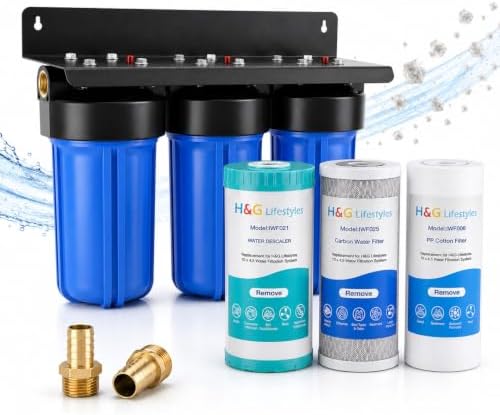
This whole-house system combines a polypropylene sediment filter, a carbon block, and an iron-reduction cartridge. The listed uses include reducing sediment, iron, manganese, rust stains, discoloration, and sulfur odor. That mix may appeal if your well water has more than one noticeable issue, rather than odor alone.
The system uses 10-by-4.5-inch housings and includes brass fittings with 1-inch NPT-to-barb adapters for PEX connections. The manufacturer describes it as suitable for whole-home use without significant pressure loss under normal operating conditions. Check the included connections against your plumbing before buying, and make sure the installation location has room for the housings and future cartridge changes.
One limitation is that the product description does not provide a specific sulfur-removal rate or a tested hydrogen sulfide range. Treat its odor-reduction language as a claim to verify against your water test, not a guarantee. The supplied listing information also indicates limited availability, so confirm that it can be ordered before planning an installation.
Pros:
- Combines sediment, carbon, and iron-reduction stages
- Designed for whole-house well-water treatment
- Addresses several common well-water concerns, including sulfur odor
- Includes brass adapters for specified plumbing connections
Cons:
- No quantified hydrogen sulfide reduction is provided
- Listing availability may be limited
Verdict: Consider this system if you want multi-stage whole-house treatment for well water, but verify availability and confirm that its odor-reduction claims match your test results.
The Sulfur Eliminator Deluxe: A Focused Choice for Rotten-Egg Odor

Unlike the cartridge-based whole-house systems here, The Sulfur Eliminator Deluxe is designed to connect to a well spigot or faucet. Its described process aerates water using recycled air and water, and it runs on well-system water pressure rather than electricity. The manufacturer says it is intended to address rotten-egg odor, as well as iron, rust, and sediment.
The product description emphasizes a simple hose-style connection, which could make it appealing if you want to avoid a powered treatment unit. But its described installation point is important: it is not presented as a standard filter housing installed directly in your home’s main plumbing. Confirm that your well setup and intended use are compatible before choosing it.
The system is described as maintenance-free, but the stated lifetime warranty depends on using the Iron Buster Filter and replacing it once a year. That condition matters if you are comparing ongoing upkeep or total ownership costs. The description does not give a numerical hydrogen sulfide capacity, so test your water and ask the manufacturer whether the system is appropriate for your measured levels.
Pros:
- Specifically designed to address rotten-egg sulfur odor
- Does not require electricity, according to the product description
- Described as a simple connection to a well spigot or faucet
- Also intended to address iron, rust, and sediment
Cons:
- Its well-spigot installation differs from a conventional main-line filter setup
- The stated warranty requires yearly Iron Buster Filter replacement
Verdict: This is the most odor-focused option in the group, especially if a well-spigot installation suits your setup; check the installation details and warranty requirements before buying.
iFilters MWH-D20-WELL: Larger Housings for Multi-Issue Well Water

The iFilters system uses 4.5-by-20-inch housings, a larger format than the 10-by-4.5-inch systems in this comparison. Its first stage is a washable pleated sediment filter intended to capture particles such as dirt, rust, sand, and silt. The next cartridge combines granular activated carbon and KDF media; the product description says these media help address taste, odor, iron, sulfur odor, and certain metals.
The larger housings may be worth considering if your water has substantial suspended sediment or you prefer a system designed for demanding well-water use. The pleated filter is described as rinseable and reusable, but that does not mean the entire system is maintenance-free: you will still need to inspect the filter and follow replacement guidance for the cartridges. Its 1-inch ports also make plumbing compatibility worth checking before installation.
Compared with The Sulfur Eliminator, this is a more conventional multi-stage housing setup. Compared with the compact systems, it takes up more room. The product description does not provide a specific hydrogen sulfide reduction figure, so use your water test to decide whether its stated media and capacity are adequate.
Pros:
- Uses larger 4.5-by-20-inch housings with 1-inch ports
- Includes a washable pleated sediment pre-filter
- Combines GAC and KDF media for several stated water concerns
- Designed for whole-house well-water treatment
Cons:
- Requires more installation space than compact 10-inch systems
- No specific hydrogen sulfide reduction rate is supplied
Verdict: Choose the iFilters system if sediment and several well-water issues call for a larger multi-stage setup, provided you have space and its stated treatment range fits your test results.
Waterdrop WHF21-FG: Stronger Focus on Iron and Manganese

This two-stage whole-house filter pairs an iron-and-manganese reduction cartridge with coconut-shell granular activated carbon. The supplied product information reports third-party testing for reduction of iron, manganese, and chlorine, and says the system also helps reduce rust, sediment, and particles larger than 5 microns. It is designed for municipal or well water.
The system has 10-by-4.5-inch cartridges, 1-inch ports, and a stated flow rate of up to 15 gallons per minute. Its listed capacity is up to 50,000 gallons or six months, with actual filter life varying by water quality and use. The manufacturer also states that the cartridges meet NSF/ANSI 372 lead-free requirements. That standard should not be confused with proof that the complete system removes every contaminant.
For a sulfur-smell problem, the key limitation is that the supplied description does not specifically establish hydrogen sulfide reduction. Carbon may help with some taste and odor concerns, but do not assume this system will resolve rotten-egg odor without confirming its performance for your water. It makes more sense when iron, manganese, chlorine, or sediment are the main known issues.
Pros:
- Tested reduction claims for iron, manganese, and chlorine are provided
- Designed for municipal and well-water sources
- Up to 15 GPM flow rate is stated
- Includes a stated capacity of up to 50,000 gallons or six months
Cons:
- The supplied product information does not specifically confirm hydrogen sulfide reduction
- Filter life depends on water quality and household use
Verdict: Pick Waterdrop when iron and manganese are the priority, but choose a system with confirmed hydrogen sulfide performance if sulfur odor is your main concern.
iSpring Iron, Manganese, H2S System: Broad Three-Stage Treatment

This iSpring whole-house system is the only one in this comparison whose product title explicitly names H2S. It uses a sediment cartridge, an iron-and-manganese filter, and a GAC/KDF cartridge. The description says the final stage is intended to reduce hydrogen sulfide, chlorine, pesticides, herbicides, and several metals. It also lists iron reduction up to 3.0 ppm and manganese reduction up to 1.0 ppm for the specified iron filter.
The compact 10-by-4.5-inch format may suit homes with limited installation space. The system has 1-inch NPT connections and a stated flow rate up to 15 GPM. The product description gives a capacity of up to 50,000 gallons or 12 months, but actual service life can vary with source-water quality and use. Pressure-release buttons are included to make cartridge changes easier.
Its stated scope makes it a broad choice for households dealing with H2S along with iron, manganese, sediment, or other listed contaminants. Still, the description does not provide a specific H2S reduction rate. Compare your water test with the manufacturer’s treatment limits, and consider professional advice if the levels or odor are severe.
Pros:
- Explicitly lists hydrogen sulfide among the contaminants it is designed to reduce
- Three stages address sediment, iron and manganese, and other listed concerns
- Compact 10-by-4.5-inch format with 1-inch NPT connections
- States up to 15 GPM and up to 50,000 gallons or 12 months of use
Cons:
- No specific hydrogen sulfide reduction rate is included in the supplied description
- Actual cartridge life depends on water conditions and usage
Verdict: This is a strong option to investigate when you need a compact whole-house system that explicitly lists H2S, but verify its performance against your measured water levels before purchasing.
How to Choose a Water Filter for Sulfur Smell
Test the water before choosing a system
A rotten-egg odor is often associated with hydrogen sulfide, but smell alone does not tell you the concentration or whether other water problems are present. A water test can help identify hydrogen sulfide, iron, manganese, pH, and sediment concerns. Use those results to compare against a filter’s stated treatment limits instead of relying on broad phrases such as “for well water.”
Look for specific hydrogen sulfide claims
Check whether the product description explicitly names hydrogen sulfide or H2S and whether it provides a treatment range or test data. A system marketed for iron, chlorine, or general odor may not be a proven match for sulfur smell. When the listing does not provide a reduction rate, contact the manufacturer and ask whether the system fits your test results.
Decide between whole-house and well-spigot installation
A whole-house system is installed on the home’s incoming water line so it can treat water headed to multiple fixtures. The Sulfur Eliminator Deluxe is described as connecting to a well spigot or faucet, which is a different installation approach. Confirm where a product must be installed and whether that setup will treat the water where you want it to.
Match the system to your other water issues
If your water also contains iron, manganese, rust, or sediment, a multi-stage system may address more of your needs than an odor-only approach. However, more stages do not automatically mean better sulfur treatment. Compare each stage’s stated purpose with your test results, and avoid paying for features that do not solve your household’s actual problems.
Check flow rate, connections, and installation space
Whole-house systems need to support the water flow your household uses at the same time across showers, faucets, and appliances. Compare the stated flow rate with your needs, and check that the inlet and outlet size matches your plumbing or can be adapted safely. Also measure the installation space, including room to remove housings when filters need service.
Understand filter life and ongoing maintenance
Cartridge life can change with water quality and how much water your home uses. Look for a stated capacity or replacement interval, but treat it as an estimate unless the manufacturer confirms it applies to your conditions. Include replacement cartridges and any required annual service in your decision. For The Sulfur Eliminator Deluxe, note that the stated lifetime warranty depends on using and replacing its Iron Buster Filter yearly.
Read certification claims carefully
Certifications apply to specific standards and claims, not necessarily to every contaminant or the complete system. For example, a lead-free materials standard is not the same as proof of hydrogen sulfide removal. Check which component or media is certified, what the standard covers, and whether the product has performance data for the contaminant you want to reduce.
Frequently Asked Questions
What causes a rotten-egg smell in well water?
Hydrogen sulfide is a common cause of rotten-egg odor, but odor alone cannot confirm the source or concentration. A water test can help identify the issue and guide your choice of treatment.
Which filter in this comparison specifically lists H2S?
The iSpring Iron, Manganese, H2S Whole House Water Filter System explicitly lists hydrogen sulfide in its product information. The Sulfur Eliminator Deluxe and several other options also describe sulfur odor reduction, but the supplied descriptions do not give a specific H2S reduction rate for these systems.
Will a carbon filter always remove sulfur smell?
No. Carbon is used in some systems to address taste and odor, but that does not establish that every carbon filter will reduce hydrogen sulfide to the level you need. Check the product’s specific H2S claims and compare them with your water test.
Should I filter all the water entering my home?
A whole-house system may make sense if the odor affects water at multiple fixtures and you want treatment on the incoming line. Confirm that the system is designed for that installation. A product that connects to a well spigot may have a different use and coverage than a main-line filter.
How often do whole-house filter cartridges need replacement?
It depends on the system, your water quality, and household use. Some products state a capacity or time interval, but those figures may not match every home. Follow the manufacturer’s instructions and monitor performance rather than assuming every cartridge will last the maximum stated period.
Can I install a sulfur filter myself?
Installation depends on the system and your plumbing skills. A hose-style connection may be simpler than cutting into a home’s main water line, while whole-house systems typically require compatible fittings, a suitable mounting location, and careful leak checks. Hire a qualified plumber if you are unsure about the installation.
Final Recommendation
For a whole-house system that explicitly lists H2S, start by comparing the iSpring Iron, Manganese, H2S system with your water-test results. The Sulfur Eliminator Deluxe is another odor-focused option if its well-spigot connection fits your setup. If iron, manganese, or sediment are also concerns, consider a multi-stage system that addresses those issues—but do not assume it will resolve sulfur odor unless its H2S performance is confirmed. Testing first is the safest way to choose a filter that fits your water.