
Choosing the best water softener and reverse osmosis system means matching whole-home treatment to your water conditions, household size, and drinking-water needs. A softener addresses hardness throughout the home, while reverse osmosis (RO) provides an added filtration step for drinking water. The three Aquasure bundles below combine these functions, but they differ in softening capacity, stated home size, and prefiltration features.
Quick Comparison
| Product | Softening capacity | Stated home size | Standout detail |
|---|---|---|---|
| Aquasure 64,000-Grain Softener and 75 GPD RO Bundle | 64,000 grains | 4–5 bathrooms; up to 6 people | Digital metered control; 75 GPD RO system |
| Aquasure Whole House Filtration Bundle with Softener and RO | 48,000 grains | 1–6 bathrooms | Sediment/GAC prefilter and four-stage RO system |
| Aquasure Signature Elite Complete Treatment System | 32,000 grains | 1–2 bathrooms | Whole-house filtration and metered softener |
Our Picks: Best Water Softener And Reverse Osmosis System reviews
1. Aquasure 64,000-Grain Bundle: Best for Larger Homes

This bundle pairs a 64,000-grain whole-house softener with a 75 GPD reverse osmosis system. Aquasure lists it for homes with four to five bathrooms and up to six family members, making it the highest-capacity choice in this group. Its digital metered control head is designed to manage regeneration based on water use rather than relying only on a fixed schedule.
The softener is intended to address hardness minerals such as calcium and magnesium. The product description also refers to iron, but water conditions vary; test your water and confirm the system’s suitability for your specific iron level before buying. The RO component adds a separate drinking-water treatment stage, though you should check the product details for installation requirements and what is included.
This is the strongest match for a larger household that wants a larger softening capacity alongside RO treatment. Its main trade-off is scale: a higher-capacity whole-house system needs room, plumbing work, and ongoing upkeep. The listing describes high-efficiency controls and a membrane intended to help reduce water use, but you should still review the system’s operating and maintenance requirements for your home.
Pros:
- Largest softening capacity of these three options
- Stated for homes with four to five bathrooms and up to six people
- Digital metered control head
- Includes a 75 GPD RO system
Cons:
- May be more capacity and equipment than a smaller household needs
- Confirm installation space, water conditions, and included RO components before purchase
Verdict: Choose this bundle if your household fits its larger-home sizing and you want the highest stated softening capacity among these picks.
2. Aquasure 48,000-Grain Bundle: Best for Added Prefiltration
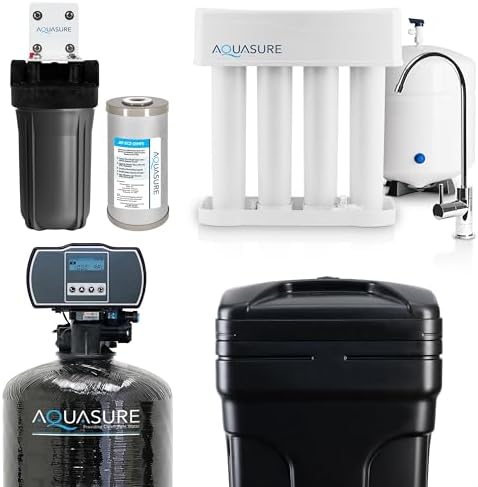
This Aquasure bundle combines a 48,000-grain softener, whole-house filtration, and a 75 GPD RO system. Its stated sizing covers homes with one to six bathrooms, giving it a broad range on paper. A sediment/GAC prefilter is described as helping reduce sediment, chlorine, odors, and taste issues, among other listed contaminants.
The four-stage RO system is intended to provide a further filtration step for drinking water. Aquasure recommends replacing its filters every six to twelve months to support filtration and flow; actual upkeep needs can depend on incoming water and use. The softener has a programmable digital control head and automatic regeneration and backwashing, which may be convenient if you prefer metered operation over manual control.
Compared with the 64,000-grain bundle, this model has less softening capacity but adds clearly described prefiltration. Compared with the 32,000-grain Signature Elite, it has more stated capacity and a defined four-stage RO system. The wide bathroom range does not replace checking hardness, household water use, and system sizing with a qualified installer.
Pros:
- Includes a sediment/GAC prefilter and four-stage RO system
- 48,000-grain capacity with a stated range of one to six bathrooms
- Programmable metered control with automatic regeneration and backwashing
- Described with a five-year extended manufacturer warranty after online activation within 60 days
Cons:
- Filter replacement is part of ongoing maintenance
- Its broad bathroom sizing should be checked against your actual water use and hardness
Verdict: Pick this bundle if prefiltration is a priority and its 48,000-grain capacity fits your tested water conditions and household demand.
3. Aquasure Signature Elite: Best for Smaller Homes

The Signature Elite is a whole-house treatment system with a 32,000-grain softener and digital metered control. Aquasure describes it as a fit for homes with one to two bathrooms and says it is designed for city or well water. Its filtration media is listed as addressing contaminants and qualities such as chlorine, VOCs, pesticides, odors, taste, sediment, and certain metals. The actual performance depends on your source water, so use the product specifications and water test results to confirm it matches your needs.
The product description also includes an RO system, but it does not state an RO production rate in the supplied details. That makes this option less straightforward to compare with the two bundles that specify 75 GPD. Aquasure says RO filters are easy to replace every six to twelve months for best filtration and flow, and the softener’s metered head is designed to set automatic flush intervals according to water quality and use.
Its lower capacity makes it the most targeted choice for a smaller home with moderate demand. It may be a poor fit if your home has more bathrooms, high water use, or significant hardness that calls for a larger system. Check the product’s full specifications for the RO configuration, installation needs, and included components before deciding.
Pros:
- 32,000-grain capacity is stated for one- to two-bathroom homes
- Digital metered control is designed to automate regeneration and backwashing
- Described for both city and well water
- Includes whole-house filtration and an RO system
Cons:
- Lowest softening capacity in this comparison
- The supplied details do not state the RO system’s GPD rating
Verdict: Consider the Signature Elite for a smaller home, but verify the RO specifications and confirm that 32,000 grains suits your water test results.
How to Choose a Water Softener and Reverse Osmosis System
Start with a water test
Test your water before choosing equipment. Hardness, iron, sediment, chlorine, and other water characteristics can affect which treatment stages you need and how much capacity to select. If you use well water, testing is especially useful for identifying conditions that a general product description cannot confirm.
Match softener capacity to your household
Softener capacity is measured in grains. The right size depends on your water hardness and how much water your household uses, not just the number of bathrooms. The products here range from 32,000 to 64,000 grains, with each listing giving a suggested home size. Treat those ranges as a starting point and compare them with your test results and daily demand.
Understand what the RO system treats
A softener treats water for the whole home, while RO is a separate filtration process often used for drinking water. Check where the RO system connects, what components are included, and whether its stated production rate meets your needs. Among these three, two listings specify 75 GPD; the Signature Elite details provided here do not give a GPD figure.
Compare prefiltration with your water concerns
Prefilters can address particular issues before water reaches later treatment stages. The 48,000-grain bundle specifically lists a sediment/GAC prefilter for concerns that include sediment, chlorine, odor, and taste. Do not assume that any system removes every contaminant: compare the manufacturer’s claims with your water test and the complete product specifications.
Plan for maintenance and operating needs
Ask what routine care each component needs, how often filters should be replaced, and what supplies or service may be required. Aquasure lists six- to twelve-month filter replacement guidance for the RO systems described. Also confirm the softener’s operating requirements, regeneration setup, and available space before installation.
Check installation details and warranty terms
Whole-house equipment connects to your plumbing, so confirm connection sizes, clearance, drainage needs, and whether professional installation is recommended for your setup. Warranty terms differ: some listings describe activation requirements for the extended warranty. Read the current product documentation carefully and verify that the coverage applies to your purchase.
Frequently Asked Questions
What does a water softener do that an RO system does not?
A water softener is designed to address hardness throughout the home. RO is a separate filtration process used for a more targeted water supply, often for drinking. The two systems serve different purposes and are not interchangeable.
Do I need both a softener and reverse osmosis?
That depends on your water test and goals. A softener may be useful if hardness is a concern, while RO may be suitable if you want an additional filtration step for drinking water. Test your water and check system specifications before choosing a combination.
Which option has the highest softening capacity?
The Aquasure 64,000-grain bundle has the highest stated capacity in this comparison. Whether it is the right size for you depends on hardness and household water use.
Which bundle is described for a smaller home?
The Aquasure Signature Elite is listed for homes with one to two bathrooms. Confirm that its 32,000-grain capacity fits your water conditions and demand.
Do these products all list the same RO production rate?
No. The 64,000-grain bundle and the 48,000-grain bundle list 75 GPD. The supplied Signature Elite details mention an RO system but do not specify its production rate.
How often do RO filters need to be replaced?
Aquasure recommends replacing the filters described for its RO systems every six to twelve months for best filtration and flow. Your actual schedule can depend on water quality and use, so follow the product instructions.
Final Recommendation
For a larger household seeking the greatest stated softening capacity, the Aquasure 64,000-grain bundle is the clearest match. Choose the 48,000-grain bundle if its sediment/GAC prefilter and four-stage RO system address your priorities. For a smaller home, the Signature Elite may be a better-sized option, but verify its RO specifications. In every case, test your water and confirm sizing and installation requirements before you buy.