
If you own a tankless water heater, mineral buildup is one of the quiet threats to its performance. Hard water leaves calcium and magnesium deposits on heat exchangers and inside small internal passages, and those deposits can reduce efficiency, slow water flow, and shorten the unit’s working life. The challenge is that “water softener” covers several different technologies. Some systems swap minerals out of your water, while others change how scale forms so it stays out of your pipes and equipment. This guide looks at five whole-house and inline options designed to protect plumbing and water heaters, so you can see how each one works and which one fits your situation.
Quick Comparison of the Top 5 Options
| Product | Treatment Method | Listed Flow Rate | Maintenance | Best Fit |
|---|---|---|---|---|
| Waterdrop AP431 Whole House Scale Inhibitor | Polyphosphate scale inhibitor | Up to 10 GPM | Cartridge about every 6 months | Homeowners who want a simple inline add-on |
| H&G Lifestyles Inline Water Softener for Water Heater | Ion-exchange resin softening | Up to 12 GPM at 25–90 PSI | Replaceable cartridge (1,000–1,500 gallons per cartridge) | RVs, apartments, and targeted point-of-use setups |
| Briskspring Salt Free Water Descaler Whole House | Alloy-based salt-free descaler | Listed at 17.6 GPM | No maintenance listed for up to 10 years | Owners who want no power, no chemicals, and no cartridges |
| Water Boss Whole House Salt-Free Scale Control | Salt-free scale control | Up to 15 GPM | No cleaning, backwashing, or salt listed | Larger households with moderate hardness |
| Aquasana Salt-Free Water Conditioner for Tankless Water Heaters | Salt-free scale conditioning (SCM technology) | Not listed in product data | Lasts 2 years, then replaced | Tankless owners who want a conditioner made for their heater type |
Our Picks: Best Water Softener For Tankless Water Heater reviews
Waterdrop AP431: A Polyphosphate Scale Inhibitor for Easy Inline Protection

The Waterdrop AP431 is a whole-house scale inhibitor that installs inline on the cold water line feeding your water heater. Instead of removing minerals, it uses food-grade polyphosphates to keep calcium and magnesium from forming hard scale on surfaces. The listing describes this as a clear difference from conventional filters, and that difference matters. This unit is not a standard pre-filter. Only a portion of the incoming water passes through the cartridge, where it picks up the polyphosphates before rejoining the main flow.
The build is straightforward. The system uses a 304 stainless steel T-fitting with 3/4-inch NPT connections, and the listing gives a flow rate of up to 10 GPM. That is enough for most standard residential plumbing, though the listing does not say how it performs with very large or unusual plumbing layouts. The cartridge is the only consumable, and the listing says it lasts about six months under regular use, with the actual interval depending on local water quality. Installers should keep the unit upright, as the listing recommends, to get the best scale inhibition effect.
In everyday use, many owners appreciate that the setup has few moving parts and no power requirement. Because it works by treating the water chemically in a small amount, it does not add salt or demineralize the water. Some users report that the six-month cartridge schedule is easy to remember, though others note that it adds a recurring task to the calendar. A practical concern is that polyphosphate-based systems depend on the water being treated consistently, so the protection you get is only as good as your replacement schedule. Compared with the true softening option in this list, the Waterdrop AP431 offers less dramatic results on hard water, but it asks less of your plumbing and your wallet over time.
Pros:
- Simple inline installation on the cold supply line to the water heater
- Uses food-grade polyphosphates and does not add salt to your water
- Listed flow rate of up to 10 GPM with 3/4-inch NPT connections
- Includes one replacement cartridge in the package
Cons:
- It inhibits scale rather than removing hardness minerals, so results are less dramatic in very hard water
- The cartridge needs replacing about every six months, which can be easy to forget
Verdict: The Waterdrop AP431 is a good choice if you want an easy, low-maintenance way to slow scale in your tankless water heater and nearby fixtures. It works best in areas with moderate hardness and for owners who will stick to the replacement schedule. If you need your water truly softened, look at the ion-exchange option below instead.
H&G Lifestyles Inline Softener: Ion-Exchange Resin in a Compact Cartridge
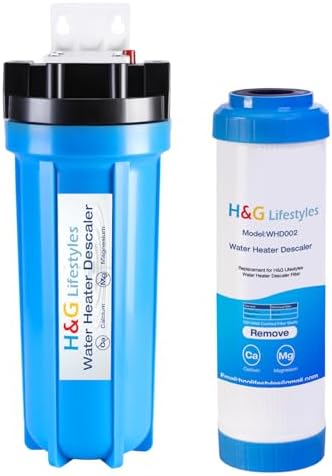
The H&G Lifestyles unit is the only option in this list that works as a true water softener. It uses cation exchange resin to swap calcium and magnesium ions for other ions, which removes hardness from the water rather than just changing how scale forms. The listing claims removal of up to 99.6 percent of calcium and 99.3 percent of magnesium, and it describes the resin as NSF/ANSI certified food-grade media. The resin uses a 10 percent crosslink formulation, which the listing says improves chlorine resistance compared with standard 8 percent media.
The hardware is compact. The package includes two 3/4-inch NPT male by 3/4-inch hose barb solid brass fittings, so you can connect to 3/4-inch ID hoses without buying extra adapters. The listed flow rate is up to 12 GPM at 25 to 90 PSI. Each cartridge is rated for roughly 1,000 to 1,500 gallons depending on water quality, so your replacement schedule depends heavily on how hard your water is and how much you use. This makes it a flexible tool for RVs, apartments, and point-of-use or targeted applications, though the listing presents it as a whole-house calcium filter option as well.
Owners who need a compact, portable-feeling solution often find the size appealing, and the brass fittings feel solid for the price class. Some users report that the hose barb connections are simpler to set up in tight spaces than rigid plumbing work. The main trade-off is that a cartridge softener is a consumable system, and it will need regular replacement. Heavy water use can exhaust a cartridge faster than the rated range, so you should track your usage. Among the five choices, this is the most direct answer to the question of softening, but it also has the most ongoing maintenance.
Pros:
- Removes hardness minerals instead of only inhibiting scale
- Compact design suits RVs, apartments, and tight spaces
- Includes two brass fittings, so hose connections work without extra adapters
- Listed flow rate of up to 12 GPM at 25 to 90 PSI
Cons:
- Cartridges need regular replacement, and lifespan varies widely with water quality and use
Verdict: This is the right pick if you want actual softening for your tankless heater and fixtures in a compact package. It suits RVs, small apartments, and targeted setups well. Plan on tracking your water use and budgeting for cartridge replacements, because that will decide how well this system performs over time.
Briskspring Q1 Salt-Free Descaler: A No-Power, No-Chemical Alternative

The Briskspring Q1 is a salt-free descaler built around an internal alloy. According to the listing, the alloy changes how calcium and magnesium ions behave in flowing water so they are less likely to crystallize into scale. The listing also states that the device does not require external power or chemicals and produces no wastewater. The manufacturer cites a scale inhibition rate of 86 percent and says the internal alloy can release electrons for up to 10 years without disassembly or maintenance. The listing also says the unit can soften and remove existing scale over time, and it notes that it retains beneficial minerals in the water.
The physical design is simple. The connection is 3/4-inch NPT, and the listing gives a flow rate of 17.6 GPM. The manufacturer recommends water hardness below 300 ppm, which is roughly 17.5 grains per gallon. That threshold is an important limit, so you should test your water before you buy. A homeowner on very hard water may see weaker results than the listing suggests.
Many owners appreciate the appeal of a maintenance-free device with no cartridges, no salt, and no electrical connection. Some users report that once it is installed, they rarely think about it, which is a real advantage for anyone who dislikes recurring service tasks. The trade-off is that the performance claims are harder to verify than those for a standard cartridge system, and salt-free devices of this type are generally less predictable than resin softeners. The product data also lists this item as currently unavailable, so check stock before you plan around it. Compared with the Waterdrop AP431, the Briskspring trades ongoing cartridge replacements for a longer-term, less verifiable promise.
Pros:
- No power, chemicals, or cartridges required
- Listed alloy lifespan of up to 10 years with no routine maintenance
- High listed flow rate of 17.6 GPM with 3/4-inch NPT connections
- Keeps beneficial minerals in the water, according to the listing
Cons:
- Performance depends on hardness below 300 ppm, and the product data lists this unit as currently unavailable
Verdict: The Briskspring Q1 is worth considering if you want a set-and-forget scale control device and your water hardness falls within the recommended range. Test your water first, confirm the stock status, and treat the manufacturer’s scale-reduction figures as claims rather than guarantees.
Water Boss WB-WH-DSCLR: A High-Flow Salt-Free Scale Control for Larger Homes

The Water Boss Whole House Salt-Free Scale Control is designed to prevent scale in pipes, plumbing, and connected equipment without softening the water. It does not remove the minerals that cause hard water, and the listing states clearly that it does not reduce TDS, sulfur, or iron. The system is rated for water with hardness under 15 grains per gallon, alkalinity below 250 mg/L, pH under 8.3, and iron below 0.3 ppm. Those limits are narrower than some competitors, so you should compare your water report against them before you commit.
The listing gives a maximum flow rate of 15 GPM and a 6-year service life, which is one of the longest maintenance intervals in this group. The system needs no cleaning, backwashing, salt refills, or electricity, which keeps day-to-day upkeep minimal. The listing states the product is designed, engineered, and assembled in the USA, and it is positioned for households of four or more people. That positioning makes sense, because larger households put more demand on water heaters and the flow capacity matters more in those homes.
In practical use, owners often value the steady water pressure and the lack of routine maintenance. Some users report that it works well as a first line of defense for plumbing in homes with moderate hardness, while others note that it cannot replace a full softener if they dislike soap scum or spotting. Because the system does not soften the water, you may still see some of those effects. The best use case is a larger household with moderate hardness that wants scale control without salt, cartridges, or power. Compared with the Waterdrop AP431, it has a longer maintenance interval and higher listed flow, but it is more limited by your water chemistry.
Pros:
- Long 6-year service life with no salt, power, or routine cleaning needed
- Listed maximum flow rate of 15 GPM for larger households
- Designed and assembled in the USA, according to the listing
- Clear water chemistry limits make it easier to decide if it fits your home
Cons:
- Does not soften water or reduce minerals, so spotting and soap effects may remain
Verdict: The Water Boss is a strong choice for larger homes with moderate hardness that want low-maintenance scale control for a tankless heater and whole-house plumbing. Confirm that your water falls within the listed limits before buying. If your main goal is softer water for showers and laundry, a true softener is the better fit.
Aquasana EQ-AS20: A Salt-Free Conditioner Made for Tankless Heaters

The Aquasana EQ-AS20 is a salt-free water conditioner built specifically for tankless water heaters. It uses what the manufacturer calls SCM technology, which converts dissolved hard minerals into inactive microscopic crystals that pass through the water and down the drain rather than sticking to surfaces. Like the other salt-free options here, it does not demineralize your water, so you keep the minerals in your drinking water. The listing also says the system does not need electricity, a drain for wastewater, or salt.
The main selling point is the heater-specific design. A tankless unit has tighter internal passages than a storage tank, so scale can build up faster in those spots. A conditioner built for that use case makes sense on paper, and the manufacturer positions it for that purpose. The listing states the system lasts about two years and is easy to replace. The product data does not provide a flow rate, so you should confirm that the unit matches your heater’s requirements and your home’s plumbing before you order. This item is also listed as currently unavailable.
Owners who want a maintenance-light system often appreciate that the installation involves no power or drainage work. Some users report that softer-feeling water and easier cleaning on fixtures are noticeable benefits, although salt-free systems do not change the hardness level itself. The two-year replacement interval is longer than a six-month cartridge but shorter than the alloy-based or 6-year scale control options in this list. In terms of value, the EQ-AS20 is most attractive to tankless owners who want a product designed around their heater type, but you will need to confirm the stock status and verify the fit for your plumbing.
Pros:
- Designed specifically for tankless water heaters
- No electricity, wastewater drainage, or salt required
- Does not demineralize water, so minerals stay in your supply
- Simple two-year replacement cycle
Cons:
- The product data lists no flow rate, and the unit is currently listed as unavailable
Verdict: The Aquasana EQ-AS20 is a sound pick for tankless owners who want a salt-free conditioner made for their heater type and a simple replacement cycle. Check that it is in stock and confirm the flow requirements for your home before you buy. It is a better fit for homeowners who value the heater-specific design than for those who need a verified flow rating.
How to Choose the Right Water Softener for Your Tankless Water Heater
Understand Your Water Hardness Before You Buy
Hardness is the starting point for any buying decision in this category. Hard water contains calcium and magnesium, and the concentration is usually measured in grains per gallon or parts per million. Your local water utility publishes a water quality report, and many home test kits can give you a reading. Once you know your number, you can match it to the product’s stated limits. Some salt-free devices work best below certain thresholds, so a product that performs well in one home may underperform in another. Testing first saves money and prevents disappointment.
Know the Difference Between Softening and Scale Control
Many shoppers use the word “softener” for any device that protects plumbing, but the technologies differ. Ion-exchange systems remove calcium and magnesium from the water, which gives you the most noticeable change in soap lather and spotting. Salt-free scale control systems leave the minerals in the water and change how they form deposits. Polyphosphate inhibitors do something similar but use a chemical treatment. Each approach has trade-offs in cost, maintenance, and the level of protection they offer. For a tankless heater, scale control may be enough if your main goal is protecting the heat exchanger, while softening is better if you also want to change how your water feels and behaves in daily use.
Check Flow Rate and Connection Size
Tankless water heaters need steady flow to operate correctly, and a restriction in the supply line can cause performance problems. Look at the listed maximum flow rate and make sure it exceeds your home’s peak demand. Pay attention to the connection size as well. Most of the products here use 3/4-inch NPT connections, but you should confirm the size of your existing pipes and fittings before buying. A mismatch may require adapters, which add cost and potential leak points. If the listing does not provide a flow rate, consider that a gap you need to fill before you purchase.
Plan for Installation and Location
Most of the options in this guide are designed for inline installation on the cold water supply line that feeds your water heater. Some listings give specific guidance about orientation, such as keeping a unit upright during installation. Plan where the unit will sit, and make sure you have enough space for servicing or cartridge replacement. If you are not comfortable with plumbing work, a licensed plumber can handle the job. Also check your tankless water heater’s manual for any requirements about water quality or added equipment, since some manufacturers set conditions for warranty coverage.
Consider Maintenance and Long-Term Upkeep
Maintenance determines how a product fits into your routine. Cartridge systems need replacement on a schedule that depends on use and water quality, so they require attention over time. Alloy-based and salt-free devices may need little or no routine service, but their performance depends more on your water chemistry and is harder to verify. Think about how much attention you are willing to give the system. A device you forget to maintain may stop protecting your heater, so match the maintenance schedule to your habits.
Look at Certifications, Materials, and Warranty Terms
Materials and certifications tell you something about build quality and intended use. Several products here reference food-grade materials, brass or stainless steel fittings, or NSF/ANSI certified media. Those details matter if you care about drinking water quality, since the water passing through the system may reach your kitchen tap. Read the warranty terms carefully, especially for devices that claim long service lives. A warranty backs up the manufacturer’s claims and gives you a way to address defects.
Frequently Asked Questions
Do I really need a water softener for a tankless water heater?
Not every home needs a full softener, but most tankless owners benefit from some form of scale protection in hard water areas. Tankless units heat water on demand, and mineral deposits can reduce efficiency and cause buildup inside the heat exchanger. Test your water hardness first. If the number is high, a scale control or softening device is a sensible investment. If your water is soft or only slightly hard, you may not need a separate device at all.
Is a salt-free system the same as a water softener?
No. A salt-free system does not remove calcium and magnesium from your water. It changes how those minerals behave so they are less likely to form hard scale. A true softener removes the minerals through ion exchange. Salt-free systems keep minerals in the water, which can be a benefit for drinking, but they do not give the same results for soap lather or spotting.
How often do the cartridges need replacing?
It depends on the product type and your water conditions. The Waterdrop AP431 is listed at about six months of regular use, while the H&G Lifestyles cartridge is rated for roughly 1,000 to 1,500 gallons depending on water quality. The Aquasana EQ-AS20 is listed as lasting about two years. Water Boss lists a 6-year service life. Check the product listing and your water hardness before setting a replacement reminder.
Can I install one of these systems myself?
Many of these products are designed for inline installation with standard 3/4-inch NPT fittings, so a handy homeowner may be able to install one. Still, you should shut off the water supply, relieve pressure, and follow the manufacturer’s instructions closely. If you are unsure about cutting pipe, adding fittings, or working near a water heater, hire a licensed plumber. A poor installation can cause leaks or reduced flow.
Will a scale inhibitor protect my fixtures as well as my water heater?
Scale inhibitors and salt-free devices are often marketed to protect pipes, faucets, shower heads, and dishwashers as well as water heaters. Those claims are plausible because scale forms throughout a plumbing system. However, the level of protection depends on your water chemistry and how well the product matches your home. Some listings specify limits such as hardness levels or iron content, so read those details carefully before you rely on the system.
Do these systems change the taste of my drinking water?
Salt-free and scale inhibition systems generally do not demineralize water, so they are less likely to change taste than a full softener. The H&G Lifestyles softener removes hardness minerals through ion exchange, which can change the water chemistry more noticeably. Taste is subjective, and your existing water source will also affect the result. If drinking water is your main concern, consider a separate point-of-use filter for the kitchen tap.
Which option is best for a small home or RV?
The H&G Lifestyles inline softener is the most suitable of these five for RVs, apartments, and smaller setups, because it is compact and includes hose barb fittings. It also provides true softening, which many small-space owners prefer. Keep in mind that cartridge replacement depends on your water use, so track your consumption. A smaller home with moderate hardness may also do well with the Waterdrop AP431 if you want a simple, low-cost inline system.
Final Recommendation
For most homeowners who want a simple, inline way to slow scale in a tankless water heater, the Waterdrop AP431 is the most practical starting point. It is easy to install, uses no salt or power, and includes a replacement cartridge. If your water is very hard and you want true softening, the H&G Lifestyles inline softener is the stronger choice, especially for compact spaces. Larger households with moderate hardness should look closely at the Water Boss system because of its high listed flow and long service life. The Briskspring and Aquasana options suit owners who want salt-free, low-maintenance protection, but both are currently listed as unavailable, so confirm stock before you plan around them. Test your water first, match the product to your hardness and flow needs, and choose the option that fits the maintenance routine you will actually keep.