
Hard water can leave scale on fixtures, make soap harder to rinse, and add mineral buildup inside plumbing and appliances. A whole-house water softener treats water as it enters your home, but the right choice depends on your water hardness, household use, installation space, and how much upkeep you want to handle. These five options range from metered systems with digital controls to a model with smart-home features.
Quick Comparison: Whole-House Water Softeners
| Product | Capacity | Standout feature | Best suited for |
|---|---|---|---|
| Aquasure Harmony Series 48,000-Grain Water Softener | 48,000 grains | Metered control head and included pre-filter | Homes with 3–4 bathrooms |
| Kenmore 350 Whole House Water Softener | 32,000 grains | Regeneration that learns household water use | Households of 1–4 people |
| Aquasana SimplySoft 40K Grain Water Softener | 40,000 grains | Metered operation; NSF/ANSI 44 certification | Homes with up to 5 people and 4 bathrooms |
| GE Smart Water Softener | 35,000 grains | Wi-Fi alerts and optional remote shutoff pairing | Households of up to 6 people |
| AFWFilters Fleck 5600 SXT Water Softener | 48,000 grains | Metered-demand valve and 10% crosslink resin | Shoppers who want a configurable, traditional system |
Our Picks: Best Water Softener For Whole House reviews
1. Aquasure Harmony Series: A 48,000-Grain System with a Pre-Filter

The Aquasure Harmony is a salt-based, metered whole-house softener rated for 48,000 grains. Its product information positions it for homes with three to four bathrooms. The digital control head lets you program regeneration based on water use, rather than relying only on a fixed schedule.
This package also includes a sediment, carbon, and zinc pre-filter. The manufacturer says the filter targets chlorine, odors, sediment, and other listed contaminants. A pre-filter is a separate treatment stage from softening, so check the filter specifications for the particular substances in your water rather than assuming it addresses every water-quality concern.
The tank is described as fiberglass-lined polyethylene, with a corrosion-resistant design, a bypass valve, and prefilled resin. This is a feature-rich option, but it needs suitable space and plumbing access, along with room for routine salt replenishment. The product lists a 30-day money-back policy and a five-year extended manufacturer warranty, with free US-based technical support after online activation within 60 days; check the seller’s terms for details.
Pros:
- 48,000-grain capacity and metered controls
- Includes a sediment, carbon, and zinc pre-filter
- Designed for homes with three to four bathrooms
- Product information includes warranty and US-based technical support terms
Cons:
- The pre-filter adds another component to maintain and replace as needed
- May be more system than a small household requires
Verdict: Choose the Aquasure if you need a larger metered softener and value having a pre-filter in the package, but confirm that its capacity and filter setup match your water test results.
2. Kenmore 350: A Compact, Learning-Control Softener
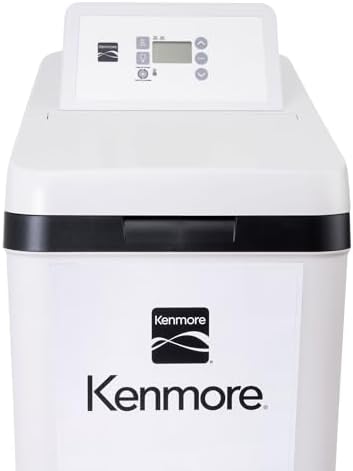
The Kenmore 350 is a 32,000-grain whole-house softener intended for households of one to four people. Its IntelliSoft control is designed to learn a household’s water-use pattern and regenerate when needed. The system also monitors salt levels, which can help you keep an eye on routine maintenance.
Kenmore lists a compact footprint and a high-flow 3/4-inch valve, along with a digital display for flow and salt information. It is described as reducing hardness minerals and clear-water iron, but the supplied product details do not give a specific iron limit. If your water contains iron, test it and confirm the system’s suitability before buying.
The listed warranty is one year for the full unit, three years for electronics, and ten years for the tank. The product information supplied for this article indicates that this model is not currently marked available, so check the listing before making installation plans.
Pros:
- 32,000-grain capacity aimed at households of one to four people
- Learning-based regeneration is designed to respond to household use
- Compact design and digital monitoring features
- Warranty coverage is listed for the unit, electronics, and tank
Cons:
- Lower capacity than the 40,000- and 48,000-grain choices here
- Availability should be confirmed before you plan a purchase
Verdict: The Kenmore is a sensible size to consider for a smaller household that wants adaptive controls, provided the listing is available and its capacity fits your hardness and water use.
3. Aquasana SimplySoft: A Certified, Metered 40,000-Grain Option

The Aquasana SimplySoft is a 40,000-grain ion-exchange softener designed for homes with up to five people and four bathrooms. Its metered control lets the system regenerate based on water use. Aquasana says metered operation can use less salt and water than standard time-based regeneration, though actual use depends on household demand and settings.
A notable distinction is the product’s stated IAPMO certification to NSF/ANSI 44 for reducing water hardness and to CSA B483.1. It is described for use with city or well water. The system has an LCD control, and its product information lists a 5/10-year limited warranty; confirm the exact coverage and terms before purchase.
The product is listed as a base tank and cabinet system. An optional pre-filter is recommended by the manufacturer and sold separately, so budget for that separately if you want the added filtration stage. The supplied listing information indicates that the product is not currently marked available, so check its status before choosing it.
Pros:
- 40,000-grain capacity for homes with up to five people and four bathrooms
- Metered operation and an LCD control
- Stated certification to NSF/ANSI 44 and CSA B483.1
- Product information lists a 5/10-year limited warranty
Cons:
- The recommended pre-filter is an additional purchase
- Availability and exact warranty coverage should be checked before buying
Verdict: Consider the SimplySoft if certification and metered operation are priorities, but verify current availability and whether you need to add the optional pre-filter.
4. GE Smart Water Softener: Wi-Fi Alerts for a Connected Home

GE’s 35,000-grain softener is designed for households of up to six people. Its Wi-Fi connection works with the SmartHQ app to provide water-flow alerts, low-salt reminders, and a Vacation Mode. These features may suit you if you prefer to monitor a home system from your phone rather than rely only on a control-panel check.
The unit has 1-inch plumbing connections and includes quick connectors that the product description says can accommodate 3/4-inch and 1-1/4-inch plumbing. A bypass blending control lets you adjust the preferred softness level or use complete bypass. GE also describes leak detection and remote water shutoff when paired with the RMVALVESFT shutoff valve, which is sold separately.
That optional valve is an important cost and setup consideration: the softener alone does not provide the described remote shutoff feature. The supplied product information also indicates that the listing is not currently marked available, so confirm its status and compatibility with your plumbing before planning around it.
Pros:
- 35,000-grain capacity, with a stated fit for households of up to six people
- Wi-Fi alerts, low-salt reminders, and Vacation Mode
- Bypass blending control for adjusting softness or bypassing treatment
- Quick connectors are described for several common pipe sizes
Cons:
- Remote water shutoff requires a separately sold valve
- Availability should be confirmed before purchase
Verdict: The GE is the most connected option in this group, but it makes the most sense if you will use the app features and are prepared to buy the separate shutoff valve if needed.
5. AFWFilters Fleck 5600 SXT: A Traditional Metered System with Crosslink Resin

This AFWFilters system pairs a 48,000-grain rating with a Fleck 5600SXT digital metered-demand control valve. Its product details list a 10-by-54-inch mineral tank, 1.5 cubic feet of 10% crosslink resin, and a brine tank that holds up to 250 pounds of salt. Bypass and drain fittings are included.
The maker says the 10% crosslink resin is designed to handle chlorinated municipal water better than standard 8% media. That may be useful if your home is on a chlorinated supply, but it does not replace checking your water or following the system’s maintenance instructions. The 1-inch NPT connections are described as fitting standard residential plumbing layouts; confirm your pipe size and installation requirements before ordering.
The system is described as USA-assembled, with installation instructions and product support available. Compared with the Aquasure, it has a similar stated grain capacity but a more component-focused setup; the Aquasure includes a pre-filter, while this AFWFilters listing emphasizes its resin, tank dimensions, and Fleck valve.
Pros:
- 48,000-grain rating with metered-demand controls
- 10% crosslink resin is designed for better chlorine resistance than standard 8% media
- Includes bypass and drain fittings
- Lists tank dimensions, resin amount, and brine tank capacity for planning
Cons:
- The listed tank and brine capacity require space for a full-size system
- Does not include the pre-filter supplied with the Aquasure option
Verdict: Pick the AFWFilters system if you want a 48,000-grain metered softener with specified tank components and crosslink resin, and have room for its separate tanks.
How to Choose a Whole-House Water Softener
Test your water before choosing a system
Start by finding out how hard your water is, preferably with a reliable test. If you use well water, consider testing for other issues such as iron as well. A softener’s grain rating alone does not tell you whether it is the right fit; the system must be sized for both your water’s mineral content and how much water your household uses.
Match grain capacity to household demand
Grain capacity describes how much hardness a softener can handle before it needs to regenerate. A larger household, harder water, or heavier water use can require more capacity. Use the product’s household guidance as a starting point, then compare it with your test results and daily use. Avoid choosing solely by the largest number, since an oversized or undersized unit may not suit your needs.
Compare metered and learning controls
Metered systems use water-use information to determine when to regenerate, while learning controls are designed to adapt to household patterns. These approaches can help avoid regeneration based only on a fixed timer, but you should still check the control settings and salt level. Look for a display that makes routine monitoring clear to you.
Plan for salt, water, and maintenance
Conventional ion-exchange softeners need salt in a brine tank and periodically regenerate. Consider whether you have room to store salt and can reach the tank for refills. If a system includes a pre-filter, factor in the additional filter maintenance. Read the manufacturer’s guidance for upkeep and regeneration rather than assuming all models have the same schedule.
Check plumbing, drain access, and installation space
Before ordering, confirm the unit’s connection sizes and the available space near your home’s water entry point. Whole-house systems also need an appropriate place for their tanks and a suitable drain arrangement for regeneration. If you are unsure about plumbing changes, have an installer check the location and connection requirements first.
Know what the softener does—and does not do
A water softener is intended to reduce hardness minerals through ion exchange. That is not the same as removing every contaminant or making unsafe water safe to drink. If you have concerns beyond hardness, use a water test to identify them and select treatment designed for those specific needs. Some ion-exchange softeners add sodium to the treated water; if that matters for your household, discuss suitable options with a qualified professional.
Compare certifications, warranty terms, and added features
Certifications can help you understand what a product has been tested to do, so check the exact standard and claim rather than relying on broad terms like “filtered.” Review warranty length and coverage carefully, since tank, electronics, and other parts may have different terms. Also decide whether features such as app alerts or a separately sold shutoff valve are useful enough to justify the added setup.
Frequently Asked Questions
What does a whole-house water softener do?
It treats water as it enters the home, reducing hardness minerals before the water reaches household taps and appliances. Most conventional systems use ion exchange and require salt for regeneration.
How do I know what grain capacity I need?
Use your water-hardness test results together with your household’s water use. The right capacity depends on both, so the number of people in your home is only a starting point. Follow the manufacturer’s sizing guidance or ask a water-treatment professional to help calculate the fit.
Do I need a separate filter with a water softener?
Not always. A softener targets hardness, while a filter is selected for particular substances or concerns. Some systems include a pre-filter, and some offer one separately. Test your water and check the filter’s stated capabilities before deciding.
Can a water softener be used with well water?
Some models are described for city or well water, but well water can vary. Test for hardness and other relevant conditions, including iron where appropriate, and confirm the selected system can handle your results.
How much maintenance does a softener need?
Expect to monitor and replenish salt, check the system’s controls, and follow the manufacturer’s maintenance instructions. Systems with pre-filters may need filter changes as well. The exact routine depends on your water and the model.
Does a softener remove all water contaminants?
No. Softening is designed to reduce hardness minerals, not to remove every possible contaminant. If you have other water-quality concerns, test for them and choose treatment specifically intended for those issues.
Final Recommendation
For a larger household looking for a 48,000-grain metered system with an included pre-filter, the Aquasure Harmony is the most complete package in this group. The Aquasana stands out for its stated certification, while the GE is worth considering if app alerts matter to you and you are willing to account for its separately sold shutoff valve. Before choosing any model, test your water, confirm the system’s capacity against your household’s needs, and verify current availability and installation requirements.