
Iron in well water can leave rust-colored stains, affect taste, and add to the work your water system has to do. The right setup depends on your water test results: some systems pair a softener with an iron filter, while others are softeners designed to handle a limited amount of iron. These five options cover both approaches, from whole-house filtration bundles to softeners with fine-mesh resin. Check your iron level, hardness, and household water use before choosing.
Quick Comparison
| Product | System type | Notable details | Best fit |
|---|---|---|---|
| PRO+AQUA Elite 5-Stage Bundle | Whole-house filter and softener bundle | Five-stage treatment; automatic regeneration | Small to medium households seeking several treatment stages |
| AFWFilters Fleck IRON Pro 2 | Combination softener and iron filter | Fine-mesh resin; stated iron range of 4–7 ppm | Homes that need both softening and iron treatment |
| Kenmore 420 | Whole-house water softener | 40,000-grain capacity; designed to reduce clear-water iron | Households looking for a softener with added iron reduction |
| PRO+AQUA PRO-E-S25E | Three-stage filter and softener combo | 25,000-grain capacity; metered regeneration | Smaller homes with one to three people |
| DuraWater Fleck 5600 SXT Iron Blaster | Water softener with fine-mesh resin | 48,000-grain capacity; metered regeneration | Homes needing a higher-capacity softener for iron-bearing well water |
Our Picks: Best Water Softeners For Well Water With Iron reviews
PRO+AQUA Elite: A Multi-Stage Well Water Bundle

The PRO+AQUA Elite combines a whole-house softener with multiple filtration stages. Its five-stage design is intended for well water and is described as reducing a range of contaminants, including heavy metals, as well as hardness. This makes it a broader treatment package than a softener alone.
The bundle is aimed at small to medium households. Its listed features include automatic regeneration for the softener system and easy filter changes. Since it combines separate treatment stages, plan for the space and plumbing connections needed for the full setup, and confirm which contaminants each filter stage is designed to address.
This pick makes the most sense when you want softening and filtration in one package. It is not the most direct choice if your main concern is a measured iron level and you want a system with a clearly stated iron-treatment range; the AFWFilters option provides a specific stated range.
Pros:
- Combines a softener with a five-stage filtration package.
- Designed specifically for well-water treatment.
- Includes automatic regeneration and changeable filters.
- Intended for small to medium households.
Cons:
- The supplied details do not state an iron-removal range in ppm.
- Multiple treatment stages mean more components to fit and maintain than a softener alone.
Verdict: Choose the PRO+AQUA Elite if you want a broad whole-house well-water package, but match its filtration stages to your water test results before buying.
AFWFilters Fleck IRON Pro 2: A Dedicated Softener and Iron-Filter Combo

The AFWFilters Fleck IRON Pro 2 is designed to treat hardness and iron in one whole-house system. Its fine-mesh resin is intended for higher-iron well-water applications, and the listing states an iron range of 4–7 ppm. It also lists manganese reduction up to 6 ppm and removal of sediment, sand, and rust.
A Fleck 5600SXT digital metered valve controls regeneration. Metered control is useful when you want regeneration tied to water use rather than a fixed schedule, though the right settings depend on your household and water conditions. The listing also specifies a Pentair tank and includes an installation kit.
This is one of the more targeted choices here for a home with tested iron and hardness. The stated range gives you a useful point of comparison, but do not assume it will work for every well: confirm your water chemistry and the manufacturer’s operating requirements. For iron beyond the stated range, a separate treatment stage may be needed.
Pros:
- Combines water softening and iron treatment in one system.
- Fine-mesh resin is specified for higher-iron well-water use.
- Lists an iron range of 4–7 ppm and manganese reduction up to 6 ppm.
- Includes a digital metered valve and installation kit.
Cons:
- Its stated iron range may not cover wells with higher iron levels.
- Water testing and correct system setup are important for suitable operation.
Verdict: If your test results fall within the listed iron range and you need both softening and iron treatment, the AFWFilters combo is a strong match to consider.
Kenmore 420: A Higher-Capacity Softener for Clear-Water Iron

The Kenmore 420 is a 40,000-grain whole-house softener designed for households of one to five people. Its product details say it softens calcium and magnesium and reduces clear-water iron. A built-in sediment screen adds a first layer of protection for the system and household plumbing.
IntelliSoft technology is described as learning household water-use patterns and regenerating when needed. The system also includes a sediment pre-filter and is presented as suitable for well water. Keep in mind that this is still primarily a softener, not a dedicated iron-filter-and-softener combination like the AFWFilters unit.
The supplied product data marks this model as unavailable. Availability can change, so check the listing before planning a purchase. If it is not available, compare the capacity and iron-treatment needs with the PRO+AQUA or DuraWater options rather than assuming they are direct replacements.
Pros:
- 40,000-grain capacity for whole-house softening.
- Designed to reduce clear-water iron as well as hardness.
- IntelliSoft adjusts regeneration to household water-use patterns.
- Includes a built-in sediment screen.
Cons:
- The supplied product data marks it unavailable.
- The details do not state a specific iron-removal range.
Verdict: Consider the Kenmore 420 if it is available and your concern is hardness with clear-water iron, but verify its iron limits against your lab results.
PRO+AQUA PRO-E-S25E: A Compact Three-Stage Combo

The PRO+AQUA PRO-E-S25E combines three-stage filtration with a 25,000-grain softener. Its listed filtration targets include chlorine, lead, iron, volatile organic compounds, sulfur, and other contaminants. The product details describe it as suitable for one to three people and one to two bathrooms.
A smart digital valve provides metered regeneration, and the kit includes the resin tank, brine tank, valves, drain line, and manual. The filters are listed for changes every six months, so factor filter replacement into ongoing upkeep. The supplied information does not give a specific iron-removal capacity or ppm range, so it is important to confirm that the system suits your well’s iron level.
This is the smallest-capacity softener in this group and is aimed at smaller households. It offers more than softening alone, but households with higher water use or iron levels beyond its specified treatment capability may need another system or additional treatment.
Pros:
- Pairs a softener with three filtration stages.
- Lists iron among the filtration targets.
- Metered regeneration and a complete installation kit are included.
- Designed for smaller homes with one to two bathrooms.
Cons:
- The listed 25,000-grain capacity is lower than the 40,000- and 48,000-grain options here.
- The supplied details do not state an iron-removal range in ppm.
Verdict: The PRO-E-S25E is worth considering for a smaller household that wants filtration and softening together, provided its iron treatment is suitable for your test results.
DuraWater Fleck 5600 SXT Iron Blaster: A 48,000-Grain Softener
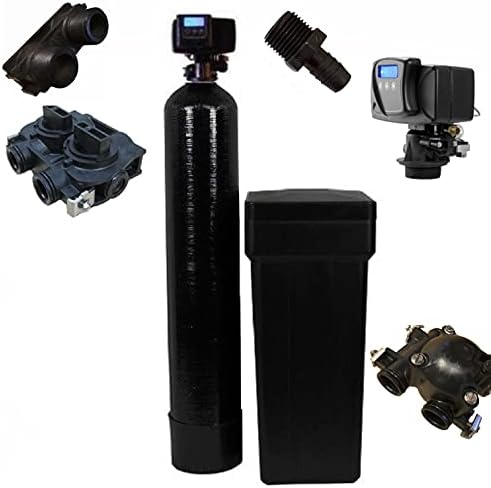
The DuraWater Iron Blaster is a 48,000-grain softener supplied with fine-mesh resin. The product details say this resin performs best in well-water applications when removing hardness with higher amounts of iron. Its listing does not provide a specific iron limit, so check with the seller or manufacturer to confirm suitability for your water.
The system uses a Fleck 5600 SXT digital metered control valve and regenerates based on measured water use. The supplied components include a resin tank, a brine tank with a safety float, and an overflow drain. Its capacity is higher than the two PRO+AQUA softener options in this selection, which may be useful for households with greater softening demand, depending on water hardness and use.
Unlike a system explicitly described as including a separate iron filter, this model relies on fine-mesh resin as part of the softener. That distinction matters: if your well has substantial iron or other water-quality concerns, a dedicated filtration stage may be a better fit.
Pros:
- 48,000-grain softening capacity.
- Fine-mesh resin is specified for well water with higher iron.
- Metered regeneration is designed to respond to water use.
- Includes a brine tank with a safety float and overflow drain.
Cons:
- The supplied details do not state a specific iron-removal range.
- It is not described as a separate, multi-stage iron-filter system.
Verdict: Choose the DuraWater if you want a higher-capacity softener with fine-mesh resin for iron-bearing well water, but confirm the iron limit before relying on it as your only iron treatment.
How to Choose a Water Softener for Well Water With Iron
Start With a Well-Water Test
Test for hardness and iron before choosing a system. Ask the lab or testing provider to identify the iron level and, if possible, the form of iron present. Well water can also contain other contaminants, so use the results to decide whether you need softening, filtration, or both. A product’s general claim about iron reduction is not a substitute for matching its limits to your water.
Match the Treatment to the Type and Amount of Iron
Some softeners are designed to handle clear-water iron within limits, while combination systems add a dedicated iron-treatment stage. The AFWFilters product lists a specific iron range; the other product descriptions do not provide comparable ppm limits. If your test shows iron above a system’s stated range, ask the manufacturer about pretreatment or a separate iron filter instead of assuming a softener will solve the problem.
Choose Capacity for Your Water Use and Hardness
Grain capacity is one factor in how much hardness a softener can handle between regenerations. Household size, water use, and the hardness level all affect the capacity you need. A higher grain rating is not automatically better for every home; choose a properly sized unit and consider how its regeneration settings work with your water use.
Check the System’s Other Filtration Claims
Whole-house systems may target contaminants beyond iron and hardness, such as sediment, sulfur, chlorine, or lead. Those claims vary by product and filter stage. Compare the system’s stated targets with your test results, and confirm the filter’s replacement schedule and any operating limits before buying.
Plan for Installation and Maintenance
These systems need space for tanks and access to plumbing, a drain, and a power source where required by the design. Some packages include installation components, but that does not mean every home has the connections needed for a straightforward setup. Check the manual and installation requirements. Also account for salt, filter changes, and the care needed to keep the system operating as intended.
Consider Regeneration Controls and Ongoing Use
Metered systems regenerate based on water use, while other systems may use different control settings. Follow the setup instructions and confirm that the settings reflect your water test and household needs. Incorrect settings can affect how well a softener handles hardness and how often it regenerates.
Frequently Asked Questions
Can a water softener remove iron from well water?
Some softeners can reduce certain forms of iron within specified limits, but not every softener is designed for iron. A dedicated iron filter or a combination system may be a better choice for higher levels. Check the product’s stated limits and compare them with a water test.
Should I buy a softener or a separate iron filter?
That depends on your test results. If you need to treat both hardness and iron, a combination system may be convenient. If the iron level is beyond the softener’s stated range, or your water has additional issues, a separate filter or a staged treatment setup may be needed.
Is fine-mesh resin enough for well water with iron?
Fine-mesh resin is designed for certain iron-bearing water applications, but the product data still matters. Check the system’s iron limit and operating requirements. Do not assume that fine-mesh resin will handle every iron level or type.
What does a grain-capacity rating tell me?
Grain capacity describes the amount of hardness a softener is designed to handle between regeneration cycles. It does not tell you the system’s iron limit by itself. Sizing should take your household’s water use and hardness into account.
Can these systems treat every well-water contaminant?
No. Treatment varies by system and filter stage. A softener targets hardness, while additional filters may address other listed contaminants. Test your water and confirm that the system is designed to treat the contaminants you have identified.
How often do whole-house filters need replacement?
It depends on the filter and how much water you use. The PRO+AQUA PRO-E-S25E details specify filter changes every six months; other products may have different schedules. Follow the product instructions and replace filters as directed.
Final Recommendation
For a system that explicitly combines softening and iron treatment with a stated iron range, the AFWFilters Fleck IRON Pro 2 is the clearest match in this group—if your test results fall within its listed limits. If you want several filtration stages in addition to softening, consider the PRO+AQUA Elite or PRO-E-S25E, and confirm their iron-treatment limits before ordering. For every option, base your decision on a well-water test rather than the product name alone.