
If your tap water leaves white crust on faucets, cloudy spots on glassware, and a chalky film inside the kettle, you are dealing with hard water. Hard water is mostly calcium and magnesium, and over time it can build up scale in pipes, water heaters, dishwashers, and washing machines. A whole house filter can help, but not every system handles hard water the same way. Some focus on sediment and chlorine, some use scale inhibitors that keep minerals from sticking to surfaces, and some use a softening cartridge. This guide compares five whole house options so you can match a system to your water supply, your budget, and your plumbing.
Quick Comparison Table
| Product | Main Hard Water Approach | Filtration Highlights | Connection Size | Best Fit |
|---|---|---|---|---|
| Express Water Whole House Water Filter System, Ultimate Protection | Polyphosphate scale control | Chlorine and heavy metal reduction, sediment protection | Not specified in product data | Homeowners who want heavy metal reduction plus scale protection |
| Mervian Whole House Water Filter System with Water Softener Cartridge | Softening cartridge for hard water minerals | Sediment, chlorine and odor reduction, three full filter sets | ¾-inch brass ports | Families who want softening and a long supply of replacement cartridges |
| XINSHUO Whole House Water Softener System, 3-Stage | Softening and scale reduction | 0.5-micron filtration for sediment, rust, chlorine, and odors | ¾-inch inlet and outlet | Small to medium households that want easy filter changes |
| iSpring WGB32B-DS Anti-Scale Whole House Water Filter System | Patented scale inhibitor for calcium and magnesium | 5-micron sediment stage and coconut shell carbon block | 1-inch NPT | Buyers who want scale and corrosion protection with a long-capacity filter |
| iSpring WDS80K Anti-Scale 10″ x 4.5″ Whole House Water Filter | Patented scale inhibitor for calcium and magnesium | Single-stage anti-scale and corrosion-control media | 1-inch NPT | Homeowners who want a simple, low-maintenance scale guard |
Our Picks: Best Whole House Filter For Hard Water reviews
Express Water Whole House Water Filter System: Best for Heavy Metal Concerns and Scale Protection

The Express Water Ultimate Protection system is a three-stage whole house setup built around a heavy-duty stainless steel bracket and a free-standing frame. Its main selling points are chlorine reduction, heavy metal reduction (the listing names lead, arsenic, mercury, chromium, and cadmium), and scale control. For hard water specifically, it uses a laboratory-packed polyphosphate media that works to take scale-forming minerals out of the picture before the water enters your home. This is a conditioning approach. It helps keep calcium and magnesium from bonding to pipes and fixtures, which is different from a true ion-exchange softener.
The build is one of the most practical features of this unit. The frame and bracket are designed to hold the housings steady, and each filter has its own pressure release button. That matters more than it sounds. Being able to relieve pressure before you open a housing makes cartridge changes less messy and less stressful. A pressure gauge also lets you check how the system is performing over time, which helps you know when a filter may be near the end of its useful life.
In everyday use, this system suits homes where water quality concerns go beyond hard water. If you have older plumbing, a private well, or local reports of heavy metals in the supply, the extra contaminant reduction is a real advantage. Buyers often appreciate that the system tackles several problems at once. Some users also note that the stainless steel hardware looks more solid than many plastic-heavy alternatives, which is reassuring for a unit that sits in a utility area for years.
The main drawback is that the product data does not clearly specify connection size or flow rate, so you should confirm fit with your plumber before ordering. Also, because this unit is positioned mainly as a protection system rather than a softener, households that want the softest possible water may still find it falls short. It is also a larger, more involved installation than a simple single-cartridge unit. Compared with the softening-focused options in this list, it trades some of that softness for broader contaminant coverage and a sturdier frame.
Pros:
- Targets heavy metals such as lead and arsenic alongside chlorine and scale
- Stainless steel bracket and free-stand frame feel durable for a utility-area install
- Pressure release buttons and gauges make filter changes and monitoring easier
- Polyphosphate media works to control scale before water reaches your fixtures
Cons:
- Connection size and flow rate are not clearly listed in the product data
- Scale control is a conditioning method, not full softening, so very hard water may need additional treatment
Verdict: The Express Water Ultimate Protection system is a strong choice if you want hard water scale control and heavy metal reduction in one unit with a sturdy frame. Confirm the fittings and flow capacity with a plumber first, and consider a dedicated softener if your main goal is soft water at every tap.
Mervian Whole House Water Filter System: Best for Families Wanting Softened Water and Ample Filters

The Mervian system uses a three-layer process. A sediment filter catches rust and debris, a granular activated carbon (GAC) stage reduces chlorine and taste and odor problems, and a water softener cartridge targets hard water minerals and limits limescale. Of all the products here, this one most directly addresses the “soft water” goal that many hard water shoppers have in mind. It is designed to work with both well water and municipal supplies and is rated for up to 15 GPM, which covers most full-home demand.
One detail that stands out is the supply of replacement media. The package includes three complete sets of cartridges, which the listing estimates will last roughly 1.5 to 2 years with regular use. That is a meaningful advantage because filter costs can add up quickly, and many people delay changes when they are unsure when to reorder. Having several sets on hand also makes it easier to keep the system on a consistent schedule. The included ¾-inch brass threaded ports and bypass valve support a fairly standard installation for a home with typical plumbing.
Practically, this unit suits busy households. The softening stage can make a noticeable difference for kettles, showerheads, and laundry, and the carbon stage helps with the chlorine taste that often bothers people who drink tap water. In everyday use, many owners appreciate that the cartridges are easy to access, which encourages regular maintenance. The product description also notes that it preserves natural minerals, and it is important to read that claim alongside the softening function. Changes in your water may be more noticeable through taste and feel than through a TDS meter.
The limitations are worth weighing. The product data does not include a detailed description of the softening media’s capacity, so you should ask a water professional for a hardness test before you assume the results. The system also relies on regular cartridge changes, and skipping them will reduce performance. Compared with the iSpring units, which focus on scale inhibition, this model offers a more traditional softening feel, but it also requires you to stay on top of a filter schedule.
Pros:
- Combines sediment, carbon, and softening stages in one three-stage system
- Three full filter sets included, which helps with long-term planning
- Works with both well water and municipal water at up to 15 GPM
- Brass ports and bypass valve simplify installation on typical plumbing
Cons:
- Softening capacity and hardness reduction levels are not detailed in the product data
- Performance depends on keeping up with regular cartridge changes
Verdict: The Mervian system is a practical pick for families who want softer water and a long supply of replacement cartridges without buying filters separately. Test your water hardness first so you know whether this level of softening matches your needs.
XINSHUO Whole House Water Softener System: Best for Easy Filter Changes in Small to Medium Homes

The XINSHUO system is a three-stage whole house unit with a 0.5-micron filtration rating. It is designed to reduce sediment, rust, chlorine, and unpleasant tastes and odors, and it also aims to reduce hard water minerals and scale on fixtures, laundry, and appliances. Like the Mervian model, it is built for both municipal and well water, which makes it flexible if you are not sure what your supply will look like after a move or a change in service.
The hardware is a clear strength. The housings use double O-ring seals, and the listing describes them as rugged and leak-resistant. The clear housing lets you see the condition of the filter media, which is helpful for knowing when a change is due. The dual valve design is one of the most useful features in this group. It allows you to swap filters without shutting off the main water supply, which saves time and avoids interruptions for the rest of the house. A wrench and written instructions are included, so a confident DIY installer can handle the setup.
For a small to medium household, this system fits well. The three-stage design covers the sediment and chlorine issues that often come before hard water becomes the main concern, and the softening element addresses the scale that builds up over time. Owners who value simple maintenance often appreciate that the system does not require a plumber for installation, as long as your plumbing is accessible. The 1–2 year cartridge estimate, based on the three included sets, is a reasonable planning window for most homes.
Be realistic about what it can and cannot do. The listing states that it does not reduce TDS, so you should not expect a dramatic shift in total dissolved solids. Water changes should be judged by taste, feel, and appliance performance. For very large households or homes with heavy sediment loads, a higher-capacity unit may last longer between changes. Compared with the iSpring options, this model leans more toward a softening approach with a larger set of filtration goals, while the iSpring units focus more tightly on scale inhibition.
Pros:
- Dual valve design allows filter changes without shutting off the main water supply
- Clear housing lets you check filter condition at a glance
- Double O-ring seals and sturdy housings support leak-resistant operation
- Works with both well and city water and includes the tools needed for setup
Cons:
- Does not reduce TDS, so the change is mostly felt in taste and appliance performance
Verdict: The XINSHUO system is a sensible choice for small to medium homes that want a three-stage setup with easy filter changes and a clear view of the cartridges. If you need a major TDS reduction or handle heavy sediment, look at a different technology.
iSpring WGB32B-DS Anti-Scale Whole House Water Filter: Best for Long-Lasting Scale and Corrosion Protection

The iSpring WGB32B-DS is built around a patented inhibitor that targets calcium and magnesium, the minerals behind hard water scale. The listing also describes a protective film that helps pipes resist corrosion and reduces the chance of bio-film forming on the inside of plumbing. The system pairs this scale and corrosion control with a first-stage sediment filter rated at 5 microns and a third-stage coconut shell carbon block for chlorine, herbicides, and other contaminants. The product data indicates that both filtration stages meet NSF/ANSI standards.
The cartridges are a 20-inch by 4.5-inch format, and the 1-inch NPT inlet and outlet are sized for a more robust flow path than the ¾-inch options in this group. The listing states the system can handle up to 15 GPM and has a capacity of up to 250,000 gallons. Those figures suggest a long service life when the system is sized correctly for your household. The individually wrapped cartridges help keep media fresh before installation, which is a small but useful detail when you are planning to store spare filters.
This model suits homeowners who care most about protecting appliances and plumbing over the long term. If your main concern is scale buildup in a water heater or dishwasher, the inhibitor approach can be an effective fit. Buyers often mention that the install feels manageable for a handy homeowner, especially with the 1-inch connections and straightforward cartridge design. The included 1-year warranty and lifetime tech support also give you a path to help if something goes wrong.
The main drawback is that this unit does not soften water in the traditional sense. The listing explicitly says it does not reduce TDS and keeps healthy minerals in the water. That is a benefit for mineral content, but it also means you may still notice some hardness at the tap. If you want the feel of softened water, such as smoother skin and less soap scum, you will likely need a true softening cartridge like the ones in the Mervian or XINSHUO systems. The unit’s larger footprint also means you need enough room in your utility area.
Pros:
- Patented inhibitor targets calcium and magnesium scale and helps limit corrosion
- Two-stage filtration with 5-micron sediment and coconut shell carbon block
- 1-inch NPT connections and a large capacity suit a range of household sizes
- Individually wrapped cartridges and a 1-year warranty add to long-term confidence
Cons:
- Does not reduce TDS or soften water in the traditional sense, so you may still notice some hardness at the tap
Verdict: The iSpring WGB32B-DS is an excellent option if you want scale and corrosion protection for your plumbing and appliances with a high-capacity cartridge. Choose it over a softener if you prefer to keep minerals in the water, but pick a softening system if you want the softest possible feel.
iSpring WDS80K Anti-Scale Whole House Water Filter: Best for Simple, Low-Maintenance Scale Control
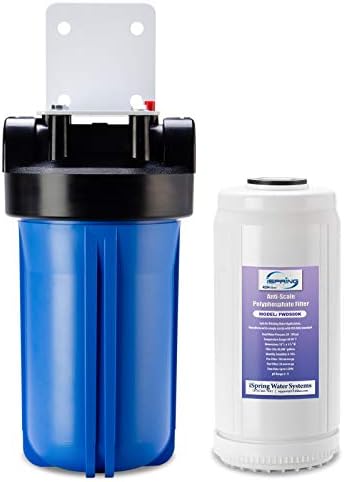
The iSpring WDS80K is a single-cartridge anti-scale filter that uses the same patented inhibitor concept found in the WGB32B-DS. Its job is to sequester calcium and magnesium so they are less likely to form scale in pipes and fixtures, and to help clear partially clogged piping over time. The filter media is also described as helping protect iron, steel, galvanized, copper, and lead pipes from corrosion by forming a protective coating. The listing notes that the filter is third-party tested to NSF 42 and NSF 60 standards.
The physical design is simple. The cartridge measures 10 inches by 4.5 inches, and the 1-inch NPT inlet and outlet support flow of up to 15 GPM. Replacement is straightforward: you twist off the housing, swap the filter, and reinstall. For people who want to avoid complicated plumbing or multiple stages, that simplicity is appealing. The rated capacity is up to 80,000 gallons, or about six months, depending on the quality of the incoming water, so the change schedule can vary from home to home.
This unit is best for a homeowner who wants a focused solution for scale and does not need a multi-stage system. It is a good fit if your water is mainly a scale concern rather than a mix of sediment, taste, and chemical problems. Many owners appreciate that maintenance is minimal and that the housing is easy to handle during changes. The U.S.-based support line in Atlanta, Georgia, is also a plus for buyers who like to reach a real team when questions come up.
The trade-offs are clear. Because it is a single-stage anti-scale unit, it does not include a dedicated carbon stage or a softening cartridge. If your water has noticeable chlorine taste or odor, or if you want the feel of softened water, you may need to add another step. The six-month estimate also means you need to track your usage, since heavier demand can shorten the service interval. Compared with the three-stage options in this list, it is a more modest solution that does one job well.
Pros:
- Simple single-cartridge design with a twist-off housing for easy changes
- Patented inhibitor targets calcium and magnesium and helps protect pipes from corrosion
- Third-party tested to NSF 42 and NSF 60 standards according to the product data
- Rated for up to 15 GPM with 1-inch NPT connections
Cons:
- Single-stage design does not include a carbon stage or softening cartridge for taste, odor, or chlorine concerns
Verdict: The iSpring WDS80K is a practical choice if your primary concern is scale and you want an uncomplicated, low-maintenance system. Pick a multi-stage model if you also need sediment, taste, or chlorine control.
How to Choose the Best Whole House Filter for Hard Water
Understand What Hard Water Does in Your Home
Before you compare products, it helps to know what problem you are solving. Hard water contains dissolved calcium and magnesium. As water heats or evaporates, those minerals come out of solution and form scale on heating elements, showerheads, faucets, and inside pipes. Over time, scale can reduce water heater efficiency and make appliances work harder. Some people also notice dry skin, dull laundry, and soap that does not lather well. Knowing which of these symptoms bothers you most will help you decide whether you need true softening or simply scale control.
Softening Versus Scale Inhibition
This is the most important distinction in this category. A water softener uses a process that swaps calcium and magnesium for another mineral, which is why softened water feels slick and rinses soap more easily. A scale inhibitor, like the polyphosphate or patented media in several of these products, works differently. It keeps minerals from sticking to surfaces without removing them from the water. Inhibitors are often a good fit when you want to protect plumbing and appliances while keeping minerals in your drinking water. If you want the softest possible feel at every tap, a softening cartridge is the more direct route. Decide which goal matters more before you buy.
Check Your Water Quality First
A simple water hardness test, available from many hardware stores or water treatment professionals, tells you how hard your supply is. You should also consider whether you have sediment, rust, chlorine taste, or heavy metal concerns. If your water comes from a private well, a broader test that checks for bacteria, metals, and other contaminants is often worth the cost. Matching a filter to your actual water chemistry prevents overbuying or underbuying. A system that handles sediment and chlorine well may still leave scale problems untouched if your hardness is high.
Flow Rate, Connection Size, and Installation
Whole house filters are rated by how much water they can pass at a given pressure, and several products here list a maximum of 15 GPM. That rating is useful, but you also need to confirm the inlet and outlet size. Some systems use ¾-inch connections, while others use 1-inch NPT fittings. Check your existing pipe size before ordering, and make sure you have room to mount the housing near the main line with clearance for filter changes. A bypass valve is valuable because it lets you isolate the system for maintenance without shutting off water to the whole house. If you are not comfortable with pipe work, a licensed plumber can handle installation.
Cartridge Life and Long-Term Cost
The purchase price of a whole house filter is only part of the cost. Replacement cartridges can add up over the life of the system. Some products here include several full sets of cartridges, which can reduce short-term costs and simplify planning. Others rely on single cartridges with capacity ratings expressed in gallons or months. Capacity depends on your water quality and usage, so treat the listed estimates as a starting point. Keep a simple log of your change dates, and consider setting a calendar reminder so you do not run filters past their useful life.
Housing Design, Monitoring, and Maintenance
Build quality matters because the housing sits under pressure every day. Look for sturdy seals, durable mounting hardware, and an easy twist-off or quick-release design. Features such as pressure release buttons, pressure gauges, and clear housings make maintenance easier. A clear housing lets you see when sediment is building up, while a gauge can help you spot pressure changes that may signal a clogged filter. A dual valve system is another useful feature because it lets you change cartridges without shutting off the main supply. These small design details often decide how pleasant the system is to live with over the years.
Match the System to Your Household
Finally, think about the size of your household and your priorities. A small household with modest water use may do well with a single-cartridge scale unit. A larger family that uses a lot of hot water may benefit from a higher-capacity system and a softening stage. If you want a combination of sediment removal, taste improvement, and scale control, a multi-stage setup is usually the most convenient option. The best choice is the one that solves your most important water problem at a cost and maintenance level you are willing to keep up with.
Frequently Asked Questions
Will a whole house filter soften my water?
It depends on the product. Some systems in this category include a dedicated softening cartridge that replaces calcium and magnesium with other minerals, which gives water a softer feel. Others use scale inhibitors that keep minerals from forming scale on pipes and fixtures without removing them from the water. Read the product description carefully to see which approach it uses.
Do I need a plumber to install a whole house filter?
Many whole house systems are designed for DIY installation, especially if your main water line is easy to reach and you have basic tools. Some units include a wrench and instructions, and several have standard connections. However, if you are unsure about cutting pipe, working with pressure, or meeting local plumbing codes, hiring a licensed plumber is a smart choice.
How often do I need to change the filter cartridges?
Change intervals vary by product and by water quality. Some systems list an estimated lifespan of about 1.5 to 2 years, while others list a capacity of up to 80,000 gallons or about six months, depending on the water. Heavy sediment, high usage, or very hard water can shorten the life of any cartridge, so monitor your system and follow the manufacturer’s guidance.
Will a whole house filter remove all the minerals from my water?
Not necessarily. Several of the systems discussed here state that they do not reduce TDS and that they preserve healthy minerals. That is a benefit if you want to keep minerals in your drinking water. If you want very low TDS levels, you would need a different technology, such as reverse osmosis, which is a separate category from the systems in this guide.
Can I use a whole house filter with well water?
Several of the systems in this guide are described as suitable for both well water and municipal water. Well water often has different sediment, iron, and mineral levels than city water, so it is wise to test your supply before choosing a filter. A well-specific test can reveal problems that a standard hardness test may miss.
Will a whole house filter fix the taste and odor of my tap water?
Filters that include a carbon stage, such as granular activated carbon or coconut shell carbon block, are designed to reduce chlorine and certain odors and tastes. The Mervian, XINSHUO, and iSpring WGB32B-DS systems all include carbon-based or taste and odor reduction features. Systems focused only on scale may not change the taste noticeably, so check the filtration stages before you buy.
Do scale inhibitor filters work with water heaters?
Scale inhibitor systems are designed to help prevent limescale buildup in pipes, water heaters, and appliances. They work by keeping calcium and magnesium from bonding into hard deposits. Results can vary with water temperature, flow rate, and the condition of your existing plumbing, so plan on monitoring your appliances over time to see the benefit.
Final Recommendation
For most homeowners who want a complete whole house solution, the Mervian and XINSHUO systems are the most direct answers to hard water because both include softening-focused stages and multi-stage filtration. The Mervian model stands out for its three included filter sets, while the XINSHUO model is appealing for its clear housing and dual valve design that makes changes easier. If your main concern is long-term protection for plumbing and appliances while keeping minerals in your water, the iSpring WGB32B-DS offers a high-capacity, multi-stage option with strong scale and corrosion control. The iSpring WDS80K is a simpler choice for buyers who want focused scale protection without a complicated setup.
The Express Water Ultimate Protection system is a strong pick if heavy metal reduction is part of your plan alongside scale control, but confirm the fittings and flow rate first. Whatever you choose, start with a water hardness test, match the system to your priorities, and factor in cartridge costs and installation requirements. A well-matched filter will protect your home and make everyday water feel noticeably better.