Iron in well water can leave orange stains, metallic-tasting water, and buildup on fixtures. The right filter depends on what is in your water: sediment filters catch rust and sand, while dissolved iron may need a filter designed for iron reduction. The products below include whole-house systems, replacement cartridges, and a sediment-only option, so check the product type and your water test results before choosing.
Quick Comparison
| Product | Type | Best fit | Key limitation |
|---|---|---|---|
| PUREPLUS 1-Stage Whole House Water Filter | Housing and cartridge | Homes wanting a flexible 10-inch filter setup | Confirm the included cartridge suits your well-water test results |
| iSpring F3WGB32BM 3-Stage Replacement Pack | Replacement cartridges | Compatible systems needing iron and manganese reduction | Not a complete filter system; cartridges fit 20-inch housings |
| Waterdrop WHF21-FG 2-Stage System | Whole-house system | Homes seeking iron, manganese, and chlorine reduction | Filter life depends on water quality and household use |
| Membrane Solutions 5-Micron String-Wound Cartridge | Sediment replacement cartridge | Capturing sand, rust, and other particles | Does not target dissolved iron |
| PUREPLUS Iron-Reducing Sediment Filter 4-Pack | Replacement cartridges | Compatible 10-by-4.5-inch housings and sediment reduction | Product information cautions that it may not work as expected for well water |
Our Picks: Best Whole House Iron Filter For Well Water reviews
1. PUREPLUS 1-Stage Whole House Filter: A Flexible Housing Setup
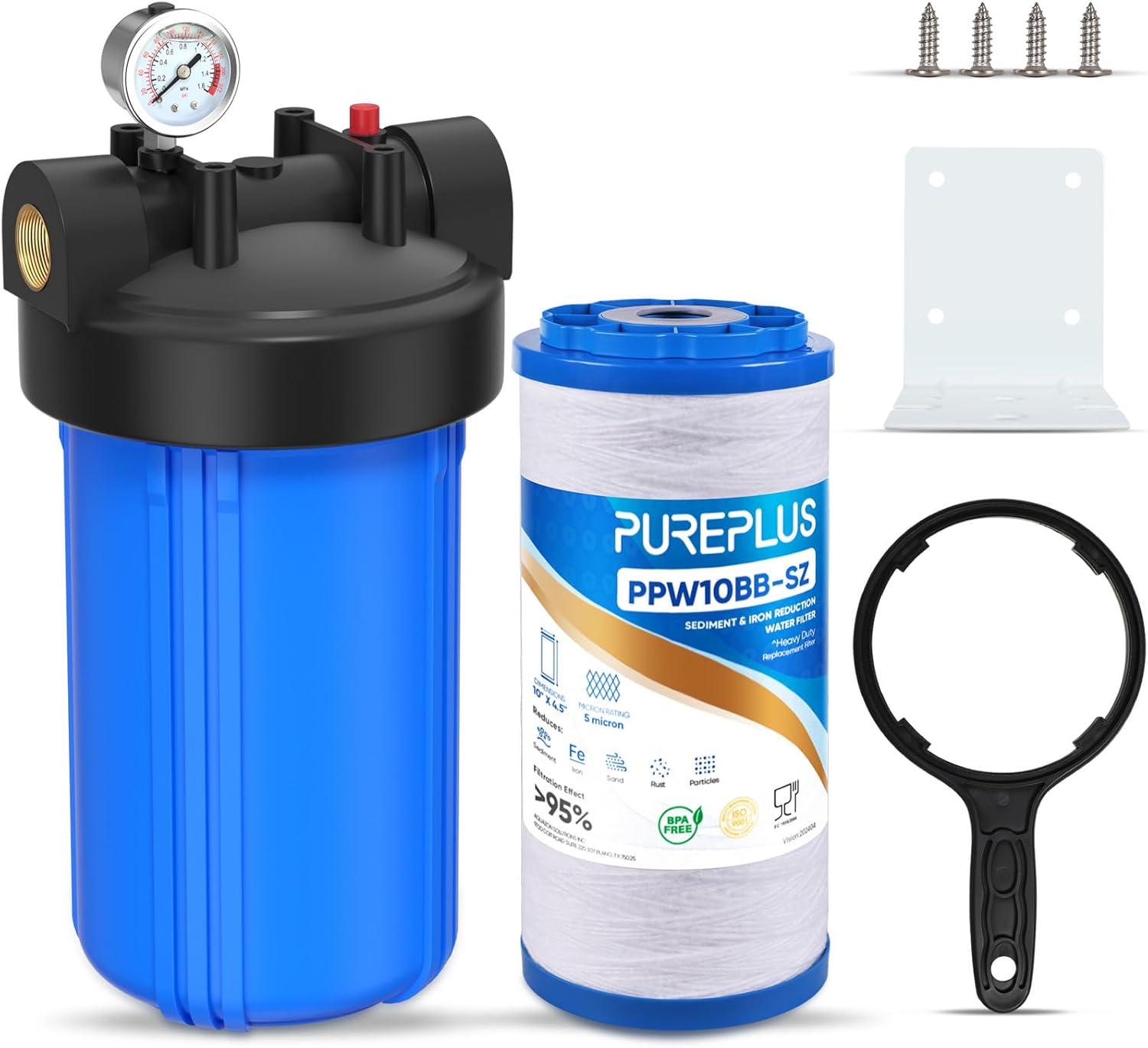
This PUREPLUS package includes a whole-house filter housing and a composite cartridge. The system is intended for well-water use and is described as reducing sediment, rust, and heavy metals. Its main advantage is flexibility: the housing can take standard 10-by-4.5-inch cartridges, including sediment and carbon options, so you can choose a replacement cartridge that better matches your water conditions.
The housing is made from food-grade polypropylene and comes with a steel mounting bracket, wrench, screws, and O-ring. That makes it a practical option for a planned DIY installation, though you still need to confirm your plumbing connections and leave room to open the housing for cartridge changes. The product listing describes high flow, but actual flow and pressure can vary with the cartridge, plumbing, and incoming water.
One important caveat: the listing does not provide an iron-reduction capacity or a maximum iron concentration for this package. Its claims should not replace a water test. Compared with the Waterdrop system, it gives you more cartridge choice, but the Waterdrop listing provides more specific iron and manganese reduction figures.
Pros:
- Includes a housing, cartridge, mounting bracket, and wrench.
- Accepts several standard 10-by-4.5-inch cartridge types.
- Designed for whole-house installation and well-water filtration.
- Lets you change the cartridge type as your filtration needs change.
Cons:
- The supplied details do not state a specific iron limit or reduction capacity.
- Cartridge selection matters; not every compatible option is intended for dissolved iron.
Verdict: Choose this package if you want a flexible whole-house housing, but verify that its included cartridge is suitable for the iron and other contaminants in your well water.
2. iSpring F3WGB32BM: Replacement Set for Iron-Treating Systems

This is a three-stage replacement pack, not a complete whole-house filter system. The listing describes an iron-and-manganese filter designed to reduce iron up to 3.0 ppm and manganese up to 1.0 ppm, along with cartridges for sediment and other filtration needs. Check your existing system and cartridge dimensions before ordering: these cartridges are made for standard 20-by-4.5-inch housings.
The listed maximum flow is up to 15 gallons per minute, and the pack is described as having minimal impact on flow. Its staged setup pairs a 5-micron polypropylene sediment filter with coconut-shell carbon, while the product information says the sediment and carbon filters are independently tested to meet NSF/ANSI standards. Those statements apply to the specified filters and standards; they should not be taken as proof that the entire system removes every possible well-water contaminant.
Owners using the set with compatible systems describe straightforward installation and say it helped reduce rust-related staining, though results depend on the water and setup. It is a useful replacement choice when you already have a compatible iSpring or standard-size housing. For very high iron or manganese levels, the listing points shoppers toward other iSpring systems rather than this cartridge set.
Pros:
- Provides stated iron and manganese limits for the iron-treatment cartridge.
- Includes sediment and carbon filtration stages.
- Fits standard 20-by-4.5-inch housings and is listed for flow up to 15 GPM.
- Owners report that installation and routine cartridge changes are manageable.
Cons:
- It is a replacement pack, so you need a compatible housing already installed.
- The stated iron and manganese limits may not suit wells with higher concentrations.
Verdict: This is a strong candidate for replacing cartridges in a compatible system when your well-water test falls within its stated iron and manganese limits.
3. Waterdrop WHF21-FG: Two-Stage Whole-House Iron and Manganese Filtration

The Waterdrop WHF21-FG is a complete two-stage system for whole-house use with municipal or well water. Its first cartridge is intended to reduce iron and manganese, while the second uses coconut-shell granular activated carbon. The listing reports reductions of up to 96.4% for iron and 98.2% for manganese, as well as chlorine reduction. These are product claims; your results can vary with the water’s starting quality and the way the system is installed and maintained.
The system uses 10-by-4.5-inch cartridges and standard 1-inch NPT ports, with a stated flow rate of up to 15 GPM. The listing says the cartridges filter particles larger than 5 microns and provide up to 50,000 gallons or six months of use. Actual cartridge life depends on water quality and household use. It also has lead-free material certification to NSF/ANSI 372; that is a materials standard, not a certification of iron-removal performance.
Compared with the PUREPLUS housing, this system comes with two defined treatment stages rather than asking you to select a cartridge. Its stated performance details are useful when comparing options, but you should still test your water and confirm that the system addresses your iron level and any other contaminants of concern.
Pros:
- Complete two-stage system for whole-house installation.
- Provides stated reduction figures for iron, manganese, and chlorine.
- Uses standard 10-by-4.5-inch cartridges and 1-inch NPT connections.
- Includes a mounting bracket and pre-installed filters, according to the listing.
Cons:
- Cartridge life can be shorter or longer depending on source-water quality and use.
- The lead-free materials standard does not certify iron-removal performance.
Verdict: Consider the Waterdrop if you want a complete two-stage system with specific stated iron and manganese reduction claims, and your water test indicates it is a suitable match.
4. Membrane Solutions String-Wound Cartridge: A Sediment Prefilter

This six-pack of 5-micron string-wound cartridges is designed to capture sediment such as rust, sand, and silt. It is a replacement cartridge, not a complete system, and its standard 10-by-2.5-inch size fits many 10-inch housings. Check your housing specifications before buying, since whole-house housings are not all the same size.
The cartridge’s graded winding is designed to catch larger particles toward the outside and smaller particles farther in. That can make it a useful first stage for protecting downstream filters, plumbing, and appliances from suspended sediment. The listing says the material is food-grade polypropylene and that the cartridge is tested to NSF/ANSI 42 material requirements; this does not mean it removes dissolved iron.
In everyday use, this type of cartridge is best viewed as a sediment-control step in a broader treatment plan. It may help with visible rust particles, but it cannot replace an iron-reduction system when dissolved iron is the problem. The listing suggests replacing cartridges at least every six months, while the actual change interval will depend on how much sediment enters your water.
Pros:
- Designed to capture sand, silt, rust, and other suspended particles.
- Six cartridges are included in the listed set.
- Useful as a prefilter to help protect other filters and equipment.
- Standard 10-by-2.5-inch size fits many common housings.
Cons:
- Does not target dissolved iron or manganese.
- Must be matched to the dimensions of your existing housing.
Verdict: Buy this only as a sediment prefilter or replacement cartridge; it is not a stand-alone answer to dissolved iron in well water.
5. PUREPLUS Iron-Reducing Sediment 4-Pack: Check Well-Water Suitability First

This four-pack of replacement cartridges is made for compatible 10-by-4.5-inch housings. The product description says its layered polypropylene construction and ion-exchange resin are designed to reduce sand, silt, rust, dirt, and scale particles. It also lists compatibility with several housing and filter models, but you should compare the dimensions and model information with your existing setup before ordering.
The key caution is in the product information itself: it says the cartridge may not achieve the expected effect when used with well water and directs well-water shoppers to another product. That warning deserves attention even though the title describes the cartridge as iron-reducing. It is not a complete filter system, and its stated capacity and replacement interval depend on water quality and usage.
Compared with the iSpring replacement set, this option does not provide a stated maximum iron concentration in the supplied details. It may suit someone seeking replacement sediment cartridges for a compatible setup, but it is a less certain choice when the main goal is treating iron in well water.
Pros:
- Four replacement cartridges are included.
- Designed to reduce common suspended particles such as sand, rust, and silt.
- Fits many standard 10-by-4.5-inch housings, subject to model compatibility.
Cons:
- The product information warns that performance may be inadequate for well water.
- The supplied details do not give a specific maximum iron concentration.
Verdict: Treat this as a compatible replacement cartridge, not a dependable first choice for well-water iron treatment unless the manufacturer confirms it fits your water conditions.
How to Choose a Whole-House Iron Filter for Well Water
Test Your Well Water Before Choosing a Filter
Start with a water test that measures iron and manganese, and consider testing for other well-water concerns as well. Iron can be dissolved in water or present as visible particles, and those forms may call for different treatment. A test gives you a clearer basis for comparing filter claims and helps you avoid buying a sediment cartridge when your main issue is dissolved iron.
Know Whether You Need Iron Treatment or Sediment Filtration
A sediment cartridge is meant to catch suspended material such as sand, rust particles, and silt. It is not the same as a filter designed to reduce dissolved iron. Some systems combine iron-reduction media with sediment or carbon stages, while products such as the Membrane Solutions cartridge are for sediment only. Match the treatment method to the problem your test identifies.
Check the Stated Iron and Manganese Limits
Look for specific performance details and compare them with your test results. The iSpring cartridge set lists maximum levels for iron and manganese, while the Waterdrop system lists percentage-reduction claims. Neither type of claim guarantees the same result in every home: starting concentration, water conditions, flow, and maintenance can affect performance.
Confirm Whether You Need a Complete System or Replacement Cartridges
Some products in this list include a housing or complete system; others are cartridges only. If you do not already own a compatible whole-house housing, a replacement pack will not be enough on its own. Before buying, confirm the housing’s dimensions, cartridge length and diameter, connection size, and any model-specific compatibility requirements.
Size the System for Your Household Flow
Whole-house filtration must handle water used at multiple taps and appliances. Check the stated flow rate and port size, then compare them with your plumbing and household needs. A filter that restricts flow can be frustrating during showers or other simultaneous use. Keep in mind that a cartridge’s condition and the amount of sediment in the water can also affect flow.
Plan for Cartridge Changes and Upkeep
Replacement intervals are estimates, not fixed guarantees. Water with more sediment or higher contaminant levels can use up a cartridge sooner, and household water use also matters. Choose a system with replacement cartridges you can identify and obtain, and follow the manufacturer’s instructions for shutting off water, releasing pressure, and changing filters safely.
Read Certifications Carefully
Certifications apply to specific materials or performance claims, not automatically to every function of a system. For example, NSF/ANSI 372 addresses lead content in materials; it does not by itself verify iron removal. Check which exact standard is listed and what it covers, and seek test data for the contaminant you want to reduce.
Frequently Asked Questions
Can a sediment filter remove iron from well water?
A sediment filter can catch iron-containing particles, rust, and other suspended material. It may not remove dissolved iron. If your water test shows dissolved iron, look for a system with iron-reduction media and performance details that fit your water conditions.
Do I need a whole-house system or just a replacement cartridge?
You need a complete system if you do not already have a compatible housing. A replacement cartridge is intended to fit an existing system, so confirm the housing size and model before purchasing.
Will an iron filter also reduce manganese?
Some products are designed to reduce both iron and manganese, but not every filter is. Check the product’s stated capabilities and limits, then compare them with a water test.
How often should I change whole-house filter cartridges?
It depends on the cartridge, water quality, and household use. Follow the product’s instructions and monitor for changes in flow or water appearance. Sediment-heavy water may require more frequent changes than cleaner source water.
Does NSF/ANSI 372 mean a filter removes iron?
No. NSF/ANSI 372 is a lead-free materials standard. It does not establish that a product reduces iron. Look for a standard or test information that applies specifically to the treatment claim you care about.
Which option is best if my well has high iron levels?
First, get a water test and compare the results with the filter’s stated operating limits. The iSpring listing directs people with very high iron or manganese toward other systems, and the PUREPLUS 4-pack cautions that it may not deliver the expected results for well water. For concentrations outside a product’s stated range, consult a water-treatment professional.
Final Recommendation
For shoppers seeking a complete whole-house option with stated iron and manganese reduction claims, the Waterdrop WHF21-FG is the clearest match in this group, provided its listed performance suits your test results. The PUREPLUS housing is a flexible alternative if you want to select among compatible cartridges. The iSpring pack is best for replacing cartridges in a compatible 20-inch system. Treat the Membrane Solutions cartridge as sediment filtration only, and pay close attention to PUREPLUS’s well-water caution before choosing its 4-pack. A water test is the best starting point for selecting any iron filter.
