
Well water can carry sediment, rust, iron, manganese, odors, and other substances that affect your plumbing and the water from your taps. The right whole-house filter depends on what a water test finds, how much flow your home needs, and how often you’re willing to replace cartridges. These five options range from systems designed to reduce iron and manganese to simpler housings that let you choose a compatible filter cartridge.
Important: No filter on this list is a substitute for testing your well water. Test for the contaminants that matter in your area, then confirm that a system is designed to address them before buying.
Quick Comparison
| System | Type | Notable details | Best fit |
|---|---|---|---|
| Waterdrop WHF3T-FG 3-Stage System | Three-stage filtration | Designed to reduce iron and manganese; listed 15 GPM flow rate | Homes with iron or manganese concerns |
| Ziwshom 3-Stage System | Three-stage filtration | Three sets of cartridges; built-in shut-off valves | Shoppers seeking a bundled cartridge supply |
| iSpring Iron, Manganese & H2S System | Three-stage filtration | 5-micron sediment stage; listed flow up to 15 GPM | Homes with several specific water-quality concerns |
| PUREPLUS 1-Stage Whole House Filter | Single housing and cartridge | Accepts standard 10-inch by 4.5-inch cartridges | Those who want to choose their own cartridge type |
| Aquaboon Whole House Well Water Filter System | Single-stage housing | 1-inch ports; listing details give conflicting housing sizes | Those comparing a high-flow housing with compatible cartridges |
Our Picks: Best Whole House Well Water Filtration System reviews
Waterdrop WHF3T-FG: A Well-Water System Focused on Iron and Manganese

The Waterdrop WHF3T-FG is a three-stage whole-house system designed for well water, with a particular focus on reducing iron and manganese. Its description says the iron-and-manganese cartridges are SGS tested and reports reductions of 95.9% for iron and 99.7% for manganese. Those figures are tied to test conditions, so compare them with your own water test rather than assuming the same results in every home.
The system also uses a granular activated carbon stage and is intended to reduce odors, chlorine, sediment, rust, sand, and other larger particles. The listing gives a flow rate of 15 GPM and says the system can be used with well or municipal water. Its lead-free materials are listed as NSF/ANSI 372 certified, while the description names other standards for filter media. Check the exact certification scope if a particular contaminant or standard is important to you.
For maintenance, the manufacturer’s guidance is to replace the iron-and-manganese cartridges every six to twelve months and the GAC cartridge about once a year. Actual replacement timing can vary with water quality and use. This pick is a stronger match for a household whose test results show iron or manganese than for someone seeking a basic sediment-only filter. It does not replace a water softener or a treatment system for contaminants it is not designed to address.
Pros:
- Designed specifically with iron and manganese reduction in mind
- Also targets odors, sediment, rust, sand, and chlorine
- Listed flow rate of 15 GPM
- Provides stated cartridge replacement intervals
Cons:
- Cartridge changes may be needed as often as every six months, depending on conditions
- Not a complete answer for every well-water contaminant
Verdict: Choose the Waterdrop if iron or manganese is a known concern and its stated treatment capabilities match your water test.
Ziwshom 3-Stage System: A Convenient Bundle of Replacement Filters

This Ziwshom system uses three filtration stages and comes with three full sets of cartridges: PP, GAC, and CTO filters. The listing describes that supply as enough for about 1.5 to two years, although actual cartridge life depends on water quality, household use, and the maker’s replacement guidance. Having spares included can make ongoing maintenance easier to plan.
The system is intended to reduce sediment, chlorine, and odors while preserving natural minerals. The seller specifically notes that it does not lower total dissolved solids (TDS), so it is not the right choice if your goal is TDS reduction. The kit includes a bypass valve head, two built-in shut-off valves, a wrench, tape, connectors, and a manual. It is listed for standard 3/4-inch plumbing.
This is a broad, general-purpose option rather than a system with stated iron- or manganese-specific performance. If your well test shows elevated levels of those minerals, compare the results with a system designed and documented for that issue. Also verify the available installation space: the product is described as compact, but a whole-house installation still needs room to access the housings and change cartridges.
Pros:
- Includes nine cartridges across three complete filter sets
- Built-in shut-off valves are intended to simplify filter changes
- Targets sediment, chlorine, and odors
- Designed to preserve natural minerals rather than reduce TDS
Cons:
- No specific iron- or manganese-reduction performance is provided
- Does not reduce TDS
Verdict: Consider the Ziwshom if you want a bundled supply of general-purpose cartridges and your main concerns are sediment, chlorine, and odors.
iSpring Iron, Manganese & H2S System: Three Stages for Multiple Concerns

The iSpring system has three specialized cartridges. A polypropylene sediment filter captures particles down to 5 microns, followed by a compound filter described as targeting chlorine, chloramine, lead, mercury, hydrogen sulfide, and heavy metals. Its third-stage filter is designed to reduce iron up to 3.0 ppm and manganese up to 1.0 ppm.
These stated limits make this a useful option to compare when a water test identifies several of those concerns. They are not a guarantee that the system will treat every concentration or water condition. The manufacturer recommends checking that your test results fall within the filter’s stated capabilities. For a contaminant with health implications, follow local guidance and confirm the system’s suitability before relying on it.
The system uses 20-inch by 4.5-inch cartridges and 1-inch NPT connections. The listing gives a flow rate of up to 15 GPM and says the filters can last up to a year, depending on water quality and use. It preserves TDS, so it is not intended to remove dissolved minerals. Compared with the Waterdrop, it provides more detail about its individual stages and stated iron and manganese limits, but it also calls for a larger cartridge format and appropriate plumbing connections.
Pros:
- Three distinct stages for sediment and several listed water concerns
- Provides stated iron and manganese reduction limits
- Listed flow rate of up to 15 GPM
- Uses individually wrapped cartridges, according to the listing
Cons:
- Needs 1-inch NPT connections, which may require plumbing adapters
- Does not reduce TDS
Verdict: The iSpring is worth considering when your water test points to iron, manganese, hydrogen sulfide, or other listed concerns and the stated limits fit your results.
PUREPLUS 1-Stage Filter: A Flexible Housing for Cartridge Choice
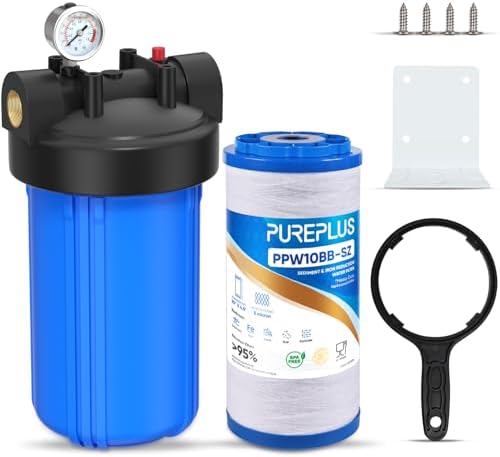
The PUREPLUS is a single-stage whole-house housing supplied with an iron- and manganese-reducing cartridge. Its main advantage is flexibility: the housing is described as compatible with standard 10-inch by 4.5-inch cartridges, including sediment, carbon, and pleated options. That lets you select a cartridge type based on your water conditions, but it also means you need to match the cartridge carefully to the problem you are trying to address.
The package is described as including a steel mounting bracket, wrench, screws, and an O-ring. The listing also says the housing is designed for high flow, but it does not give a specific GPM figure. For maintenance, the instructions say to release pressure through the red valve before changing the cartridge. As with any whole-house filter, shutoff access and room to remove the housing are important parts of a practical installation.
Unlike the multi-stage Waterdrop and iSpring systems, this pick does not give a detailed, multi-contaminant performance breakdown in the supplied product information. It may suit someone who wants a replaceable-cartridge setup or already knows which cartridge type they need. If your water has several problems, you may need more than one treatment stage or a different type of treatment altogether.
Pros:
- Compatible with several standard 10-inch by 4.5-inch cartridge types
- Includes a mounting bracket and filter wrench
- Supplied with an iron- and manganese-reducing cartridge
- Cartridge options allow you to tailor the setup to your needs
Cons:
- One stage may not address multiple water-quality issues at once
- The listing does not provide a specific flow-rate figure or detailed reduction limits
Verdict: Choose the PUREPLUS if cartridge flexibility matters more to you than having several dedicated filtration stages in one system.
Aquaboon Whole House Filter: A Single-Stage Housing With a Size Detail to Verify

The Aquaboon is a single-stage whole-house filter housing with 1-inch inlet and outlet ports. Its listing describes reinforced polypropylene construction and compatibility with replaceable cartridges, making it a basic option for filtering water throughout the home. The description does not identify a specific included cartridge or provide detailed reduction claims, so check what comes in the package and which cartridge fits your needs before ordering.
There is an important sizing inconsistency in the supplied product information: the title identifies a 20-inch by 4.5-inch system, while the description refers to a 10-inch by 4.5-inch housing. Confirm the actual housing and cartridge size with the seller before buying, especially if you are replacing an existing filter or have limited installation space.
The 1-inch ports may suit plumbing setups designed for that connection size, but you should still check your pipe size and installation requirements. This is a more basic option than the multi-stage systems above. It may make sense if you want a housing for a compatible cartridge and are comfortable choosing that cartridge separately; it is less suitable if you want clearly stated contaminant-specific treatment in a complete system.
Pros:
- 1-inch inlet and outlet ports
- Designed to accept replaceable filter cartridges
- Reinforced polypropylene housing is described as suitable for high-flow use
Cons:
- Product details give conflicting housing sizes that should be verified
- The supplied description does not specify contaminant reduction performance or a cartridge type
Verdict: Consider the Aquaboon only after confirming the housing dimensions, included cartridge, and cartridge compatibility for your water concerns.
How to Choose a Whole-House Well Water Filtration System
Start With a Well-Water Test
Test your water before choosing a filter. A test can show which issues need attention and help you avoid buying a system that targets the wrong things. Iron, manganese, sediment, odor, and other concerns call for different treatment methods. If you are unsure what to test for, contact your local health department or a certified water-testing lab for guidance.
Match the System to the Contaminants
Read the product’s stated reduction claims and check whether they match your results. A system designed to reduce sediment, chlorine, and odors is not automatically a solution for elevated iron, manganese, or other contaminants. Pay attention to any stated concentration limits and testing conditions. For health-related concerns, confirm that the system is appropriate for your specific water before relying on it.
Check Flow Rate and Plumbing Connections
A whole-house filter sits on the main water line, so it needs to support your household’s water use. Compare the system’s stated flow rate with your likely demand, especially if several taps, showers, or appliances may run at once. Check inlet and outlet sizes, such as 3/4-inch or 1-inch connections, and confirm whether adapters or a plumber may be needed.
Understand Cartridge Size and Replacement Needs
Cartridge dimensions and replacement intervals affect both ongoing effort and cost. Check which cartridges are included, what replacements are compatible, and how often the manufacturer recommends changing them. Actual cartridge life can vary based on your water quality and how much water your household uses. A bundled supply can be convenient, but only if those cartridges address your needs.
Consider Installation and Maintenance Access
Measure the installation area and leave enough space to remove filter housings and change cartridges. Look for practical details such as a mounting bracket, pressure-release valve, bypass, or shut-off valves. Follow the installation instructions, depressurize the system as directed, and make sure you can safely reach the unit for routine service.
Know What the System Does Not Do
Many cartridge filters preserve dissolved minerals and do not reduce TDS. A sediment or carbon stage also cannot be assumed to handle every dissolved contaminant. If your test shows an issue outside a product’s stated capabilities, you may need a different treatment method or a combination of systems. Choose based on verified needs, not broad claims that a filter makes all water safe.
Frequently Asked Questions
Do I need to test my well water before buying a filter?
Yes. Testing helps identify what is in your water so you can choose a system designed for those specific concerns. Without a test, it is easy to select a filter that does not address the main problem.
Will a whole-house filter remove iron and manganese?
Some systems are designed to reduce iron and manganese, including the Waterdrop and iSpring options here. Their stated capabilities differ, so compare the product information with your water-test results. A general sediment or carbon filter should not be assumed to reduce those minerals.
Does a whole-house water filter reduce TDS?
Not necessarily. The Ziwshom and iSpring descriptions state that their systems preserve TDS rather than reduce it. Check the specifications of any system you consider if TDS reduction is a goal; a different treatment method may be needed.
How often do whole-house filter cartridges need to be replaced?
It depends on the system, the cartridge, your water quality, and household use. For example, Waterdrop lists a six-to-twelve-month interval for its iron-and-manganese cartridges and about twelve months for its GAC cartridge. Follow the instructions for the specific system you buy.
Can I install a whole-house filter myself?
Some systems include instructions and installation parts, but installation involves the main water line and must match your plumbing. Check connection sizes and available space before starting. If you are unsure about plumbing work, ask a qualified installer.
Which system is best for a well with sediment and odor?
The right choice depends on your test results and the type of odor. The Ziwshom is described as targeting sediment and odors, while the Waterdrop also lists those concerns along with iron and manganese reduction. Verify that the chosen system covers the specific issue in your water.
Is one filtration stage enough for well water?
It can be enough for a specific, limited need if the cartridge is matched to that need. Homes with multiple water-quality concerns may require several stages or another treatment approach. Let your water test guide the decision.
Conclusion
For a well with documented iron or manganese concerns, the Waterdrop WHF3T-FG is the most focused pick in this group, while the iSpring offers several specialized stages and stated reduction limits for additional concerns. The Ziwshom stands out for its bundled cartridge supply, and the PUREPLUS and Aquaboon provide simpler housing-based options for shoppers who want cartridge flexibility. Before choosing any system, test your water, check the product’s specific capabilities, and confirm that its connections and cartridge sizes fit your home.