
A wireless camera system without a required subscription can help you monitor your property while keeping recordings on local storage. The right choice depends on how many areas you need to cover, whether you prefer solar or battery power, and how much detail you want in recorded video. These five systems offer different combinations of camera count, resolution, tracking, and storage, so compare their features against your home’s layout before choosing.
Quick Comparison
| System | Video and coverage | Power and storage | Standout feature |
|---|---|---|---|
| aosu 2K Solar 6-Camera System | 2K; six-camera kit | Solar panels; expandable local storage | Split solar panels and cross-camera tracking |
| aosu 2K Battery 6-Camera System | 2K with 6× digital zoom; six-camera kit | Rechargeable battery; expandable local storage | Flexible placement and hub-based playback |
| aosu D1 Max 4K Solar 4-Camera Kit | 4K; 360° pan and tilt | Solar power; 32GB included, expandable | Auto tracking and vehicle detection |
| ELYSOO 4K Solar 4-Camera System | 4K; 360° panoramic coverage | Solar power; 32GB included, expandable | Encrypted local storage and cross-camera playback |
| aosu 2K Solar 4-Camera System | 2K; fixed 130° view per camera | Integrated solar panels; 32GB included | Dual-band Wi-Fi and synchronized camera tracking |
Our Picks: Best Wireless Camera System Without Subscription reviews
Best for Broad Coverage: aosu 2K Solar 6-Camera System

This six-camera kit is designed for homeowners who want to monitor several parts of a property through one app. The system records locally through the aosuBase, and a subscription is not required for the advertised local-storage features. Storage can be expanded up to 1TB with a microSD card, which is sold separately.
The cameras use 2K video, color night vision, and PIR plus AI human detection. The split solar-panel design is useful when the best camera position is shaded but a nearby spot gets more sun: you can mount the camera and panel in separate places. Solar charging still depends on sunlight, placement, season, and settings, so the panel’s position matters.
The app can show up to four camera feeds at once, while cross-camera tracking groups footage of the same person into a timeline. That can make it easier to follow activity between camera views. The trade-off is that people who want the sharpest available video in this group may prefer one of the 4K options.
Pros:
- Six cameras provide coverage for multiple areas.
- Split solar panels allow flexible camera placement.
- Local storage can expand up to 1TB with a separate microSD card.
- Color night vision and cross-camera tracking support event review.
Cons:
- Solar performance depends on sunlight and installation location.
- A microSD card for expanded storage is sold separately.
Verdict: Choose this kit if you want six 2K cameras, flexible solar-panel placement, and local recording without a required subscription.
Best for Flexible Mounting: aosu 2K Battery 6-Camera System

This battery-powered aosu kit is a good fit when you want six cameras but do not want to position each one near a solar panel. Its wire-free design is made for indoor or outdoor placement, including tight corners and spots that can be difficult to wire. The kit is also offered in smaller camera-count options, according to the product details.
The cameras record in 2K and include up to 6× digital zoom for examining details in a captured view. PIR and AI human detection are designed to focus alerts on people rather than general movement. Through the aosuBase, the app can display up to four cameras at once and group activity across cameras into a timeline.
Local storage is expandable up to 1TB with a microSD card, sold separately, and a subscription is not required for the listed local-storage functions. Hub-based playback and offline-capable security are intended to help reduce camera power use. Compared with the solar kits, the main consideration is that this option relies on battery power rather than a solar panel for ongoing charging.
Pros:
- Six-camera kit offers broad placement options without solar panels.
- 2K video and 6× digital zoom provide detail for checking recorded scenes.
- Local storage expands up to 1TB with a separate microSD card.
- Cross-camera tracking and multi-camera viewing simplify monitoring.
Cons:
- Battery cameras may need recharging; no solar charging is listed for this kit.
- Expanded storage requires a separately purchased microSD card.
Verdict: Pick this system if flexible, wire-free placement matters more to you than solar charging and you want six cameras under one local-storage hub.
Best 4K Feature Set: aosu D1 Max 4K Solar 4-Camera Kit

The aosu D1 Max is a four-camera solar system aimed at homeowners who want higher-resolution video and cameras that can move to cover a wide area. Its 4K, 8MP cameras have 6× digital zoom, pan-and-tilt coverage, and automatic tracking for people and vehicles. The product also lists full-color night vision, with infrared viewing available when you prefer a less visible view.
AI detection is designed to identify people and vehicles, and Smart Vehicle Guard can alert you to movement near a parked vehicle. You can also set activity zones and use light and sound warnings. For installation, the detached solar panels allow you to position the panels for better sunlight than the cameras might receive at their mounting spots.
The included aosuBase has 32GB of local storage, expandable up to 1TB. Cross-camera tracking groups clips into a timeline, and the system is described as requiring no subscription. This kit offers more camera movement and detection features than the fixed-view 2K option below, but it includes four cameras rather than six.
Pros:
- 4K video, 8MP imaging, and 6× digital zoom.
- Pan-and-tilt coverage with auto tracking for people and vehicles.
- Includes 32GB of local storage, expandable up to 1TB.
- Detached solar panels allow flexible placement for charging.
Cons:
- The four-camera kit may not cover as many separate areas as a six-camera system.
- More advanced tracking features may take time to configure for your property.
Verdict: Choose the D1 Max if 4K video, movable coverage, and vehicle detection matter more than having the largest camera count.
Best for Encrypted Local Recording: ELYSOO 4K Solar 4-Camera System
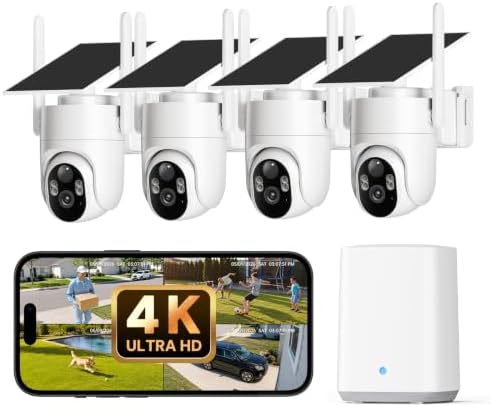
This four-camera ELYSOO system combines 4K video, solar charging, and a base with local storage. It comes with a pre-installed 32GB memory card, supports expansion up to 256GB, and is described as using encrypted local recordings without a required subscription. The product also advertises loop recording of up to 60 days; actual recording time can depend on use and settings.
The cameras offer 360° panoramic coverage, automatic tracking for people, vehicles, or animals, and cross-camera playback that links clips from the same period. The 8× digital zoom and four LED lights are intended to help with detail and color night vision. The system supports dual-band 2.4GHz and 5GHz Wi-Fi, and the listing states compatibility with Alexa and Google Home.
Solar charging and an IP65 weather-resistance rating suit outdoor installation, but the advertised charging performance depends on access to sunlight. Compared with the aosu D1 Max, this system has a smaller stated storage expansion limit and does not list vehicle-specific Smart Vehicle Guard. It may suit shoppers who value encrypted local recording and smart-home compatibility.
Pros:
- 4K video with 360° panoramic coverage and automatic tracking.
- Includes encrypted 32GB local storage and supports expansion up to 256GB.
- Supports 2.4GHz and 5GHz Wi-Fi, Alexa, and Google Home, according to the listing.
- Cross-camera playback can link related clips from multiple cameras.
Cons:
- Storage expansion tops out at 256GB, below the 1TB limit of some alternatives.
- Solar charging depends on sunlight and camera placement.
Verdict: Consider ELYSOO if you want a four-camera 4K solar system with encrypted local storage and stated Alexa and Google Home support.
Best Fixed-View 2K Solar Kit: aosu 2K Solar 4-Camera System

This four-camera aosu kit uses fixed-view 2K cameras with a 130° field of view. That design is suited to monitoring specific areas such as a driveway, gate, garage, or fence rather than moving the camera to follow activity. The cameras have integrated solar panels, so each unit can be installed where sunlight reaches without mounting a separate panel.
The aosuBase includes 32GB of encrypted local storage, and the product advertises playback and downloads without a subscription. It also lists dual-band Wi-Fi, simultaneous multi-camera viewing, and camera-to-camera tracking that synchronizes footage across cameras. Color night vision is listed for visibility at night, while solar charging is intended to reduce manual recharging.
Compared with the six-camera solar kit, this set includes fewer cameras but has listed included storage and dual-band Wi-Fi. It is also a simpler choice than the 4K pan-and-tilt kits if you prefer cameras aimed at fixed areas. Since the cameras have a fixed view, thoughtful placement is important; they will not pan around an area to follow movement.
Pros:
- Four fixed-view 2K cameras with a 130° field of view.
- Includes 32GB of encrypted local storage and free playback, according to the listing.
- Integrated solar panels avoid separate panel placement.
- Dual-band Wi-Fi and synchronized camera tracking are included features.
Cons:
- Fixed-view cameras cannot pan or tilt to follow activity.
- Solar charging depends on access to sunlight.
Verdict: This is a practical pick if you want a four-camera 2K solar setup with included local storage and fixed views of key areas.
How to Choose a Wireless Camera System Without a Subscription
Decide how many areas you need to cover
Count the places you want to monitor, such as an entry, driveway, backyard, and side path. A six-camera kit can suit a larger property or give you more placement options, while a four-camera set may be enough for the main approaches. Check each camera’s view and decide whether you need a fixed angle or the ability to pan and tilt.
Choose between solar and battery power
Solar-powered cameras can reduce the need for manual recharging, but they need suitable sunlight. A split-panel design lets you place a panel apart from the camera, while an integrated panel keeps each camera and panel together. Battery-only systems offer more freedom from solar placement, but you will need to account for recharging. Consider shade, seasonal sunlight, and the convenience of reaching each camera.
Match resolution and night vision to your needs
2K cameras can be a sensible fit for general monitoring, while 4K models provide higher listed resolution for people who want more image detail. Digital zoom can help inspect a recorded view, but it does not change where a camera is pointed. Also compare night vision: some systems list color night vision, while others offer infrared viewing as another mode.
Understand local storage and expansion
“No subscription required” does not mean every system includes the same storage. Check whether a memory card or base storage is included, what the maximum expansion capacity is, and whether an additional card must be purchased separately. Consider how you will review or download clips, and check the product details for any limits tied to recording settings or retention.
Compare detection and tracking features
AI person or vehicle detection can help make alerts more focused than alerts based on all motion, but results depend on placement, distance, lighting, and settings. Cross-camera tracking can group activity across views, which may help you follow an event. If you need a camera to follow movement within a wide area, look for pan-and-tilt or auto-tracking features rather than a fixed-view camera.
Check Wi-Fi, weather protection, and installation
Confirm that your Wi-Fi reaches each planned camera location and check which Wi-Fi bands the system supports. For outdoor use, review the listed weather-resistance rating and temperature range where provided. Wireless installation avoids running video cables, but mounting still requires secure placement, a suitable view, and—on solar models—attention to panel exposure.
Frequently Asked Questions
Can these camera systems record without a monthly subscription?
Each system in this roundup is described as offering local storage without a required subscription for its listed recording features. Storage capacity, included memory, and optional features differ by model, so check the product details before buying.
Do solar security cameras work in shade or cloudy weather?
Solar performance depends on sunlight, placement, season, and settings. A split-panel camera can place its panel in a sunnier spot than the camera, but shaded locations may still need more frequent battery attention. Check the product’s charging guidance for your installation conditions.
Is 2K or 4K better for outdoor cameras?
4K offers higher listed resolution and may be useful if fine detail is a priority. 2K systems can still be a good choice for general monitoring and may offer features such as larger camera counts or simpler fixed-area coverage. Camera placement, lighting, and the area being monitored also affect what details you can see.
Do all these systems include local storage?
No. The aosu D1 Max, ELYSOO system, and aosu 2K four-camera kit list included 32GB storage. The two six-camera kits describe expandable local storage, but a microSD card is sold separately for expansion. Confirm what is in the box for the exact configuration you choose.
What does cross-camera tracking do?
Cross-camera tracking links or groups footage of the same person or event across cameras. Depending on the system, this can create a timeline or synchronized playback so you can review activity from more than one camera without searching through each feed separately.
Should I choose a fixed-view or pan-and-tilt camera?
A fixed-view camera is suited to a specific area, such as a door or driveway, and needs careful aiming during setup. A pan-and-tilt camera can move to cover a wider area, and some models can automatically track people or vehicles. Choose based on whether you need a stable view of one zone or adjustable coverage.
Final Recommendation
For broad coverage with solar power, the aosu 2K Solar 6-Camera System is a strong place to start. Choose the aosu D1 Max if 4K video, pan-and-tilt coverage, and vehicle detection are priorities. If you prefer battery-powered cameras that can be placed without solar panels, consider the aosu 2K Battery 6-Camera System. Before ordering, confirm the included storage, charging needs, and camera coverage for your property.