
A safe jump starter can help you get moving when a 12-volt vehicle battery is too weak to start the engine. The right choice depends on your engine size, how much protection the clamps provide, and whether you want extras such as a power bank or tire inflator. These five picks range from compact, spark-resistant NOCO models to multi-function units with built-in compressors.
Quick Comparison
| Jump Starter | Listed Engine Coverage | Safety and Standout Features |
|---|---|---|
| NOCO Boost GB40 | Up to 6.0L gas / 3.0L diesel | Spark-proof and reverse-polarity protection; compact design |
| Joltekon VP20 Jump Starter with Air Compressor | Up to 9L gas / 8L diesel | 10-in-1 protection; 150 PSI compressor and LCD |
| NOCO Boost GB70 | Up to 8.0L gas / 6.0L diesel | Spark-proof and reverse-polarity protection; higher output |
| TOPDON JS3000 | Up to 9.0L gas / 7.0L diesel | 10 protection technologies; boost function and power bank |
| OUTLEV Jump Starter with Air Compressor | All gasoline engines / up to 10.0L diesel | 10-layer protection; 160 PSI compressor |
Our Picks: Best Battery Jump Starters With Safety Protection reviews
1. NOCO Boost GB40: A Compact Pick with Spark-Proof Connections
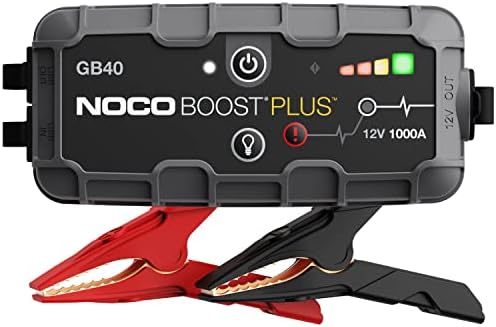
The NOCO Boost GB40 is a portable 12-volt lithium jump starter rated at 1,000 peak amps. It is listed for engines up to 6.0L gas and 3.0L diesel, making it a fit for many everyday cars and smaller trucks. NOCO states that a full charge can provide up to 20 starts, though actual results depend on the vehicle and battery condition.
Its main safety features are spark-proof technology and reverse-polarity protection, designed to help reduce the risk of sparks or incorrect clamp connections. The housing has an IP65 rating and rubberized over-molding, and the unit weighs 2.5 pounds. It also works as a power bank and includes a 100-lumen flashlight with multiple modes, including SOS and strobe.
The GB40 is the most compact, lower-output NOCO option in this group. That makes it easier to store than the larger GB70, but its engine coverage is narrower. It does not include an air compressor, so it is a focused choice for jump-starting and basic emergency charging rather than a complete roadside kit.
Pros:
- Spark-proof and reverse-polarity protection
- Compact 2.5-pound design with an IP65-rated housing
- Power bank and multi-mode flashlight add emergency utility
- Listed for up to 20 starts per charge
Cons:
- Engine coverage is lower than the GB70 and several other picks
- No built-in tire inflator
Verdict: Choose the GB40 if you want a compact, safety-focused jump starter for a compatible car or light-duty vehicle and do not need a compressor.
2. Joltekon VP20: A Jump Starter and Tire Inflator in One

The Joltekon VP20 combines a 5,000-amp-peak jump starter with a 150 PSI air compressor. Its listed engine coverage reaches 9L gas and 8L diesel, which is broader than the GB40’s. The compressor has modes for different types of inflatables, several nozzles, and an auto-shutoff feature. A screen displays battery level and operating status.
For jump-starting, the product description lists 10 protection features, including protection related to sparks, temperature, and overheating. It also has a 500-lumen emergency light with several modes and can charge mobile devices. These additions may be useful if you want one unit for battery trouble, low tires, and basic device charging.
The trade-off is a more feature-heavy design than a simple jump pack. If you only need to jump-start a car, the compressor and extra functions may be unnecessary. The supplied details also do not list the unit’s weight, so check the product listing if portability and storage space are priorities.
Pros:
- Listed for engines up to 9L gas and 8L diesel
- Built-in 150 PSI compressor with auto-shutoff
- Described as having 10 protection features
- LCD, power bank, and multi-mode emergency light
Cons:
- Extra functions may be more than you need for basic jump-starting
- Product details provided do not specify its weight
Verdict: The VP20 is worth considering if you want broad listed engine coverage and an inflator in the same emergency unit.
3. NOCO Boost GB70: More Output for Larger Engines

The GB70 offers 2,000 peak amps and is listed for engines up to 8.0L gas and 6.0L diesel. That gives it more engine coverage than the GB40, which may make it a better match for larger vehicles. NOCO states that it can provide up to 40 starts per charge, but real-world results can vary with battery condition and use.
Like the GB40, the GB70 uses spark-proof and reverse-polarity protection. It has an IP65-rated housing with rubberized over-molding, plus a power bank and a 400-lumen flashlight with several modes. At 5 pounds, it is still portable, but it is twice the listed weight of the GB40 and takes longer to recharge: NOCO lists six hours.
This is a more powerful alternative for drivers who want NOCO’s stated connection protections and need higher engine coverage. It costs some portability compared with the smaller model, and it has no compressor. Check your vehicle’s engine size and the product instructions before choosing it; higher peak output does not replace correct connection steps.
Pros:
- 2,000 peak amps and coverage for larger listed engines
- Spark-proof and reverse-polarity protection
- Power bank and 400-lumen multi-mode flashlight
- IP65-rated housing with rubberized over-molding
Cons:
- Heavier than the GB40 at 5 pounds
- No built-in air compressor
Verdict: Pick the GB70 over the GB40 if your vehicle needs its higher listed engine coverage and you are comfortable carrying a larger unit.
4. TOPDON JS3000: High Listed Coverage and Multiple Charging Ports

The TOPDON JS3000 is rated at 3,000 peak amps and is listed for 12-volt vehicles with engines up to 9.0L gas or 7.0L diesel. TOPDON says a full charge can provide up to 45 jumps. Its boost function is intended for use with a dead or damaged battery; follow the unit’s instructions and your vehicle manual when using it.
For safety, the product description lists 10 intelligent protection technologies, along with heavy-duty cables, copper clamps, and an IP54 fireproof enclosure. The JS3000 also works as a 24,000mAh power bank, with USB, DC, and USB-C PD ports. Its 400-lumen light includes an SOS mode, and the package includes a carrying case.
This model offers more charging options and higher listed engine coverage than either NOCO pick. It is also a more involved unit, with ports and functions to manage, and the supplied product details do not state its weight. If you only need an occasional jump for a smaller car, a simpler model may be easier to store and use.
Pros:
- Listed for engines up to 9.0L gas and 7.0L diesel
- 10 protection technologies and an IP54 fireproof enclosure
- Multiple power-bank ports, including USB-C PD
- Boost function, SOS light, and included carrying case
Cons:
- Extra ports and functions may be unnecessary for basic use
- Product details provided do not specify its weight
Verdict: Consider the JS3000 if you need its broader listed engine coverage and want a jump starter that can also power several types of devices.
5. OUTLEV Jump Starter: A 160 PSI Inflator with Layered Protection

The OUTLEV jump starter pairs a 6,000-amp-peak battery pack with a 160 PSI air compressor. It is listed for all gasoline engines and diesel engines up to 10.0L, the broadest diesel coverage in this group. The compressor has four preset modes, real-time pressure monitoring, and auto-shutoff. Its screen is described as sunlight-readable.
For connection and operating safeguards, OUTLEV lists 10 layers of protection, including reverse-polarity and spark-related protection. The unit also includes two USB-A charging ports, a multi-mode emergency light, smart clamps, air nozzles, and a storage bag. The manufacturer lists a two-year warranty.
The combination may appeal to drivers who want both jump-starting and tire inflation equipment in one package. The included details do not state the unit’s weight or how many starts are available per charge, so those are worth checking if portability or repeat use matters to you. As with any built-in compressor, expect to manage both the battery’s charge and the inflator’s use.
Pros:
- Listed for all gas engines and up to 10.0L diesel
- 160 PSI compressor with pressure monitoring and auto-shutoff
- 10-layer protection, including reverse-polarity protection
- Two USB-A ports, emergency light, and two-year warranty
Cons:
- Product details provided do not list weight or starts per charge
- Its compressor and extra functions may be unnecessary for some drivers
Verdict: Choose the OUTLEV if its broad listed engine coverage and built-in inflator matter more to you than having a simple, compact jump pack.
How to Choose a Battery Jump Starter with Safety Protection
Match the jump starter to your engine
Check your vehicle’s engine size and fuel type, then compare them with the jump starter’s listed limits. A model with higher peak amps is not automatically the right choice for every vehicle. If your vehicle’s engine size is close to a listed limit, confirm compatibility in the product details and your vehicle manual before buying.
Look for clear clamp-protection features
Spark-proof and reverse-polarity protection are useful features because they are designed to help reduce risks from sparks or incorrect clamp connections. Other models list broader protection systems, but the exact features differ. Read the instructions to understand what the protections cover, and do not treat them as a substitute for connecting the clamps correctly.
Choose a size and weight you will keep in your vehicle
A jump starter only helps if it is charged and available when you need it. The GB40’s listed weight is 2.5 pounds, while the GB70 is listed at 5 pounds. The other product details here do not provide weights, so check the listing if you plan to store the unit in a small compartment or carry it by hand.
Decide whether an air compressor is useful
The Joltekon VP20 and OUTLEV models include tire inflators, which can be useful when you want jump-starting and inflation features in one unit. Compressor pressure ratings are not the whole story: consider the modes, nozzles, pressure display, and auto-shutoff features too. If you only need a battery booster, a model without an inflator may better suit your needs.
Consider charging and lighting features
Several models can charge phones or other devices, and each has an emergency light. Compare the ports and listed light output with what you expect to use. A power bank is a helpful extra, but it does not replace checking the jump starter’s charge before a trip or following its charging instructions.
Check recharge details, warranty, and instructions
Recharge times and warranty terms vary. NOCO lists recharge times of three hours for the GB40 and six hours for the GB70; OUTLEV lists a two-year warranty. Confirm the current product terms and included accessories on the listing. Before use, read both the jump starter instructions and your vehicle manual, since the correct procedure can vary by vehicle.
Frequently Asked Questions
What does reverse-polarity protection do?
It is designed to help protect against a connection made with the clamps on the wrong battery terminals. It does not mean you can ignore the instructions: connect the clamps as directed by the jump starter and vehicle manuals.
Are spark-proof jump starters completely risk-free?
No. Spark-proof protection is a safety feature, not a guarantee that every situation is safe. Inspect the equipment, follow the supplied instructions, and do not use a jump starter if it appears damaged or if the vehicle manual advises against the procedure.
Which of these jump starters is the most compact?
The NOCO GB40 is the lightest model in this comparison with a listed weight: 2.5 pounds. Weight is not provided in the supplied details for the other four models, so check their product listings before deciding based on size or portability.
Which option includes a tire inflator?
The Joltekon VP20 and OUTLEV models include air compressors. The VP20 is listed at 150 PSI, while the OUTLEV is listed at 160 PSI. Both descriptions include auto-shutoff, but their modes and other compressor details differ.
Can I use a jump starter to charge my phone?
The product descriptions for all five models include power-bank or device-charging functions. Check the available ports and the instructions for your chosen unit to make sure they suit your devices.
How often should I recharge a portable jump starter?
Follow the manufacturer’s storage and recharge guidance, and check the charge level periodically. A unit that has been sitting in a vehicle for a long time may need charging before it is ready for an emergency.
Should I choose the highest peak-amp model?
Not necessarily. First match the listed engine coverage to your vehicle, then consider protection features, storage size, and any extras you will use. More peak amps do not make a model a better fit if it is too large or lacks a feature you need.
Final Recommendation
For a compact jump starter with clearly listed spark-proof and reverse-polarity protection, the NOCO GB40 is a strong fit for compatible smaller vehicles. If you need more engine coverage, consider the NOCO GB70 or TOPDON JS3000. For a combined jump starter and tire inflator, compare the Joltekon VP20 and OUTLEV, paying close attention to their listed engine limits and compressor features. Whichever you choose, verify compatibility and follow the product and vehicle instructions before use.