
Choosing the best night vision scope for an AR means balancing magnification, infrared performance, weight, battery life, and fit with your rifle’s rail. Digital scopes can work in daylight and darkness, but they vary widely in zoom range and features. The picks below focus on what each product’s listed specifications offer—and where you may want to check details before buying.
Quick Comparison
| Scope | Magnification | Standout feature | Best suited to |
|---|---|---|---|
| Triton StarStrike Gen II | 5–20x | Built-in recording and stated 120-minute runtime | Hunters who want high magnification and video capture |
| Triton StarStrike-R PRO HDX | 5–20x | 940nm IR, Picatinny mount, and picture-in-picture | Buyers looking for a feature-rich digital optic |
| DNT Optics ZULUS HD V2 | 5–20x | 60Hz Micro-OLED display and ED glass | Day-to-night use with an emphasis on display clarity |
| NightCrystal NC8 | 5x digital zoom | 50mm objective and built-in IR | Observation and closer-range use |
| Triton StarStrikeX | 1–6x | Low-power variable magnification | Close-range viewing and a compact zoom range |
Our Picks: Best Night Vision Scope For Ar reviews
1. Triton StarStrike Gen II: High Magnification with Recording

The StarStrike Gen II is a 5–20x digital night vision scope designed to cover both daytime and nighttime viewing. Its listed features include an infrared illuminator, a fixed magnifier with a wider objective lens, and onboard photo and video recording. A 32GB microSD card is included, and the description says the storage can be upgraded to 64GB.
Triton describes the housing as reinforced and shockproofed for high-caliber recoil, including .50 caliber firearms. That stated durability may appeal if your equipment sees demanding use, but it is still worth confirming mounting requirements and rifle compatibility before purchase. The scope runs for a stated 120 minutes on medium settings and supports USB-C charging and continuous power from a connected source.
The 5–20x range is a better fit for identifying detail at a distance than for fast, close-range scanning. At higher digital magnification, it is especially important to check how the image looks in your intended conditions. Compared with the StarStrikeX, this model offers much more magnification and recording, but it is less focused on a low-power, close-range view. Its stated battery runtime is also a planning consideration for longer sessions.
Pros:
- 5–20x magnification for detailed viewing
- Records 1080p video and takes photos
- Includes a 32GB microSD card
- USB-C charging and a stated 120-minute runtime on medium settings
Cons:
- The stated runtime may require planning for longer outings
- Confirm rail fit and mounting needs for your specific AR
Verdict: Choose the StarStrike Gen II if high magnification, recording, and a stated rugged build matter more to you than a low-power close-range view.
2. Triton StarStrike-R PRO HDX: 940nm IR and Picatinny Mount

The StarStrike-R PRO HDX combines a 5–20x digital zoom range with a 1920×1080 CMOS sensor and a built-in 940nm infrared illuminator. Triton says the IR supports viewing in total darkness without external equipment. The product description also claims identification of deer-sized targets up to 400 yards with IR active; actual visibility depends on conditions, setup, and the target.
This model has several practical setup and aiming features: an included Picatinny mount, five reticle patterns, digital zeroing, and MOA adjustment. Picture-in-picture mode enlarges the central aiming area while keeping a wider view visible. It also records 1080p video at 30 frames per second to the included 32GB microSD card.
At a listed 7 inches and 680g (24 oz), it has specific size and weight figures to compare with your rifle setup. Triton says each production batch is tested on a recoil-simulation rig at a .50 BMG impulse, and the product has a lifetime warranty. The narrowest tradeoff is the 5x minimum magnification: it may not be the best match if you want a true 1x-style view for close, fast scanning. Confirm that the included mount gives you the fit and eye position you need.
Pros:
- 940nm IR illuminator for use in darkness
- Includes a Picatinny mount and 32GB microSD card
- Picture-in-picture, digital zeroing, and five reticle patterns
- Records 1080p video at 30 frames per second
Cons:
- 5x minimum magnification may feel limiting at close range
- Confirm the scope’s size and mount position suit your rifle
Verdict: This is the strongest all-around feature set in the group if you want a listed Picatinny mount, 940nm IR, and recording in one scope.
3. DNT Optics ZULUS HD V2: High-Refresh OLED Display
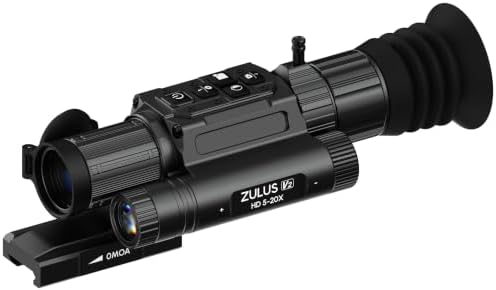
The ZULUS HD V2 is a 5–20x digital day-and-night scope. Its listed components include a low-light sensor, ED glass, image-processing algorithms, and a 1920×1080 Micro-OLED display with a 60Hz refresh rate. Those specifications make the display and image system the main reasons to consider it alongside the other high-magnification options.
DNT lists a peak display brightness of 1800 nits and five brightness settings. That adjustability can be useful when moving between bright surroundings and darker conditions, though the best setting depends on your environment and personal preference. The product is described for use in daylight, dawn, dusk, and darkness, but the supplied details do not specify an IR wavelength, runtime, included mount, or recording features.
Compared with the Triton models, the ZULUS HD V2’s supplied information puts more emphasis on its display and optics than on mounting, storage, or battery details. If those practical details are important to your AR setup, check the listing and manufacturer information before ordering. Its 5x minimum magnification also makes it more oriented toward magnified viewing than close-range scanning.
Pros:
- 1920×1080 Micro-OLED display with a listed 60Hz refresh rate
- ED glass and a low-light sensor
- Five display-brightness settings
- 5–20x magnification for extended-range viewing
Cons:
- The supplied details do not specify battery runtime or included mount
- Does not list recording or IR wavelength information in the provided description
Verdict: Consider the ZULUS HD V2 if display quality is your priority, but verify mounting, power, and infrared details before choosing it over the more fully specified Triton options.
4. NightCrystal NC8: 50mm Objective and Built-In IR

The NC8 combines a digital monocular and riflescope in one device. It has a 2MP 1080p CMOS sensor, a 50mm objective lens, 5x digital zoom, and a built-in 850nm IR illuminator. NightCrystal lists a viewing distance of up to 300m in complete darkness and more than 500m in daylight. Treat those as product-stated figures rather than guaranteed identification distances; real-world results vary with conditions and the subject.
The NC8 records 1080p video and supports USB-C charging, including power from an external power bank. The body is described as alloy metal, with a stated impact strength of up to 6000J and suitability for .308 rifles. That does not by itself confirm fit on an AR, so check the mounting system and the manufacturer’s firearm guidance before use. The listing also mentions an AI zoom function that keeps the crosshairs centered during zooming.
This model may suit someone who wants a straightforward 5x device for observation and recording, but its zoom range is more limited than the 5–20x scopes above. The supplied product data flags it as unavailable, so verify the listing before making plans to buy it. Its listed .308 suitability should not be taken as confirmation that it fits or is appropriate for every AR configuration.
Pros:
- 50mm objective lens and built-in 850nm IR
- Records 1080p video
- USB-C charging with external power-bank support
- Combines monocular and riflescope functions
Cons:
- 5x digital zoom offers less range than the 5–20x choices
- Supplied data flags the item as unavailable; check the listing
Verdict: The NC8 is worth considering for its simple 5x format and recording features if it is available, but verify stock and AR mounting compatibility first.
5. Triton StarStrikeX: Compact 1–6x Digital Night Vision

The StarStrikeX is a low-power variable digital night vision scope with a 1–6x range. Its listed features include a built-in IR illuminator and an optical system intended to work in daylight, low light, and darkness. The 1x setting gives it a different role from the 5–20x choices: it is the most relevant option here if you prefer a lower starting magnification for scanning nearby areas.
The description also lists multi-coated optics intended to support light transmission and reduce glare. However, the supplied information does not state a sensor resolution, IR wavelength, recording capability, battery runtime, or included mount. Those missing details make it harder to compare the StarStrikeX on image quality and practical setup. Confirm them with the manufacturer or listing, along with compatibility for your specific rail.
Compared with the other Triton models, the StarStrikeX trades long-range magnification and listed recording features for a 1–6x range. It may be the more natural fit for close-to-mid-range viewing, but the available specifications do not support a detailed comparison of its imaging performance or endurance.
Pros:
- 1–6x range starts at low magnification
- Built-in IR illuminator
- Designed for day, low-light, and night use
- Multi-coated optics are listed
Cons:
- Supplied details do not list sensor resolution or IR wavelength
- Battery runtime, recording, and mount details are not provided
Verdict: Choose the StarStrikeX if low starting magnification matters most, but confirm its mount, power, and imaging specifications before buying.
How to Choose a Night Vision Scope for an AR
Match Magnification to Your Use
Think about how close or far away you expect to view. A scope that starts at 1x, like the StarStrikeX, offers a lower starting magnification than the 5–20x models. Higher magnification can help you inspect distant detail, but it can make nearby scanning less convenient. Consider your usual terrain and viewing distance rather than choosing the largest zoom range by default.
Check the Infrared Details
Digital night vision needs usable light from the environment or an infrared illuminator. Check whether the scope has built-in IR, and look for its wavelength and any stated range. The StarStrike-R PRO HDX lists a 940nm illuminator, while the NC8 lists 850nm. Product claims about visibility are not guarantees: surroundings, weather, target size, and setup can all affect what you can see.
Confirm Fit, Mounting, and Balance
Do not assume that every digital scope fits every AR just because it is marketed as a rifle scope. Check the rail type, included mount, mounting position, eye relief, and clearance on your rifle. The StarStrike-R PRO HDX lists an included Picatinny mount; the other supplied descriptions do not give the same mounting detail. Also consider total weight and how the optic will balance with your existing setup.
Understand the Display and Image Specifications
Digital scopes rely on a sensor and screen, so compare both rather than judging by magnification alone. Look for sensor resolution, display type, refresh rate, and brightness controls. The ZULUS HD V2 lists a 1920×1080 Micro-OLED display and a 60Hz refresh rate. Those figures help describe its display, but they do not guarantee the same image quality in every setting.
Plan for Battery Life and Power
Battery runtime matters when you are away from a charging source. The StarStrike Gen II lists 120 minutes on medium settings, while some of the other product descriptions do not provide a runtime. USB-C charging or external power support can help, but confirm whether the scope can operate while connected and whether the cable or power bank will suit your setup.
Decide Whether You Need Recording
Built-in recording can be useful for documenting observations, but it adds features you may not need. Check the video resolution, frame rate, included memory card, and maximum supported card size. The StarStrike Gen II and StarStrike-R PRO HDX both list 1080p recording and an included 32GB card. Do not assume other models record simply because they have a digital display.
Check Recoil Guidance and Warranty Terms
Look for the manufacturer’s stated recoil limits and warranty coverage, then confirm the terms for your location and intended firearm. Some product descriptions include specific recoil claims, while others offer less detail. A stated test or warranty is useful information, but it does not replace confirming compatibility and following the manufacturer’s mounting instructions.
Review Local Rules and Safe Use
Night vision equipment and its use while hunting can be subject to local laws and season rules. Check current regulations where you plan to use the optic, and follow safe firearm handling practices. Confirm that the scope is mounted securely and that you can identify your target and what lies beyond it before taking any shot.
Frequently Asked Questions
Can a digital night vision scope be used during the day?
Several options here are described for both daylight and nighttime use, including the StarStrike-R PRO HDX, ZULUS HD V2, NC8, and StarStrikeX. Follow the manufacturer’s instructions for daylight use, since operating limits can vary by model.
Is 940nm or 850nm IR better?
Neither wavelength is automatically best for every user. The StarStrike-R PRO HDX lists 940nm IR, and the NC8 lists 850nm IR. Compare the manufacturer’s specifications for your intended use, including any information about range and visibility, rather than assuming the wavelength alone determines performance.
Which scope has the lowest magnification?
The Triton StarStrikeX has the lowest listed starting magnification at 1x. The other models in this selection start at 5x or have a fixed 5x digital zoom, based on the supplied product information.
Which option includes a Picatinny mount?
The StarStrike-R PRO HDX description specifically lists an included Picatinny mount. Check the product listing or manufacturer information for the other scopes to confirm what mounting hardware is included.
Do these scopes record video?
The StarStrike Gen II and StarStrike-R PRO HDX list 1080p video recording, and the NC8 lists 1080p recording as well. The supplied descriptions for the ZULUS HD V2 and StarStrikeX do not specify video recording.
Are all five scopes confirmed to fit an AR?
The supplied details do not confirm fit for every AR model and configuration. Check the rail type, mount, clearance, and manufacturer’s compatibility guidance before purchasing. Do not rely on the product category alone as proof of fit.
What is the best overall choice?
The StarStrike-R PRO HDX offers the most complete set of listed features for many shoppers: 5–20x magnification, 940nm IR, an included Picatinny mount, picture-in-picture, and recording. If you prefer a lower starting magnification, consider the StarStrikeX instead, while checking its less-detailed specifications first.
Final Recommendation
For a feature-rich digital scope for an AR, the Triton StarStrike-R PRO HDX is the most balanced pick based on the supplied specifications, especially if its 5–20x range, 940nm IR, included Picatinny mount, and recording features suit your needs. Choose the StarStrikeX if a 1x starting magnification is more important, or the ZULUS HD V2 if its listed display features are your priority. Before ordering any model, verify fit, power needs, and local rules for your intended use.