
Choosing the best water softener for a home with a septic system means balancing hard-water control with careful management of regeneration water and salt. The systems below use ion exchange to reduce hardness, but the supplied product information does not identify any as specifically approved for septic systems. Before buying, ask your septic professional or local health department whether a salt-based softener is suitable for your system and where its discharge should go.
For many homes, a metered softener sized to water hardness and household use is a practical starting point. The right choice also depends on whether you have well water, how many people live in your home, and whether you need filtration as well as softening.
Quick Comparison
| Water Softener | Capacity | Best For | Standout Feature |
|---|---|---|---|
| Aquasure Harmony Series 40,000-Grain | 40,000 grains | Homes with 3–4 bathrooms | Metered control valve and included pre-filter |
| Kenmore 420 Water Softener | 40,000 grains | Households of 1–5 people, including some well-water users | Demand-based regeneration and iron reduction |
| Kenmore 350 Water Softener | 32,000 grains | Smaller households and tight utility spaces | Compact design with smart regeneration |
| Aquasana SimplySoft 60K | 60,000 grains | Larger homes with 5 or more people | NSF/ANSI 44 and CSA B483.1 certification |
| PRO+AQUA PRO-E-S80E Elite Combo | 80,000 grains | Large homes needing softening and filtration | Combined filtration and softening system |
Our Picks: Best Water Softener For Septic Systems reviews
1. Aquasure Harmony Series: A Balanced 40,000-Grain System

The Aquasure Harmony Series is a whole-house, 40,000-grain ion-exchange softener intended for homes with three to four bathrooms. Its automatic metered valve tracks water use to control regeneration, so it is a more relevant option for septic households than a system that regenerates only on a fixed schedule. Metering does not eliminate brine discharge, however, so check how the system should be plumbed for your septic setup.
This package also includes a sediment, GAC, and zinc pre-filter. The product description says the filter targets chlorine, certain contaminants, odors, and sediment. That extra filtration can be useful if your water needs treatment beyond hardness reduction, but a softener and pre-filter should not be treated as a complete drinking-water purification system.
The unit has a corrosion-resistant stainless-steel bypass valve and prefilled resin. Its 40,000-grain capacity makes it a middle-ground choice: larger than the Kenmore 350, but below the Aquasana SimplySoft and PRO+AQUA systems. Homes with very hard water or heavy use should confirm the capacity is appropriate before choosing it.
Pros:
- Metered regeneration can be adjusted to water use.
- Includes a multi-purpose pre-filter.
- Designed for homes with three to four bathrooms.
- Includes a stainless-steel bypass valve and prefilled resin.
Cons:
- The product information does not state that it is approved specifically for septic systems.
- Its included filter does not replace water testing or treatment matched to a specific contaminant.
Verdict: Choose the Aquasure Harmony if you want a metered, mid-capacity softener with an included pre-filter, provided your septic professional approves the discharge arrangement.
2. Kenmore 420: Smart Regeneration for a Busy Household

The Kenmore 420 has a 40,000-grain capacity and is described for households of one to five people. Its IntelliSoft control is designed to learn a household’s water-use pattern and regenerate when needed. That demand-based approach may help avoid unnecessary regeneration, although actual salt and water use depends on your water hardness, household consumption, and settings.
This model is also presented as a choice for well water. Its sediment pre-filter and iron-reduction features can help address some common well-water issues, such as sediment and clear-water iron. Test your water before relying on those features, since the product details do not specify treatment limits for each contaminant.
Compared with the compact Kenmore 350, the 420 offers a larger listed capacity and is aimed at a broader household size. The tradeoff is that its septic suitability is not specified. Like other salt-regenerated softeners, confirm the discharge plan with a septic professional rather than assuming the smart controls make it septic-safe.
Pros:
- 40,000-grain capacity for households of one to five people.
- Demand-based regeneration is designed to respond to household water use.
- Includes a sediment screen and is described for well-water use.
- Provides listed warranty coverage for the system, electronics, and tank.
Cons:
- No septic-system approval is stated in the supplied product information.
- Iron-reduction performance should be matched to a water test.
Verdict: The Kenmore 420 is worth considering for a family home, especially with well water, if its capacity fits your test results and your septic professional approves its regeneration discharge.
3. Kenmore 350: A Compact Softener for Smaller Homes
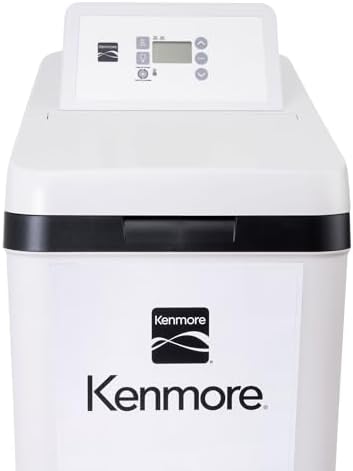
The Kenmore 350 is a 32,000-grain whole-house softener designed for one to four people. Its compact footprint may suit a utility area where a larger tank would be awkward. A digital display shows flow and salt information, and the high-flow 3/4-inch valve is intended to maintain strong household water pressure.
Like the Kenmore 420, this model uses IntelliSoft technology to adapt regeneration to water use. For a septic household, efficient regeneration is a useful feature to consider because it can help avoid regenerating on a rigid schedule. It still regenerates with salt and water, so ask about the amount and route of discharge for your specific setup.
The Kenmore 350 is the smallest-capacity choice in this group. That can be an advantage for a smaller household, but it may be undersized for a large family, very hard water, or high water use. The product description says it can reduce clear-water iron, but it does not provide a treatment range; test your water before counting on that capability.
Pros:
- Compact design for tighter installation spaces.
- Smart regeneration is designed to respond to water use.
- Digital display provides flow and salt-level information.
- Suitable capacity for some smaller households.
Cons:
- Its 32,000-grain capacity may be too small for larger homes or very hard water.
- The product information does not identify it as septic-approved.
Verdict: Pick the Kenmore 350 when space is limited and your household’s hardness and water use fit its smaller capacity; otherwise, compare it with a larger system.
4. Aquasana SimplySoft 60K: A Certified Option for Larger Homes

The Aquasana SimplySoft is a 60,000-grain metered softener designed for larger homes with five or more people and four or more bathrooms. It uses ion exchange to reduce hardness, and its metered operation is described as using less salt and water than standard time-based regeneration. Those figures are product claims, not a guarantee of what your home will use.
One point of distinction is certification: the system is listed as certified to NSF/ANSI 44 for hardness reduction and to CSA B483.1. That supports its stated softening function, but it does not mean the system has been certified as safe for every septic design. You still need to check the regeneration discharge plan locally.
The system is described for city or well water, and an optional pre-filter is recommended separately. That means the base unit focuses on softening rather than providing the same included filtration setup as the Aquasure Harmony or the PRO+AQUA combo. Its larger capacity may be useful for a high-demand home, but it may be more system than a smaller household needs.
Pros:
- 60,000-grain capacity for larger households.
- Metered operation is designed to manage salt and water use.
- Listed certification to NSF/ANSI 44 and CSA B483.1.
- Suitable for use with city or well water, according to the product description.
Cons:
- The recommended pre-filter is sold separately.
- Certification for hardness reduction is not the same as septic-system approval.
Verdict: The SimplySoft is a strong candidate for a larger home that values a certified softening system, as long as the capacity and septic discharge plan fit your property.
5. PRO+AQUA PRO-E-S80E: High Capacity with Filtration Included

The PRO+AQUA PRO-E-S80E combines whole-house filtration with an 80,000-grain softener. The product description lists treatment for hardness, chlorine, iron, VOCs, rust, and sediment, and gives a maximum flow rate of up to 20 gallons per minute. It is designed for homes with six or more bathrooms, making it the highest-capacity option in this comparison.
A digital metered valve is intended to manage salt and water use, while the combined design can reduce the need to buy separate filtration and softening equipment. For well-water homes, the listed range of treatment targets may be appealing. Still, do not assume it addresses every contaminant in your well; use a water test to confirm that the listed treatment matches your needs.
This is also the largest and most comprehensive system here, so it may be excessive for a small household. Its product details do not specify septic certification or a septic-specific discharge setup. Because it is a salt-based softener, confirm the planned regeneration discharge with your septic professional before installation.
Pros:
- Largest listed softening capacity in this comparison.
- Combines filtration and softening in one whole-house system.
- Metered valve is designed for efficient salt and water use.
- Listed for high-demand homes with six or more bathrooms.
Cons:
- May be more capacity and equipment than a smaller home needs.
- No septic-specific approval is stated in the supplied product information.
Verdict: Consider the PRO+AQUA combo for a large home that needs both filtration and softening, but get water-test guidance and septic approval before committing to its installation.
How to Choose a Water Softener for a Septic System
Confirm septic compatibility before choosing a model
These products are salt-regenerated softeners, and the supplied descriptions do not say that any is approved specifically for septic systems. Regeneration sends water and brine to a drain, so the location and amount of discharge matter. Ask your septic-system designer, service professional, or local health department whether your system can accept that discharge and whether local rules affect where it may go.
Size the unit using water hardness and household use
Grain capacity is only one part of sizing. Your water hardness, number of people, and daily water use all affect how often a softener regenerates. Have your water tested and use the results when comparing the 32,000-, 40,000-, 60,000-, and 80,000-grain models. A larger tank is not automatically a better fit if your household does not need that capacity.
Look for metered regeneration and understand its limits
A metered valve bases regeneration on water use instead of following only a fixed schedule. That can help reduce unnecessary cycles, but it does not eliminate regeneration or the resulting discharge. Ask the manufacturer or installer about programming, expected salt use, and expected regeneration water for your household’s conditions.
Test well water for iron and other concerns
Several of these systems are described as suitable for well water or as helping reduce iron and sediment. Those broad descriptions do not replace a water test, and the product information does not give treatment limits for every contaminant. Test first, then check that the selected system is designed to handle the levels found in your water.
Decide whether you need filtration as well as softening
A softener primarily targets hardness minerals such as calcium and magnesium. It does not automatically remove every unwanted substance from drinking water. The Aquasure Harmony includes a pre-filter, and the PRO+AQUA combines filtration with softening; the Aquasana SimplySoft recommends an optional pre-filter. Choose filtration based on test results and the specific contaminants you need to address.
Check installation space, flow, and maintenance needs
Measure the available space and consider how the unit will connect to your plumbing and drain. The Kenmore 350 is described as compact, while the PRO+AQUA is intended for higher-demand homes. Also check salt access, filter replacement needs, bypass access, and any installation requirements before ordering. An installer can confirm whether the available drain and plumbing layout work for your home.
FAQs
Can I use a salt-based water softener with a septic system?
It depends on your septic system, local rules, and the softener’s discharge setup. The products in this guide are not identified as specifically septic-approved. Consult a septic professional or local health department before installation.
Do these softeners send water into the septic system?
They regenerate and produce discharge, but the correct discharge route depends on the system and local requirements. Do not assume it should connect to your septic tank; have a qualified professional confirm the appropriate plumbing plan.
Is a metered softener better for a septic household?
A metered softener regenerates based on water use, which may help avoid unnecessary cycles compared with a fixed schedule. It still uses water and salt during regeneration, so metering alone does not establish that a unit is suitable for your septic system.
Which capacity should I choose?
Choose capacity based on tested water hardness and household water use, not household size alone. The models here range from 32,000 to 80,000 grains, but a water-treatment professional can help you determine which size fits your conditions.
Does a water softener remove contaminants from well water?
A softener is designed mainly to reduce hardness minerals. Some models also list filtration or iron-reduction features, but their treatment limits vary and the descriptions do not cover every possible well contaminant. Test your water and select treatment for the results.
Do I need a separate filter with a water softener?
Not always. It depends on your water test and the treatment goals. Some options in this guide include filtration or a pre-filter, while the Aquasana SimplySoft recommends an optional pre-filter. A softener alone should not be assumed to make water safe from all contaminants.
Final Recommendation
For a typical home comparing capacity, metered controls, and included filtration, the Aquasure Harmony Series is a practical starting point. Larger homes may prefer the Aquasana SimplySoft for its capacity and listed softening certifications, while the PRO+AQUA offers the broadest combined filtration-and-softening setup. No product in the supplied information is specifically identified as septic-approved, so the best choice is the one that fits your water test and household needs—and whose discharge arrangement your septic professional confirms is appropriate.